Key takeaways
- Doorways: the box is about 32 inches wide, so a 30-inch interior door may require unboxing in the hallway. The chair body itself is 28 inches wide.
- Floors: at nearly 200 lb on a small base, the chair can dent soft wood or leave marks on vinyl plank. A firm rug or a furniture mat helps.
- Outlet: keep it within cord reach; avoid extension cords on a motorized recliner.
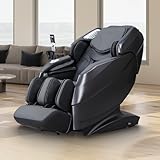
The Titan Luca V is a mid-priced, 2D-roller massage chair with an L-shaped (SL) track of about 50 inches, 16 airbags, lumbar heat, foot rollers and space-saving zero gravity recline, and it is a sensible buy for average-height users up to roughly 6’3″ who want full-body coverage without paying for 3D or 4D rollers. It is not the right chair for heavy users near 275-300 lb, for anyone who wants adjustable roller depth, or for people who mainly want deep-tissue pressure. Below is what the spec sheet actually means in a living room, where the chair is strong, where it is weak and how it compares with nearby options.
Titan Luca V at a Glance
Titan Chair (the company behind the Titan, Osaki and AmaMedic brands) has sold the Luca V for several years, so its specifications are well documented across dealers. A few numbers differ between listings, mainly the maximum user weight and whether the rollers are described as 2D or 3D. The table shows the most commonly published figures and notes where sellers disagree.
| Spec | Published figure | What it means for you |
|---|---|---|
| Upright footprint (W x L x H) | 28″ x 59″ x 43″ | Narrower than many full-body chairs, fits beside a sofa |
| Reclined footprint | 28″ x 69″ x 34.5″ | Plan for about 6 ft of floor length when fully reclined |
| Wall clearance | About 4″ behind the backrest | Seat slides forward as it reclines, so it can sit near a wall |
| Chair weight | About 198 lb net, 233 lb boxed | Two-person move; needs a ground-floor or elevator delivery plan |
| Box size | About 32″ x 51″ x 45″ | Fits a standard 32″-36″ doorway on its side; check tight stair turns |
| Track | SL-track, about 50″ | Covers neck down to the glutes |
| Rollers | 2D (most listings) | Speed and width adjust; depth does not |
| Airbags | 16 | Arms, hips, calves and feet compression |
| Heat | Lumbar | Warms the lower back only |
| User height | Roughly 5’0″ to 6’3″ | Footrest extends about 7″ |
| Max user weight | Listed from 240 lb to 300 lb depending on seller | Plan around 240-265 lb for comfortable fit |
| Power | 110-120V, about 150W | Ordinary household outlet, no dedicated circuit |
What the Massage Actually Feels Like on Paper
2D rollers on an SL-track
A 2D mechanism moves up and down the track and varies width and speed, but it cannot push the rollers further out of the backrest. In practice that means the pressure you get depends on how much you lean into the chair and on the backrest padding. People who like a medium, even massage usually find 2D chairs satisfying. People who want knots worked hard, or who are lean and want less pressure on the spine, are better served by a 3D chair where depth can be dialed up or down.
The SL-track is the strong point. Because the track curves under the seat, the rollers continue past the lower back into the glutes, which is where many budget chairs stop short. For anyone who sits at a desk all day and carries tension in the hips, that extra reach matters more than another roller dimension.
Airbags, feet and heat
The 16 airbags cover arms, shoulders area, hips, calves and feet, and there are rollers under the soles. Compression strength is adjustable. Heat is limited to the lumbar area, so there is no calf or foot heat. Four auto programs plus manual modes and a stretch function give enough variety for daily use, though the menu is simpler than flagship chairs with 20 or more programs.
Zero gravity and Bluetooth
Zero gravity recline raises the legs to roughly heart level, which spreads body weight across the seat and lets the rollers press more evenly into the back. Bluetooth speakers are included; they are fine for background music but are not a reason to choose this chair.
Room Planning: Will It Fit?
The Luca V is one of the easier full-body chairs to place. With roughly 4 inches needed behind the backrest and about 69 inches of length in full recline, a good working allowance is a floor zone of about 32 inches wide by 75 inches deep, which leaves a few inches to walk past the footrest. In a 10 x 12 ft living room, it can usually sit along the 10 ft wall next to a sofa with a side table between them.
- Doorways: the box is about 32 inches wide, so a 30-inch interior door may require unboxing in the hallway. The chair body itself is 28 inches wide.
- Floors: at nearly 200 lb on a small base, the chair can dent soft wood or leave marks on vinyl plank. A firm rug or a furniture mat helps.
- Outlet: keep it within cord reach; avoid extension cords on a motorized recliner.
Assembly and Ownership Realities
The chair ships mostly assembled; owners usually attach the arm sections, side panels and backrest cover, and connect a few air and wiring plugs. Expect 30 to 60 minutes with two people. The hardest part is moving the base, which accounts for most of the weight.
What tends to wear first on chairs in this class is the synthetic leather on the high-friction areas: the edge of the seat, the armrest tops and the footrest lip. Wiping the upholstery with a damp cloth and keeping the chair out of direct sun slows cracking. Airbag hoses and the footrest extension mechanism are the other common service items. Titan chairs are generally sold with a multi-year limited warranty that covers parts and frame longer than in-home labor, so read the labor term before buying from a dealer that does not offer white-glove setup.
Pros and Cons
- Pros: SL-track reach into the glutes, compact 4-inch wall clearance, 16 airbags with foot rollers, simple controls, typical price well below 3D chairs.
- Cons: no roller depth adjustment, heat only on the lumbar, conflicting weight limits across sellers, fewer auto programs than newer models, heavy for upstairs delivery.
Who Should Buy It and Who Should Skip It
| Your situation | Luca V a good fit? | Better direction |
|---|---|---|
| 5’2″-6’0″, 150-230 lb, wants daily relaxation | Yes | – |
| Tight apartment, chair must sit near a wall | Yes | – |
| Over 6’3″ or over 265 lb | Risky | A big-and-tall chair with a 300-350 lb rating |
| Wants deep-tissue pressure on knots | Limited | A 3D chair such as the Titan Otamic 3D LE |
| Wants calf and foot heat | No | Chairs with multi-zone heat |
| Budget under about $1,200 | Over budget at most prices | Basic L-track or S-track chairs |
How It Compares With Nearby Options
Within Titan’s own range, the Luca V sits between basic S-track chairs and 3D models. Stepping up to a 3D chair such as the Otamic 3D LE adds adjustable roller depth, longer track coverage, foot heat and quieter brushless motors, usually for roughly $800 to $1,500 more depending on sale timing. Stepping down to an S-track chair saves money but loses the glute coverage that makes the Luca V worth considering. The Luca V generally sells in the roughly $1,500 to $3,000 range, with the lower end of that range appearing during seasonal sales.
Bottom Line
The Titan Luca V makes sense if you want a full-body SL-track chair that fits close to a wall and you are of average height and build. Its weaknesses are the fixed roller depth and a weight limit that is lower than its marketing sometimes implies. If you are near the top of the height or weight range, or you want to control pressure precisely, budget for a 3D chair instead.
FAQ
Is the Titan Luca V 2D or 3D?
Most detailed spec sheets describe 2D rollers on an SL-track. Some retail listings call it 3D, but there is no published roller-depth adjustment, which is the defining 3D feature.
How much space does the Luca V need behind it?
About 4 inches between the backrest and the wall, because the seat slides forward as it reclines.
What weight should I plan around?
Sellers list anywhere from 240 to 300 lb. If you are above about 240 lb, ask the seller for the manufacturer’s current written limit before ordering.