Key takeaways
- Small apartment or shared living room: pick a wall-hugger with SL-track or shorter L-track. Neutral to mid zero-G is usually enough relief for most users, and you avoid the 66-72 inch footprint of full recline.
- Chronic lower back or sciatica discomfort: prioritize full zero-G capability with L-track, since decompressing the spine and reaching the glutes/piriformis area both matter here. Confirm floor clearance since you’ll likely use full recline often.
- Primarily shoulder and neck tension: SL-track in neutral or mid zero-G is sufficient; L-track’s extra length is wasted if lower body coverage isn’t the goal.
- Cold climates or joint stiffness: a heated full body massage chair with lumbar or calf heating adds real value, since heat plus L-track kneading on the hamstrings loosens tissue that rollers alone can take longer to reach.
- Budget under $1000: expect neutral to mid zero-G with SL-track as the realistic ceiling. True full zero-G with L-track and heat generally starts appearing in the $1200-$2500 range, with premium human-touch-style and 3D roller systems (like the mechanisms found in Insignia’s 3D zero gravity full body chairs) usually landing $2000-$4500.
What's inside
- Zero gravity isn’t one position, it’s three, and each one needs different clearance
- The three recline stages, by knee-above-heart angle
- Why the recline stage decides which roller track actually reaches your hamstrings
- Matching chair type to what you actually need
- What “3D” and “4D” rollers add in this context
- Room and delivery realities
- FAQ
Zero gravity isn’t one position, it’s three, and each one needs different clearance
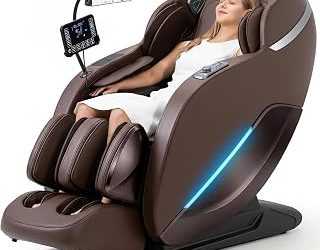
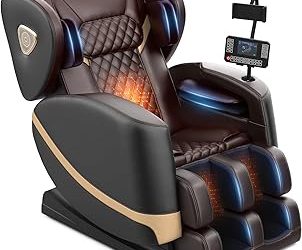
A full body massage chair in zero gravity works by tilting the seat pan back and lifting the legs so your knees sit level with or above your heart, taking spinal load off the lower back and letting the roller track drive deeper into muscle without your body bracing against it. Most chairs marketed as “zero gravity” actually offer two or three distinct recline stages, and the stage you land in determines whether the roller track can actually reach your glutes and hamstrings, or just your mid-back.
- Zero gravity isn’t one position, it’s three, and each one needs different clearance
- The three recline stages, by knee-above-heart angle
- Why the recline stage decides which roller track actually reaches your hamstrings
- Matching chair type to what you actually need
- What “3D” and “4D” rollers add in this context
- Room and delivery realities
- FAQ
The three stages you’ll see across full body electric massage chairs, from entry-level to premium, are neutral zero-G, mid zero-G, and full zero-G. They’re not marketing fluff; they correspond to real angle changes in the seat-to-leg-rest relationship, and they change your footprint in the room.
As an Amazon Associate we earn from qualifying purchases at no extra cost to you.


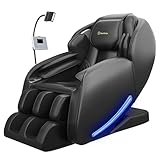
The three recline stages, by knee-above-heart angle
| Stage | Knee height relative to heart | Typical recline angle | Wall clearance needed | Floor footprint (chair extended) |
|---|---|---|---|---|
| Neutral zero-G | Knees roughly level with heart | ~120°–130° seatback | 4–6 in | ~58–62 in deep |
| Mid zero-G | Knees 2–4 in above heart | ~135°–145° seatback | 2–4 in | ~62–66 in deep |
| Full zero-G | Knees 6–10 in above heart | ~150°–160° seatback, near-horizontal | 0–3 in (true wall-hugger designs) or 8–14 in (non-wall-hugger) | ~66–72 in deep |
That wall clearance column is where a lot of buyers get surprised after delivery. Chairs advertised simply as “zero gravity” without a “space-saving” or “wall-hugger” tag usually only hit full zero-G if the whole chair slides forward on its base as it reclines, which is exactly what wall-hugger mechanisms do. Without that sliding base, reaching full zero-G pushes the backrest 10-14 inches into the room behind you, which matters a lot in a bedroom corner or an apartment den. If you’re working with a tight space, measure from the wall to where you want the chair’s front edge to sit, then add the full-recline footprint from the table above, not just the chair’s upright dimensions listed on the box.
Why the recline stage decides which roller track actually reaches your hamstrings
Roller tracks come in two common lengths: SL-track and L-track. SL-track curves from the neck down through the lower back and stops around the top of the glutes. L-track extends that curve further, following the seat pan down and under the thighs to reach the glutes and upper hamstrings directly.
Here’s the part that a spec sheet won’t tell you: an L-track chair only delivers on that extended reach if you’re in mid or full zero-G. In the upright or neutral position, the seat pan and leg rest are at separate angles, so the track’s lower curve is pointed at empty air behind your thighs rather than against them. Recline into mid zero-G and the seat pan and calf rest come closer to one continuous plane, which is when the L-track’s tail end actually presses into your glutes and hamstrings. Push to full zero-G and, on most L-track chairs, contact continues down toward the back of the thighs.
So if reaching the glutes and hamstrings is the reason you want a full body massage chair, an SL-track model won’t get you there no matter how far it reclines, and an L-track model won’t get you there unless it also reclines to at least mid zero-G. Check both specs together, not separately.
Matching chair type to what you actually need
- Small apartment or shared living room: pick a wall-hugger with SL-track or shorter L-track. Neutral to mid zero-G is usually enough relief for most users, and you avoid the 66-72 inch footprint of full recline.
- Chronic lower back or sciatica discomfort: prioritize full zero-G capability with L-track, since decompressing the spine and reaching the glutes/piriformis area both matter here. Confirm floor clearance since you’ll likely use full recline often.
- Primarily shoulder and neck tension: SL-track in neutral or mid zero-G is sufficient; L-track’s extra length is wasted if lower body coverage isn’t the goal.
- Cold climates or joint stiffness: a heated full body massage chair with lumbar or calf heating adds real value, since heat plus L-track kneading on the hamstrings loosens tissue that rollers alone can take longer to reach.
- Budget under $1000: expect neutral to mid zero-G with SL-track as the realistic ceiling. True full zero-G with L-track and heat generally starts appearing in the $1200-$2500 range, with premium human-touch-style and 3D roller systems (like the mechanisms found in Insignia’s 3D zero gravity full body chairs) usually landing $2000-$4500.
What “3D” and “4D” rollers add in this context
3D rollers move in and out (adjusting intensity/depth) in addition to the up-down and side-to-side motion of standard 2D rollers. 4D adds variable speed to that in-out motion, so the pressure changes rhythmically rather than staying constant. Neither dimension changes your recline angle or the track length, but they do change how much the roller can dig into glute and hamstring tissue once you’re in a zero-G stage where the track physically reaches that area. A 3D SL-track chair in full zero-G still won’t massage your hamstrings; the depth adjustment only helps within the zone the track covers.
Room and delivery realities
Full body massage chairs for home use typically ship in a single crate weighing 200-300 lbs, and most measure 30-33 inches wide upright, which clears a standard 32-inch interior doorway but can be tight through 28-30 inch doors common in older homes or apartments; measure your narrowest doorway before ordering. Weight limits on the seat typically run 220-300 lbs, with a handful of larger-frame models rated to 350 lbs. For a small room, a 10×12 ft space comfortably fits one chair with a 6-8 inch clearance behind it for mid zero-G use, but full zero-G wall-huggers with a 66-72 inch extended footprint will leave less than 3 feet of walking space in front, which is workable but worth mapping out with tape on the floor before delivery.
FAQ
Do all zero gravity chairs recline to the same angle?
No. Entry-level chairs often cap at neutral or mid zero-G (120-145°), while premium chairs, including most human-touch-style and higher-end shiatsu models, reach full zero-G near 150-160°. Check the listed maximum recline angle, not just the “zero gravity” label.
Is a heated massage chair worth the extra cost?
If lower back or leg stiffness is a regular issue, yes, lumbar and calf heating measurably improves how relaxed muscles feel before the rollers start working. It’s a smaller add-on cost, typically $50-150 more than the same chair without heat.
What’s a realistic price range for a genuinely full body massage chair?
Basic SL-track models with neutral/mid zero-G run roughly $600-$1200. Full zero-G with L-track and heat typically runs $1200-$2500. High-end 3D/4D roller systems with extensive body scanning and full zero-G run $2500-$5000+.