Key takeaways
- Measure from the deck to the rail: Place a tape measure on the slats and read the height of the guardrail’s top edge. Subtract five inches — that number is your maximum mattress thickness, and it is not negotiable for the upper bunk.
- Confirm the twin footprint: “Twin” ships as both 75″ x 38″ and 75″ x 39″. Older or imported bunk frames often have interior rails cut for the narrower dimension, where a 39″ mattress will bow rather than lie flat.
- Prioritize heat escape: Warm air collects near the ceiling, making the top bunk the hottest sleeping position in the room. Gel infusions, graphite layers, and open-cell foam structures all help; solid, dense foam with a tight cover does not.
- Read the fire barrier, not just the foam: CertiPUR-US covers the foam’s emissions and content, but says nothing about the flame-resistant sock beneath the cover. Look for an explicit fiberglass-free statement if a child may ever unzip the cover.
- Match firmness to a growing body: Medium-firm keeps hips and shoulders in line without the sink that lightweight sleepers get from plush foam. Removable, machine-washable covers are worth the modest premium through the elementary years.
What's inside
On the top bunk, mattress thickness stops being a comfort preference and becomes a safety specification. Guardrails are engineered to sit a set distance above the sleeping surface — typically at least five inches of exposed rail — so the plush ten-inch slab that feels luxurious on a platform bed quietly demotes a functional guardrail to a low curb. Layer in slat decks with modest weight tolerances, narrow ladder clearances, and trundles that must roll back under a frame, and parents find themselves shopping against constraints that never applied to any other bed in the house.
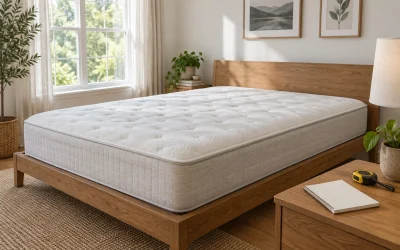
This guide covers the low-profile twin mattresses worth considering in 2026: what thickness actually clears code, which foam formulations survive a warm upstairs bedroom, and how to read certification labels that all start to look identical after the third product page. Every pick below is a five- or six-inch memory foam model sized for bunks, daybeds, and trundles.
As an Amazon Associate we earn from qualifying purchases.



🛒 Best Price Today on Amazon
Prime members get fast, free shipping on everything above, plus member-only deals. New members get a 30-day free trial — cancel anytime.
How to Choose a Bunk Bed Mattress (2026)
- Measure from the deck to the rail: Place a tape measure on the slats and read the height of the guardrail’s top edge. Subtract five inches — that number is your maximum mattress thickness, and it is not negotiable for the upper bunk.
- Confirm the twin footprint: “Twin” ships as both 75″ x 38″ and 75″ x 39″. Older or imported bunk frames often have interior rails cut for the narrower dimension, where a 39″ mattress will bow rather than lie flat.
- Prioritize heat escape: Warm air collects near the ceiling, making the top bunk the hottest sleeping position in the room. Gel infusions, graphite layers, and open-cell foam structures all help; solid, dense foam with a tight cover does not.
- Read the fire barrier, not just the foam: CertiPUR-US covers the foam’s emissions and content, but says nothing about the flame-resistant sock beneath the cover. Look for an explicit fiberglass-free statement if a child may ever unzip the cover.
- Match firmness to a growing body: Medium-firm keeps hips and shoulders in line without the sink that lightweight sleepers get from plush foam. Removable, machine-washable covers are worth the modest premium through the elementary years.
The Best Bunk Bed Mattresses (2026) Reviewed
FDW 5-Inch Gel Memory Foam Twin
A dual-layer build pairs a gel-infused comfort surface with a firmer support base, so it holds its shape better than single-density budget foam. The zip-off washable cover is the feature parents underrate right up until the first stomach bug, and five inches clears the majority of guardrail requirements without modification.
Fiberglass-Free 5-Inch Cooling Gel Twin
Built around the question that sends most parents into the review section: what is actually inside the fire barrier. Certified safe for children and dimensioned for bunks, daybeds, and trundles, it is the logical replacement for an older mattress of unknown composition.
MLILY 5-Inch Twin in a Box
Made in the USA with green tea–infused gel foam, which measurably shortens the new-mattress odor window that bothers sensitive sleepers during week one. Its 75″ x 38″ footprint is the better fit for tighter vintage bunk frames where a full 39″ mattress binds against the rails.
Dopinmin 6-Inch Twin
The extra inch delivers noticeably more support for preteens, teenagers, and lighter-weight adults on a guest bunk. Verify your guardrail clearance before committing it to an upper bunk; on a lower bunk, daybed, or trundle it is an easy recommendation.
LIFEMENT 6-Inch Basic Graphite
Graphite conducts warmth away from the sleep surface rather than relying on gel beads alone, which matters in bedrooms that run hot overnight. Standard 39″-wide twin sizing, medium-firm response, and strong value for a second or third bunk.
Frequently Asked Questions
What thickness is safe for a top bunk?
Five to six inches suits most frames. The controlling rule is clearance, not thickness: at least five inches of guardrail must remain visible above the finished mattress surface, sheets included.
Is memory foam too warm for children?
Older solid foam trapped heat, but current gel- and graphite-infused constructions sleep close to neutral. Pair one with breathable cotton or bamboo sheets and skip waterproof vinyl protectors, which undo most of the cooling engineering.
How long before the mattress is ready to sleep on?
Most compressed foam reaches roughly 90 percent of full loft within 24 hours and finishes over 48 to 72 hours. Unbox in a ventilated room and allow at least one night before first use.
Will these work in a trundle or daybed?
Yes — low-profile twins are designed for exactly that clearance problem. Measure the vertical gap under the parent bed and subtract the trundle platform height before ordering.
Final Thoughts
For a standard upper bunk, the FDW 5-Inch and its washable cover remain the most practical all-around choice, while the MLILY 5-Inch is the smarter fit for narrower 38″ frames. If clearance permits six inches, the LIFEMENT Basic Graphite offers the best support-to-price ratio — and siblings sharing a bunk-and-trundle setup may prefer the Essential Graphite version for its added motion isolation.