Key takeaways
- Create a mattress storage plan covering manufacturer-approved position, support, moving route, protection and a fallback for renovation delays.
What's inside
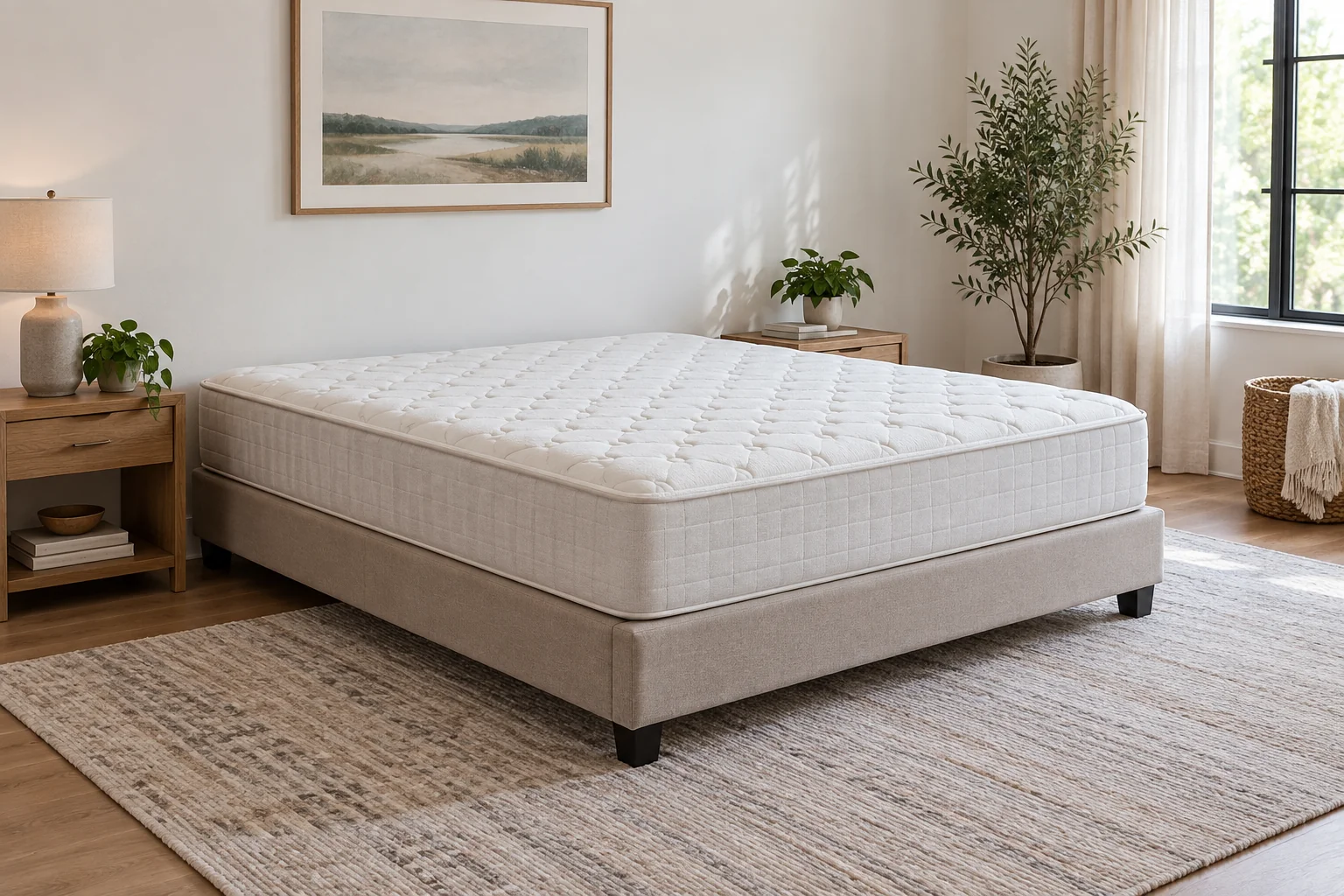
Store a mattress during a short renovation by identifying its exact care requirements, preparing a suitable location outside the work area, and planning how it will get there and back. A short timetable does not make folding, standing on an edge or re-compressing a mattress acceptable when its maker prohibits those methods.
The practical goal is a written storage plan tied to the mattress model and the actual renovation schedule. Include a fallback if the project runs longer than expected. “Only a few days” is not a useful instruction for someone else who may move the mattress.
Identify the mattress before choosing its position
Find the model name, size, care instructions and any relevant warranty guidance. Keep the label attached. Record whether the mattress has a removable cover and whether the manufacturer permits removing it; do not unzip a cover simply because you see a zipper.
For a concrete example, Tempur-Pedic’s U.S. product-care page says to transport or store its mattresses flat, not on their sides or folded. It separately allows folding only when absolutely needed for moving and advises against leaving the mattress folded for long periods. That temporary moving allowance is not permission to store a folded mattress throughout a renovation.
Apply the instructions for your own product and market. Another mattress’s material, construction or handling directions may differ. If the available space requires a position that the instructions do not address, ask the manufacturer before booking the storage location. Keep the response with your plan.
Choose a storage location by conditions and access
Choose a place that can meet the maker’s requirements and remain separate from renovation debris, wet work and moving equipment. Consider what will happen in that space during the project, not just how it looks today. A room scheduled for painting tomorrow is not necessarily a stable storage destination.
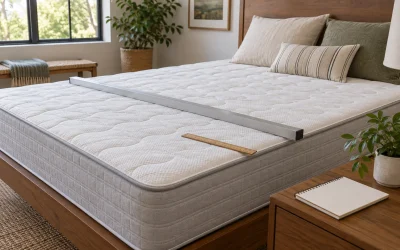
Measure the available support area and compare it with the mattress’s actual dimensions. Confirm that the proposed support is suitable for the product; do not assume two small tables or a few boxes provide adequate support merely because they hold the corners. A normal approved bed base in an unaffected room may be an option if it fits the plan.
| Plan field | What to record | When to stop and confirm |
|---|---|---|
| Mattress identity | Brand, model, size and care reference | Instructions cannot be matched to the product |
| Permitted position | Exact storage orientation | Proposed space requires a prohibited position |
| Support | Surface and usable dimensions | Support is improvised or incomplete |
| Protection | Covering and handling method approved for use | Packaging requires compression or unclear treatment |
| Schedule | Start, expected return and fallback contact | Renovation exceeds the agreed arrangement |
| Return check | Inspection and readiness steps | Moisture, damage or another concern is found |
Plan the route without assuming the mattress will bend
Measure door openings, corners and stair turns along the route. Include packaging and the people handling the load. Follow the maker’s instructions about lifting points and carrying methods; do not treat every fabric handle as a load-bearing transport handle.
Discuss the route with the mover or person helping before the workday. If the mattress cannot pass without a prohibited bend or position, change the route, location or handling plan. Avoid making an irreversible decision at the doorway while the renovation crew is waiting.
Check how the mattress will be protected against contact with dusty surfaces during the move. Use suitable packaging according to the product and packaging instructions. Do not assume vacuum packaging is reversible simply because a mattress originally arrived compressed in a factory box.
Worked example: a proposed wall space fails the storage requirement
Imagine an illustrative mattress measuring 152 by 203 centimeters whose maker requires flat storage. The host first proposes standing it beside a wall in a spare room. Even if the wall space is long enough, the proposed orientation fails that product requirement.
A second option is a flat support area measuring 160 by 210 centimeters. The size comparison leaves 8 centimeters in one direction and 7 in the other. These differences show only that the mattress footprint can fit within that rectangle; they do not establish suitable support, handling room or environmental conditions.
The host checks the actual base, route and manufacturer guidance before choosing the second option. If those checks fail, an alternative appropriate location is needed. The measurements are hypothetical and are not a claim about the exact dimensions or support needs of any Tempur-Pedic model.
Keep the stored mattress out of the work schedule
Tell everyone involved that the mattress location is reserved. Do not let it become a convenient place to stack tools, boxes or building materials. Record who can move it and where the instructions are kept, especially if several people have access to the property.
If the renovation is delayed, revisit the arrangement rather than silently extending a temporary plan. Ask about any model-specific duration, covering or environmental restrictions that have become relevant. Do not invent a universal safe number of storage days or a humidity target without the maker’s guidance.
Before returning the mattress, confirm the destination is ready and inspect the mattress and covering for moisture, damage or contamination. Resolve concerns with the appropriate manufacturer or professional before using it. Follow any instructions for acclimation or unpacking, and keep the storage notes until the mattress is back on its approved support.