Key takeaways
- No weight rating listed. Assume under 500 lb and undersized motors.
- No stated leg heights. You cannot plan bed height or frame fit without them.
- Only one carton for a split king. Likely a single king base marketed as split; check the description carefully.
- Warranty under 1 year on motors. Motors and control boxes are the components that fail.
- No retainer bar. Mattresses slide toward the foot with every adjustment.
- Vague mattress compatibility. A base that claims to work with every mattress, including thick innersprings, is overstating.
- Restocking fees above 15%. Returns on a 150 lb base are painful enough without them.
What's inside
The most expensive mistake with an adjustable bed foundation is not buying the wrong base; it is buying a base that does not work with the mattress, the frame, or the room you already have. People order a queen base for a bed frame with a footboard that blocks the foot incline, pair it with a 14-inch innerspring that will not bend, or discover the head section pulls the mattress 8 inches away from the headboard every time it rises. The second mistake is paying for massage motors and under-bed lighting while ignoring the motor weight rating, which is the spec that decides whether the base still lifts smoothly in year four. Sort out compatibility first and features last.
Decide These 3 Things First
1. Size and whether it splits. A queen base is 60 x 80 inches and moves both sleepers together. A split king is two 38 x 80 inch bases that adjust independently and can be synced to act as one king; this is the standard answer for couples who read or watch at different times. A single twin or twin XL base at 38 x 75 or 38 x 80 is common for kids, guest rooms, and one half of a split king.
As an Amazon Associate we earn from qualifying purchases at no extra cost to you. Product prices and availability are accurate as of the date shown and are subject to change.
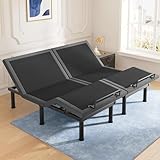


2. Where it sits. Freestanding on its own legs, inside an existing bed frame with the slats removed, or on a platform. Each requires a different leg height and headboard bracket setup, and not every base offers all three.
3. Which mattress goes on it. Memory foam, latex, and most hybrids under 14 inches bend fine. Traditional innersprings with a rigid border rod and mattresses over 14 inches generally do not. Check the mattress maker’s compatibility statement before ordering the base.
Size and Clearance
Adjustable bases add 12-16 inches of height at their lowest setting. Standard legs adjust from about 6 to 12 inches in 3-inch increments; with a 12-inch mattress, sleeping-surface height lands at 24-30 inches, which is comfortable for most adults but tall for children or anyone under 5 feet 4 inches. In the flat position a queen base takes the same 60 x 80 footprint as the mattress; at full head incline the top of the mattress rises to 60-70 inches above the floor. Non-wall-hugger bases move the mattress 4-8 inches away from the headboard as they rise; wall-hugger designs slide the whole deck backward to keep the mattress near the wall. Leave 3 inches of clearance behind the base, 2 inches on each side inside a frame, and confirm the footboard is lower than the foot section’s maximum height (typically 35-45 degrees, about 18-24 inches above flat) if the frame has one.
Frame Material and Deck
The deck is what supports the mattress: a steel frame with a plywood or engineered wood platform covered in fabric, or a steel frame with a mesh or slatted deck. Solid decks hold foam mattresses more evenly; mesh decks breathe better. Steel gauge is rarely listed, but total base weight is a proxy: a queen base at 130-170 lb has heavier framing than one at 90-110 lb. Look for a fabric cover that zips off for cleaning and a retainer bar at the foot to keep the mattress from creeping. Bases sold as heavy-duty, such as the Mixcous king with a 750 lb rating at $469.99, should show that rating in the specs; standard bases carry 600-700 lb for a queen and 350-400 lb per twin XL half. The rating includes mattress and sleepers, so subtract 70-120 lb for the mattress before comparing to body weight.
Motors and Lift Capacity
Head and foot incline each use a separate motor. Head incline should reach at least 55-60 degrees for comfortable reading and 65-70 degrees for sitting up; foot incline of 35-45 degrees is standard. Zero-gravity, which raises head and feet together with the heart slightly above the legs, is now included on nearly every base over $220, including single-size units like the Pipishell twin adjustable frame at $229.48. Motors draw 100-200 watts while moving and under 5 watts idle; listen for a stated noise level under 50 dB, since a loud motor undoes the point of adjusting quietly at 2 a.m. A battery backup that lowers the bed in a power outage is a safety feature worth $20-$40 for anyone with mobility limits. Sync cables or paired remotes let two halves of a split king move together, as on the Tami Tami T450 split king at $499.99.
Comfort Features and Controls
Wireless remotes with backlit buttons are standard; app control adds convenience but depends on a phone that may not be by the bed. Memory presets (usually 2-4 positions) are the feature people actually use daily: one for reading, one for anti-snore, one flat. Massage functions are vibration motors at 2-4 intensity levels in the head and foot sections and run on 10-20 minute timers; they are pleasant but are not a substitute for a massage chair. Under-bed LED lighting, USB-A and USB-C ports in the side rails, and a remote flashlight round out mid-range packages such as the Marsail queen adjustable frame at $379.63. Prioritize presets, a zero-gravity button, and a quiet motor over the count of massage modes.
Price Tiers
Under $250 buys a twin or twin XL base with head and foot incline, zero gravity, and a basic remote, weighing 60-80 lb; queens in this range exist but often skimp on motor rating. $300-$500 is the mainstream queen and split king tier, with 600-750 lb ratings, massage, USB ports, lighting, and 1-3 year warranties. $600-$1,200 adds wall-hugger movement, lumbar support sections, pillow tilt, app control, and 5-10 year frame warranties. Above $1,500 you are paying for smart features like sleep tracking and automatic snore response, which are useful but niche. In 2026 the $400-$550 range delivers everything most households will use.
Warranty and Repairs
Read the warranty in layers. Typical coverage is 1-3 years full on motors and electronics, then 5-20 years limited on the steel frame; the frame rarely fails, the remote and motor control box do. Ask whether replacement remotes and control boxes are sold separately (usually $30-$80) and whether motors are user-replaceable. A 90-day or longer return window matters here because adjustable base returns are heavy and expensive; some sellers charge $75-$150 restocking. Keep the box for that window.
Delivery and Assembly
Queen bases ship in one carton of about 62 x 82 x 10 inches weighing 100-170 lb; split kings ship as two cartons of 40 x 82 x 10 inches at 65-100 lb each, which is why split kings are easier to get upstairs. Assembly means attaching 4-6 legs, plugging in motors and the control box, and pairing the remote; budget 30-60 minutes and two people to flip the base. If the base goes inside an existing frame, remove slats and center rails first and confirm the interior width is 1-2 inches larger than the base. Headboard brackets are usually sold separately for $30-$60 and attach to the head of the base, not the frame.
Spec Checklist
| Spec | Budget | Mid | Premium |
|---|---|---|---|
| Price (queen or split king) | $220-$350 | $380-$600 | $700-$1,500 |
| Weight rating (queen) | 500-600 lb | 650-750 lb | 750-850 lb |
| Head incline | 50-60 degrees | 60-65 degrees | 65-70 degrees with pillow tilt |
| Foot incline | 30-35 degrees | 40-45 degrees | 45 degrees with lumbar section |
| Motor noise | 55-60 dB | 45-50 dB | Under 45 dB |
| Wall-hugger | No | Sometimes | Yes |
| Presets | Zero gravity only | 2-4 programmable | 4+ with app |
| Extras | None or basic USB | Massage, USB, LED, retainer bar | Battery backup, sleep tracking, snore response |
| Warranty | 1 year | 2-3 years motors, 5-10 frame | 3-5 years motors, 10-20 frame |
Red Flags
- No weight rating listed. Assume under 500 lb and undersized motors.
- No stated leg heights. You cannot plan bed height or frame fit without them.
- Only one carton for a split king. Likely a single king base marketed as split; check the description carefully.
- Warranty under 1 year on motors. Motors and control boxes are the components that fail.
- No retainer bar. Mattresses slide toward the foot with every adjustment.
- Vague mattress compatibility. A base that claims to work with every mattress, including thick innersprings, is overstating.
- Restocking fees above 15%. Returns on a 150 lb base are painful enough without them.
FAQ
Do I need a special mattress for an adjustable base?
You need a flexible one. Memory foam, latex, and most hybrids up to about 14 inches thick bend without damage. Traditional innersprings with a stiff border wire, very thick pillow-tops over 14 inches, and mattresses with rigid edge supports usually do not. Check the mattress manufacturer’s statement on adjustable base compatibility.
Can an adjustable base go inside my existing bed frame?
Usually, if the frame’s interior is 1-2 inches wider and longer than the base and you remove the slats and center supports. Set the base legs to the shortest height so the mattress sits at the right level relative to the side rails, and confirm any footboard is lower than the foot section’s raised height. Headboard-only frames are simplest; four-poster and sleigh beds are the hardest to fit.
How much does an adjustable bed base weigh?
A twin or twin XL base weighs 60-100 lb; a queen 100-170 lb; a split king 130-200 lb for the pair. Add 50-120 lb for the mattress. Two people are needed to flip the base during leg installation, and the total bed weight should be considered for upper floors in older homes and for moving.
Is a split king better than a single queen or king base?
For couples, almost always. Each sleeper controls their own head and foot position, the two halves sync with a cable or remote setting when you want them to move together, and the pieces are far easier to carry through doors and up stairs. The trade-off is a seam down the middle and the need for two twin XL fitted sheets plus a king flat sheet and comforter.