Most people buy a massage gun the wrong way around. They shop for the highest percussions per minute and the biggest number of attachment heads, then discover the gun is too heavy to hold against their own upper back, too loud to use while someone sleeps, or stalls the moment they press it into a tight glute. The specs that make a gun useful for recovery are amplitude, stall force, weight, and noise, and none of those is the number printed largest on the box. Sorting out what you actually need before comparing models saves you from a $30 gun that rattles in a drawer or a $130 gun you never carry anywhere.
Decide These 3 Things First
1. Where on your body you will use it most. Calves, quads, and forearms can be reached with any size gun. Upper back, rear shoulders, and glutes require either a second person or a light gun with a long or angled handle. If you are recovering alone from running or lifting, weight and handle design matter more than raw power.
Our top picks

 cotsoco Massage Gun Deep Tissue
- Portable & Super Quiet:You are able to enjoy…
- Professional Massage Gun:The cotsoco massage gun is specifically…
- 9 Massage Heads & 20speed Levels: Our muscle…

As an Amazon Associate we earn from qualifying purchases at no extra cost to you.
2. Deep tissue or surface flush. Recovery after heavy training wants 12-16 mm of amplitude and 40-60 lb of stall force to reach deep muscle. Warming up, easing soreness, or relaxing before bed works fine with 7-10 mm of amplitude, which is what compact and mini guns deliver. Choosing the wrong category leaves you either bruised or unimpressed.
3. Where it lives. A gun that stays on a shelf by the sofa can weigh 2.5 lb and have a bulky charger. A gun that travels in a gym bag or carry-on should be under 1.5 lb, charge over USB-C, and fit in a pocket-sized case around 6 x 4 x 2 inches.
Size and Weight
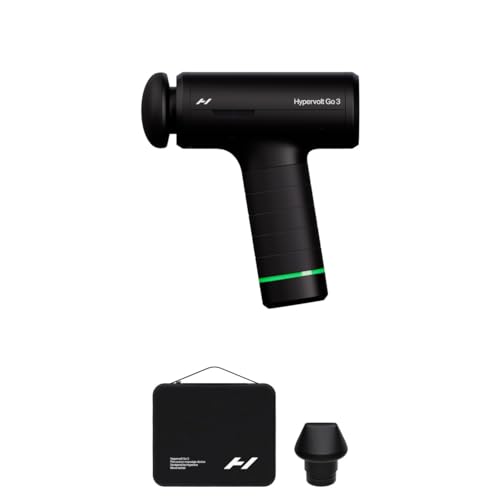
Full-size guns weigh 2-2.5 lb and measure roughly 9-10 inches tall by 7 inches wide. Compact guns land at 1.3-1.8 lb and about 6-8 inches; mini guns run 1 lb or less at 5-6 inches. For self-treatment, anything over 2 lb causes arm fatigue within 3-4 minutes when reaching behind your shoulder, so most people recovering alone are happier at 1-1.5 lb. A pocket-sized unit with heat and cold like the BOB AND BRAD Q2 Pro Mini at $69.31 sits at the small end of that range, while the Hyperice Hypervolt Go 3 at $129 is a compact-class gun sold with a carry case for travel. Handle angle matters too: a slight 10-15 degree tilt or a triangular grip reduces wrist strain compared with a straight pistol grip.
Motor, Amplitude, and Stall Force
Amplitude is how far the head travels per stroke. Minis deliver 7-8 mm, compacts 10-12 mm, and full-size deep-tissue guns 14-16 mm. Stall force is how hard you can press before the motor stops: 20-30 lb for minis, 30-45 lb for compacts, 50-70 lb for full-size. Speed ranges of 1,800-3,200 percussions per minute are standard across all tiers and are not a differentiator. A brushless motor runs quieter, cooler, and longer than a brushed motor; nearly every gun over $40 now uses one, but entry-level units around $28, like the cotsoco deep tissue gun at $27.99, may not specify, so look for “brushless” in the description. For recovery from heavy training, prioritize 12 mm or more of amplitude and at least 40 lb of stall force. For general soreness and pre-bed relaxation, 8-10 mm is plenty.
Attachments and Build
Four heads cover almost every use: a round ball for large muscles, a flat head for dense areas, a bullet for trigger points, and a fork for either side of the spine or Achilles. Kits with 8-12 heads add cushioned or metal variants that most people never use. Look at how the heads attach; a firm push-fit with an O-ring holds better than a loose friction fit that spits heads out at high speed. Body shells are ABS plastic at the budget end and aluminum or reinforced polycarbonate on premium units. A soft-touch coating on the grip keeps it from slipping when your hands are sweaty after a workout. Check the head-arm material as well: metal arms outlast plastic ones, which can crack after a year of daily use.
Comfort, Noise, and Heat or Cold
Noise is the most underrated spec. Guns at 40-50 dB on low speed can be used during a TV show; guns at 60-70 dB cannot. Manufacturers rarely list decibels honestly, so a stated range under 55 dB is a reasonable target, and “quiet glide” or similar marketing usually maps to 45-55 dB. Heated heads warm to about 104-113°F and help loosen muscle before deeper work; cold heads drop to roughly 45-55°F and take the edge off post-run inflammation. Combination heat and cold units such as the RENPHO Active Thermacool 2 at $85.47 add 0.2-0.4 lb and about $20-$40 to the price. Battery life runs 2-3 hours per charge on minis and 3-6 hours on full-size guns, which translates to two to four weeks of 10-minute sessions. USB-C charging is a genuine convenience over proprietary barrel chargers.
Price Tiers
Under $40 buys a full-size gun with a plastic shell, 10-12 mm amplitude, 6-10 heads, and a 1-year warranty at best; quality is inconsistent and stall force is often under 30 lb despite the size. The $60-$90 range is where compact and mini guns with brushless motors, heat and cold options, and 12-18 month warranties live, and it is the sweet spot for most home users. $120-$200 buys established brand names, aluminum construction, app connectivity, 2-year warranties, and replacement parts availability. Above $300 you are paying for 16 mm amplitude, 60-plus lb of stall force, and professional-grade durability, which matters for trainers and serious athletes but not for someone easing soreness after a 5K in 2026.
Warranty and Support
A 1-year warranty is the floor; 18 months to 2 years signals the manufacturer expects the battery and motor to last. Batteries are the first thing to fail, typically after 300-500 charge cycles, and few guns have user-replaceable cells, so a longer warranty is effectively battery insurance. Check whether the brand sells replacement heads and chargers separately; losing a proprietary charger on a no-name gun turns it into a paperweight. HSA and FSA eligibility, noted on some listings, can make the purchase pre-tax if your plan covers percussion massagers.
Delivery and Setup
There is nothing to assemble. Guns arrive partially charged in a case or box roughly 8 x 6 x 4 inches for compacts and 10 x 8 x 4 for full-size units. Charge fully before first use (2-3 hours typical), then run each head against your forearm at the lowest speed to learn the feel. A gun with a carry case protects the heads and keeps the charger with the unit, which is worth $10-$20 over a bare gun if you travel.
Spec Checklist
| Spec | Budget | Mid | Premium |
|---|---|---|---|
| Price | $25-$45 | $60-$130 | $150-$400 |
| Weight | 1.8-2.5 lb | 1-1.8 lb | 1.5-2.5 lb |
| Amplitude | 8-10 mm (claimed 12) | 10-12 mm | 12-16 mm |
| Stall force | 20-30 lb | 30-45 lb | 50-70 lb |
| Motor | Brushed or unspecified | Brushless | Brushless, high-torque |
| Noise | 55-70 dB | 45-55 dB | 40-50 dB |
| Battery | 2-3 hours, barrel charger | 2-4 hours, USB-C | 3-6 hours, USB-C or dock |
| Heads | 6-10 plastic | 4-6 with heat/cold option | 4-6 premium, replaceable |
| Warranty | 90 days to 1 year | 1-2 years | 2 years or more |
Red Flags
- No amplitude or stall force listed. A gun that advertises only percussions per minute is hiding a weak motor.
- Claims of 16 mm amplitude under $40. Real 16 mm needs a large, heavy motor; budget guns claiming it are usually 8-10 mm.
- “30 speed levels.” More than 5-6 speeds is marketing; you will use two or three.
- Proprietary charger with no replacement available. When it fails or is lost, the gun is done.
- Warranty under 90 days. The maker does not expect the battery to last.
- Weight not listed. Almost always means it is over 2 lb.
- Medical claims. Any gun promising to cure conditions rather than ease soreness is overreaching.
FAQ
How much amplitude do I need for recovery?
10-12 mm handles post-workout soreness in most muscle groups and is the practical target for home users. Go to 14-16 mm only if you train heavily and want deep glute and quad work. Minis at 7-8 mm are fine for warm-ups, forearms, and calves but feel like vibration rather than percussion on large muscles.
Is a mini massage gun powerful enough?
For most people, yes. A 1 lb mini with 8-10 mm amplitude and 25-35 lb of stall force is enough to ease soreness in calves, shoulders, and forearms, and its light weight means you actually reach your upper back alone. It will not satisfy a powerlifter working a tight glute, but it beats a full-size gun that stays in the drawer because it is tiring to hold.
How long should I use a massage gun on each muscle?
One to two minutes per muscle group, floating the head over the muscle and pausing 15-30 seconds on tight spots. Keep total sessions under 15 minutes. Avoid bone, joints, the front of the neck, and the spine itself, and stop if you feel sharp pain or numbness.
Are heated massage gun heads worth it?
They are useful, not essential. Heat around 104-113°F loosens stiff muscle before percussion, which is helpful for morning stiffness and cold-weather workouts. Cold heads help after runs. Expect to pay $20-$40 more and carry 0.2-0.4 lb extra. If you already use a heating pad or hot shower before your sessions, a standard gun does the job.