Key takeaways
- Material behavior: Solid hardwood such as birch or European beech dents rather than delaminates, and can be sanded flat again years later. Rubberwood offers similar forgiveness at lower cost. Particle board and laminate are fine for light assembly and soldering but swell permanently once water gets past the edge banding.
- Thickness and deflection: Aim for 1.5 inches or more if you plan to plane, chisel, or clamp workpieces vertically. Thinner tops need closely spaced framing underneath; a 1-inch top on 48-inch unsupported spans will flex enough to ruin fine joinery.
- Clamping strategy: Decide before you buy how you’ll hold work down. Dog holes on a 96mm grid accept bench dogs and hold-fasts; a bare slab needs overhanging edges for F-clamps; an integrated vise saves space but fixes your working height.
- Mobility versus mass: Locking casters make a bench usable in a car-sharing garage, but wheels also mean the top will creep under lateral force. Mass and floor contact are what kill vibration, so choose mobility only where you truly need it.
- Integrated power and light: ETL- or UL-listed outlet strips and LED task lighting built into the bench remove trailing cords, the leading cause of workshop trips. Verify the listing mark rather than trusting the phrase “safety tested.”
What's inside
A workbench top is the one surface in your home that gets asked to do everything: hold a router steady, absorb hammer blows, catch spilled epoxy, and then look presentable when the garage door goes up. Most buyers discover the limits of a cheap top the hard way — a laminate skin that bubbles after one wet cleanup, legs that shimmy under a hand plane, or a slab so heavy it can never be moved again. The gap between “a table you work on” and “a bench that works with you” comes down to material, thickness, and how the top transfers force into the floor.
This guide sorts the current crop of workbench tops by what they’re genuinely good at rather than by spec-sheet bravado. You’ll find deflection-resistant hardwood slabs for hand-tool work, dog-hole systems built for clamping and track saws, height-adjustable steel-framed benches for assembly and repair, and compact vise-topped stations for anyone working out of a shared space. Below, the picks, followed by a buying framework and answers to the questions that come up most often.
As an Amazon Associate we earn from qualifying purchases.




🛒 Best Price Today on Amazon
Prime members get fast, free shipping on everything above, plus member-only deals. New members get a 30-day free trial — cancel anytime.
How to Choose a Workbench Top (2026)
- Material behavior: Solid hardwood such as birch or European beech dents rather than delaminates, and can be sanded flat again years later. Rubberwood offers similar forgiveness at lower cost. Particle board and laminate are fine for light assembly and soldering but swell permanently once water gets past the edge banding.
- Thickness and deflection: Aim for 1.5 inches or more if you plan to plane, chisel, or clamp workpieces vertically. Thinner tops need closely spaced framing underneath; a 1-inch top on 48-inch unsupported spans will flex enough to ruin fine joinery.
- Clamping strategy: Decide before you buy how you’ll hold work down. Dog holes on a 96mm grid accept bench dogs and hold-fasts; a bare slab needs overhanging edges for F-clamps; an integrated vise saves space but fixes your working height.
- Mobility versus mass: Locking casters make a bench usable in a car-sharing garage, but wheels also mean the top will creep under lateral force. Mass and floor contact are what kill vibration, so choose mobility only where you truly need it.
- Integrated power and light: ETL- or UL-listed outlet strips and LED task lighting built into the bench remove trailing cords, the leading cause of workshop trips. Verify the listing mark rather than trusting the phrase “safety tested.”
The Best Workbench Tops (2026) Reviewed
CAMMOO 48×24 Garage Work Bench with Pegboard & Power Strip
This is the most complete out-of-the-box package here: a rubberwood top over a heavy steel frame, with adjustable height, a pegboard back, LED lighting, and ETL-listed outlets. The stated 2,000 lb capacity is static load rather than a hand-planing endorsement, but for automotive work, repairs, and general assembly it’s a genuinely well-equipped station.
Unfinished Birch Butcher Block Countertop, 60″ x 25″ x 1.5″
The best value in raw surface area, and the pick for anyone building a bench around a base they already own. It arrives smooth-sanded and unfinished, so you control the finish — I’d recommend a penetrating oil rather than film varnish, since oil is repairable in place after gouges.
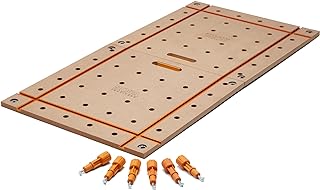
BORA Centipede T-Track Workbench Top
The T-track and 3/4-inch dog hole grid turn this into a legitimate MFT-style clamping platform for track saw work and cabinet assembly. Paired with a folding Centipede base it collapses into a corner, which makes it the strongest choice for a garage that also has to park a car.
Smart Workstation Pro Vise Top
European beech construction and cushioned jaws give you real workholding in a footprint just under 21 inches wide. It’s ideal for detail work — instrument repair, carving, small metalwork — clamped to an existing table rather than serving as a primary bench.
Seville Classics UltraGraphite Wood Top Workbench on Wheels
A tidy, roll-anywhere 48-inch bench with a sliding drawer that keeps drivers and bits at hand instead of scattered across the top. Lock the casters before any hard work; unlocked, it will wander under sideways pressure.
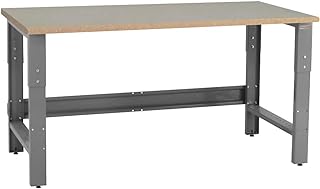
BenchPro Height Adjustable Bench, 24″ x 48″
The particle board top is the compromise, but the adjustable steel frame is the point: dial in a standing or seated height that suits your body and the task. Consider replacing the top with hardboard or a birch slab later while keeping the base.
Frequently Asked Questions
What thickness should a workbench top be?
For assembly, electronics, and light repair, 1 inch is adequate on a well-supported frame. For hand-tool woodworking, choose 1.5 inches or thicker so the surface resists both denting and flex under clamping pressure.
Is butcher block a good workbench surface?
Yes. Edge-grain hardwood is stable, quiet under tools, and can be re-flattened with a sander or hand plane. Its main weakness is standing moisture, which a periodic oil or hardwax coat prevents.
How do I finish an unfinished birch slab?
Sand to 180 grit, then apply two or three coats of boiled linseed oil or a hardwax oil, wiping off the excess after each. Skip glossy polyurethane on a work surface — it chips, telegraphs every scratch, and can’t be spot-repaired.
Should I buy a mobile bench or a fixed one?
Buy mobile if the space is shared or the bench must move to reach a project. Buy fixed if you’re chopping mortises, sawing by hand, or pressing bearings, where mass and a stable footprint matter more than flexibility.
Final Thoughts
For most home workshops the CAMMOO 48×24 workbench delivers the most usable capability per dollar, with lighting and safe power already integrated. If you want a surface that outlasts several bases, the unfinished birch butcher block slab is the smarter long-term investment; and for shared garages or job-site work, the BORA Centipede T-Track top gives you a real clamping platform that disappears when you’re done.