Key takeaways
- Match lumens to the room, not the spec sheet: A 30,000-lumen tripod is superb in an open driveway or unfinished basement, but in a one-car garage that much output bouncing off pale walls creates glare that actually reduces what you can see. Roughly 10,000–15,000 lumens suits most single-bay spaces; save the big towers for large or outdoor jobs.
- Treat color temperature as a schedule decision: 5000K–6500K daylight renders color accurately and keeps you alert, which is why nearly every work light ships in that range. It’s also the most sleep-disruptive light there is. If you routinely work past dusk, favor models with multiple modes or a dimmer so you can drop intensity, and give yourself an hour of low, warm light before bed.
- Get the light above or beside your eyeline, never in it: Adjustable tripod heads that extend past five feet let you angle illumination downward onto the work surface, which is what you want. Fixtures parked at eye level cause squinting, headaches, and the kind of fatigue people mistake for tiredness.
- Decide between cord and battery honestly: Corded fixtures deliver sustained high output without fade; rechargeables give you reach under a chassis or out at a campsite but taper as the cell drains. Many workshops genuinely need one of each rather than a compromise between them.
- Check the ingress rating and the cord length together: IP66 means confident use in rain, dust, and sawdust. A 16- to 18-foot cord means you’re not daisy-chaining extension leads across a wet floor. Both matter more than an extra few thousand lumens.
What's inside
Bright light is a tool, and like any tool it can be used well or badly. In my work on circadian health, the complaint I hear most often from tradespeople, hobbyists, and weekend garage tinkerers is not that their workspace is too dark — it’s that the lighting they’ve improvised is doing two jobs poorly. A single dim bulb forces the eyes to strain and the neck to crane; a bare 6500K floodlight aimed at the ceiling at 10 p.m. floods the retina with the exact wavelength signature that tells the brain it’s mid-morning. Either way, the work suffers and so does the night that follows.
This guide looks at work lights through both lenses: raw usable output for the task in front of you, and control over that output so you’re not paying for it in lost sleep. I’ve weighed lumen claims against beam quality, looked at how each fixture positions light relative to your line of sight, and flagged which models offer dimming, tilt, or battery portability — the features that let you dial brightness down as the evening progresses. Below you’ll find tripod towers for whole-bay illumination, magnetic rechargeables for under-hood detail work, and a fixed shop light for permanent bench duty.
As an Amazon Associate we earn from qualifying purchases.


🛒 Best Price Today on Amazon
Prime members get fast, free shipping on everything above, plus member-only deals. New members get a 30-day free trial — cancel anytime.
How to Choose a/an Work Light (2026)
- Match lumens to the room, not the spec sheet: A 30,000-lumen tripod is superb in an open driveway or unfinished basement, but in a one-car garage that much output bouncing off pale walls creates glare that actually reduces what you can see. Roughly 10,000–15,000 lumens suits most single-bay spaces; save the big towers for large or outdoor jobs.
- Treat color temperature as a schedule decision: 5000K–6500K daylight renders color accurately and keeps you alert, which is why nearly every work light ships in that range. It’s also the most sleep-disruptive light there is. If you routinely work past dusk, favor models with multiple modes or a dimmer so you can drop intensity, and give yourself an hour of low, warm light before bed.
- Get the light above or beside your eyeline, never in it: Adjustable tripod heads that extend past five feet let you angle illumination downward onto the work surface, which is what you want. Fixtures parked at eye level cause squinting, headaches, and the kind of fatigue people mistake for tiredness.
- Decide between cord and battery honestly: Corded fixtures deliver sustained high output without fade; rechargeables give you reach under a chassis or out at a campsite but taper as the cell drains. Many workshops genuinely need one of each rather than a compromise between them.
- Check the ingress rating and the cord length together: IP66 means confident use in rain, dust, and sawdust. A 16- to 18-foot cord means you’re not daisy-chaining extension leads across a wet floor. Both matter more than an extra few thousand lumens.
The Best Work Light (2026)s Reviewed
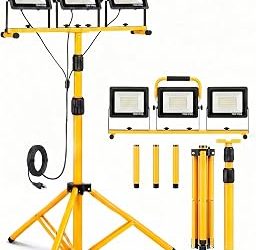
Zetunlo 21000 Lumen 3-Head Tripod Work Light
Three independently aimable heads and a 16-foot cord make this the most flexible large-area option here — you can wash a whole bay or converge all three on a single repair. The 21,000-lumen output hits a sensible middle ground: genuinely bright without the overwhelming glare of higher-wattage towers in enclosed rooms.
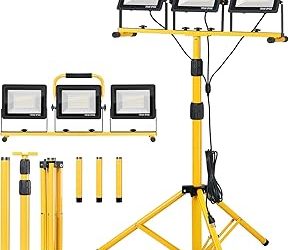
30000 Lumen 3-Head Foldable Tripod Light
This is the one I’d choose for outdoor or unfinished spaces where light has nowhere to bounce and disappears into the dark. The 47-to-68-inch height range is the real advantage: extended fully, the beam falls from above your shoulders rather than into your face, which is the single biggest predictor of whether you’ll finish a long session with tired eyes.
Rechargeable 1200 Lumen Magnetic Folding Work Light
A 5,000mAh cell, a magnetic base, and 360° rotation cover the jobs no tripod can reach — behind an engine block, inside a cabinet carcass, under a sink. Multiple output levels also make it a quietly good late-night choice, since you can run it at the lowest usable setting instead of lighting the whole room.
LUTEC 3500LM Rechargeable Magnetic Work Light
The three-mode design and 5000K output make this the most versatile crossover pick: bright enough for roadside repairs, restrained enough for fishing, camping, or a power outage. Its included stand means it works as a compact standalone floodlight rather than only as a handheld.
11000LM 100W Plug-In LED Shop Light
For a bench, workbench, or bay you use constantly, a fixed IP66 fixture with an integrated switch beats redeploying a tripod every session. The 6000K tone is clinical and unflattering by design — excellent for inspection work, worth switching off in favor of warmer ambient light once the tools are down.
Frequently Asked Questions
Will working under a bright LED work light affect my sleep?
It can, particularly in the two to three hours before bed. High-intensity 5000K–6500K light suppresses melatonin and pushes your internal clock later. The practical fix isn’t avoiding the work — it’s reducing intensity as the evening goes on, keeping the beam off your face, and switching to dim, warm lighting once you’re done.
How many lumens do I actually need for a two-car garage?
Around 12,000 to 20,000 lumens of well-aimed light is comfortable for general work in that footprint. Detail tasks like wiring or finishing benefit from a smaller light positioned close to the work rather than from adding output overhead.
Are tripod work lights or magnetic rechargeables the better buy?
They solve different problems. Tripods provide sustained, area-wide illumination; magnetic rechargeables provide precise, hands-free light in confined spaces. Most people who buy one eventually buy the other.
Does IP66 mean I can leave a work light outside?
IP66 protects against dust and powerful water jets, so brief rain during use is fine. It isn’t a rating for permanent outdoor storage — bring the fixture in, and keep plugs and connections dry regardless of the housing’s rating.
Final Thoughts
For most workshops and garages, the Zetunlo 21000 Lumen tripod is the sensible core purchase: enough output for real work, three-way aiming to keep glare out of your eyes, and a cord long enough to position it properly. Pair it with the 1200 Lumen magnetic rechargeable for the tight, awkward spots no tripod reaches, and step up to the 30000 Lumen tripod if your work regularly happens outdoors or in large unfinished spaces. Whichever you choose, remember that the goal is enough light in the right place — not the highest number on the box.