Key takeaways
- Load-test every new hang by sitting in it slowly and bouncing gently before you commit to a nap.
- Add a ridgeline — a taut cord between the two ends — to lock in the same sag every single time.
- Keep a spare carabiner on hand; steel gates outlast aluminum under repeated outdoor use.
- For overnight sleeping, use a sleeping pad or underquilt. Compressed insulation beneath you loses most of its warmth.
What's inside
As someone who spends most working hours studying how bodies settle into rest, I’ve come to think of the hammock as one of the more underrated pieces of sleep furniture. The gentle lateral sway of a well-hung hammock slows the nervous system in a measurable way, and the shallow curve it creates keeps the spine in a neutral, floating alignment that many mattresses never quite manage. But all of that depends entirely on the hang. A hammock strung too tight becomes a taut plank that squeezes your shoulders; strung too low, it turns into a bag you can’t climb out of. Get the geometry right and you have a nap platform that rivals your bed.
This guide walks through the physics and hardware of hanging a hammock properly in 2026 — how far apart your anchor points should be, what height and sag to aim for, how to attach to trees without harming them, what to bolt into indoors, and when a freestanding frame is the smarter call. I’ll also point out the specific straps, hooks, and stands that hold up under repeated use, so you’re not re-rigging your setup every third weekend.
As an Amazon Associate we earn from qualifying purchases.


🛒 Best Price Today on Amazon
Prime members get fast, free shipping on everything above, plus member-only deals. New members get a 30-day free trial — cancel anytime.
Start With the Geometry, Not the Hardware
Before you buy a single carabiner, understand the shape you’re chasing. For most 10–12 foot hammocks, anchor points 12 to 15 feet apart work beautifully. Each suspension line should leave the anchor at roughly a 30-degree angle from horizontal — steeper than that and the fabric pulls tight across your body; shallower and the load on your anchors multiplies dramatically. A 30-degree hang puts about the same force on each anchor as your body weight; flatten that to 10 degrees and you’re pulling nearly three times your weight on each side. That difference is why hammocks fail at the anchor, almost never in the middle.
Height and Sag: The Comfort Variables
Aim to have the lowest point of the hammock sit about 18 inches off the ground when you’re lying in it — roughly chair height, so you can sit down and stand up without ceremony. Unloaded, that usually means hanging the middle at around 30 to 36 inches. Attach your straps 5 to 6 feet up the tree or wall to leave room for the stretch that happens once weight goes in. Then let it sag. A visible banana curve is correct; a straight line is not. The sag lets you lie slightly diagonally across the fabric, which is what produces that flat, weightless feeling instead of a taco fold.
Hanging Between Trees Without Damaging Them
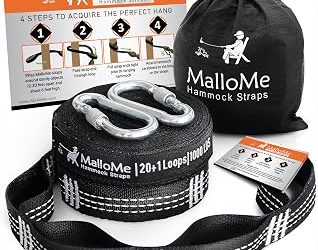
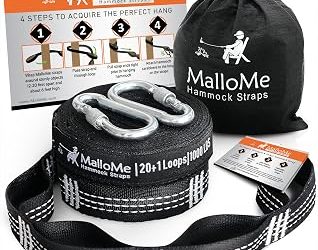
Rope tied directly around bark strangles the cambium layer and can kill a tree over a few seasons. Wide webbing straps spread the load and leave no mark. The MalloMe Hammock Straps for Trees are a reliable multi-purpose kit — adjustable, heavy duty, and rated for swings as well as hammocks, so one set covers most backyard uses. If you want more fine-tuning, the SZHLUX Hammock Straps give you two 10-foot straps with 38 total loops and a pair of carabiners, which means you can dial in the exact angle rather than settling for whichever loop is closest. Choose trees at least 12 inches in diameter, living and healthy, with no dead limbs overhead.
Indoor Mounting: Find Real Structure
Indoors, everything depends on what’s behind the drywall. Anchor into a ceiling joist or a wall stud — located with a stud finder and confirmed by drilling a small pilot hole — never into drywall anchors alone. Use a lag screw long enough to sink at least 2 inches into solid wood, and mount into the center of the joist, not the edge. For hardware, the MHMYDZ 1000 lb Capacity Hammock Hanging Kit covers straightforward ceiling and wall suspension with durable hooks and carabiners. If you’re hanging a hammock chair rather than a full hammock, look at a 360° rotating 1000 lb capacity hanging kit — the swivel prevents the slow twist-and-unwind that otherwise makes chairs unpleasant to sit in for long.
When a Stand Beats a Wall
Renting, working with brick, or wanting to chase shade across the yard? A frame solves it. The Sunnydaze Heavy-Duty Hammock Stand takes 9–14 foot hammocks, handles 550 pounds, assembles without tools, and includes its own chains and hooks. Rust-resistant steel matters if it lives outdoors year-round. A stand also lets you fix your geometry once and keep it, rather than re-guessing the angle every time you rehang.
Tips
- Load-test every new hang by sitting in it slowly and bouncing gently before you commit to a nap.
- Add a ridgeline — a taut cord between the two ends — to lock in the same sag every single time.
- Keep a spare carabiner on hand; steel gates outlast aluminum under repeated outdoor use.
- For overnight sleeping, use a sleeping pad or underquilt. Compressed insulation beneath you loses most of its warmth.
Frequently Asked Questions
How far apart should the anchor points be?
Twelve to 15 feet suits most hammocks, ideally a foot or two wider than the hammock’s total length. Closer anchors mean you’ll need to hang higher to preserve the sag.
Can I sleep in a hammock every night?
Many people do comfortably, particularly side sleepers and those with mild lower back discomfort. The key is a proper diagonal lay with real sag. If you wake with tight shoulders or calf pressure, your hang is too flat.
What weight capacity do I actually need?
Choose hardware rated well above your body weight — 1000 lb kits exist because entry and exit create brief dynamic loads far exceeding your static weight.
Will hooks damage my ceiling?
Not if anchored into a joist with an appropriately long lag screw. Removal leaves a patchable hole. Drywall-only mounting will fail, often destructively.
Conclusion
A hammock hung with attention becomes genuine restorative furniture rather than a novelty. Respect the 30-degree rule, allow generous sag, anchor into real structure, and buy hardware rated far beyond what you think you need. Do that once, and the rest is just deciding how long you can reasonably stay in it.