Key takeaways
- Carbon by weight, not by coating: Gas adsorption is a mass problem. A carbon-dusted mesh wrapped around a HEPA pleat saturates within weeks; look for granular or pelletized carbon measured in pounds, or a dedicated carbon layer with real depth.
- Noise at working speed: A 22 dB rating means little if you need speed three to turn the air over. Check the decibel figure at the setting your room size demands, and favor units whose mid-range hum is broadband rather than whiny.
- Discount the coverage claim: Headline square footage is usually calculated at a single air change per hour. For meaningful VOC control overnight, divide the advertised figure by four and shop against that number.
- Total darkness on demand: AQI displays and status LEDs suppress melatonin at close range. Insist on a display that switches fully off — dimmed is not off — and confirm the setting survives a power cycle.
- Plan for the refill: Carbon exhausts long before HEPA does, typically in six to twelve months under active off-gassing. Price a year of replacements before you commit, since a cheap unit with proprietary filters rarely stays cheap.
What's inside
A new dresser arrives, the shrink wrap comes off, and within a few hours the bedroom carries a faintly sweet, chemical edge. That smell is volatile organic compounds at work — formaldehyde released by engineered wood cores, solvents from adhesives and lacquers, residual compounds curing out of foam and textiles. The bedroom is the worst possible place to encounter them. You spend seven to nine hours behind a closed door, breathing deeply and slowly, during the window when your body does most of its repair work. Conventional HEPA media, engineered to intercept particles, allows nearly all of that gas phase to pass straight through.
This guide evaluates VOC purifiers through a sleep-wellness lens rather than a spec-sheet one. Three factors carry the most weight here: how much genuine adsorptive carbon a machine actually holds, how loud it runs at the speed required to clean your room rather than its quietest idle setting, and how much light it projects into a dark space at two in the morning. Below are the models that hold up across all three, along with a short framework for matching one to your bedroom.
As an Amazon Associate we earn from qualifying purchases.


How to Choose a VOC Air Purifier (2026)
- Carbon by weight, not by coating: Gas adsorption is a mass problem. A carbon-dusted mesh wrapped around a HEPA pleat saturates within weeks; look for granular or pelletized carbon measured in pounds, or a dedicated carbon layer with real depth.
- Noise at working speed: A 22 dB rating means little if you need speed three to turn the air over. Check the decibel figure at the setting your room size demands, and favor units whose mid-range hum is broadband rather than whiny.
- Discount the coverage claim: Headline square footage is usually calculated at a single air change per hour. For meaningful VOC control overnight, divide the advertised figure by four and shop against that number.
- Total darkness on demand: AQI displays and status LEDs suppress melatonin at close range. Insist on a display that switches fully off — dimmed is not off — and confirm the setting survives a power cycle.
- Plan for the refill: Carbon exhausts long before HEPA does, typically in six to twelve months under active off-gassing. Price a year of replacements before you commit, since a cheap unit with proprietary filters rarely stays cheap.
The Best VOC Air Purifiers (2026) Reviewed
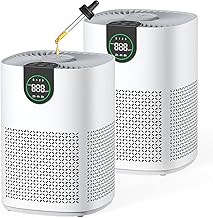
HAP603 Large Room Purifier
The 22 dB sleep setting and 360-degree outlet make this the easiest unit to place near a bed without creating a cold draft, and the PM2.5 readout dims down properly. One caveat from a sleep standpoint: leave the aromatherapy pad empty, since essential oils add the very compounds you installed the machine to remove.
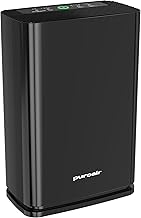
PuroAir 240
Sized sensibly for a real bedroom rather than a showroom, the CarbonTech layer gives it more gas-phase capability than most units in this footprint. Auto mode responds quickly to a fresh delivery of furniture, then settles into a low, unobtrusive hum once the initial off-gassing peak subsides.
Austin Air C100CC1 HealthMate Junior
This is the specialist of the group: a genuine carbon-and-zeolite bed built to strip solvents and formaldehyde rather than a filter with carbon sprinkled on it. Its tabletop form suits a nightstand beside a new headboard or mattress, and the five-year filter life makes the running cost far more rational than it first appears.
JF999 Smart HEPA and Carbon Purifier
Best suited to open-plan bedrooms or a primary suite that flows into a dressing area, with app and Alexa control that lets you schedule a high-speed purge before bed and a whisper setting overnight. The activated carbon stage is substantial enough to handle a room full of newly finished cabinetry.
KNKA APH4000
AHAM-verified performance is rare at this level, which means its clean air delivery rate has been measured rather than estimated. The washable pre-filter keeps dust off the carbon so it stays available for gases, and the AQI display gives useful feedback while a room finishes curing.
Frequently Asked Questions
Does a HEPA filter remove VOCs?
No. HEPA media captures particles down to submicron sizes, but VOCs are individual gas molecules that travel through the fibers untouched. Removing them requires adsorption onto activated carbon, zeolite, or a similar medium with enormous internal surface area.
How long does new furniture off-gas?
Emissions peak in the first few days and decline sharply over the following weeks, though pressed-wood pieces can release low levels of formaldehyde for a year or more. Running a carbon purifier continuously during the first month makes the largest difference.
Should the purifier run all night?
Yes. Bedroom VOC concentrations climb steadily behind a closed door, so intermittent operation lets levels rebuild while you sleep. Run auto mode if the sensor is stable, or lock in a fixed low speed if fluctuating fan noise disturbs you.
Can cleaner air actually improve sleep?
Research links bedroom air quality to fewer awakenings and better next-day alertness, and the steady low-frequency airflow provides a masking effect against household noise. Treat it as one supporting element alongside temperature, darkness, and a consistent schedule.
Final Thoughts
For pure VOC removal beside a newly delivered bed or wardrobe, the Austin Air C100CC1 remains the most honest carbon bed you can put on a nightstand. If you want quiet whole-bedroom coverage with a display that genuinely disappears at night, the HAP603 is the balanced choice, while the JF999 suits larger open-plan suites that need scheduled, app-driven control.