Key takeaways
- Drawer count vs. drawer depth: More drawers isn’t automatically better. Count the tool categories you actually own, then choose a layout with a few deep drawers for power tools and several shallow ones for hand tools, so nothing has to be stacked or dug through.
- Caster quality and noise: Look for larger-diameter wheels with at least two locking casters. Hard, undersized wheels chatter across concrete seams and transmit vibration through the floor — an underrated source of late-evening noise in attached garages.
- Modularity: Detachable top boxes and 3-in-1 designs let you carry one section to the job instead of dragging the whole cabinet. This matters if you work in multiple spots or need to move the chest seasonally.
- Locking and safety: A single central or auto-lock mechanism is worth prioritizing in homes with children. It also keeps drawers from rolling open in transit, which is where most of the noise and damage happens.
- Liners and dividers included: Non-slip liners cut metal-on-metal rattle dramatically and keep tools from sliding when you close a drawer. Chests that include liners and tray dividers save you a separate purchase and produce a measurably quieter workspace.
What's inside
Most garage upgrades get judged on capacity alone, but there’s a quieter cost to bad storage that shows up around 11 p.m. A disorganized workspace turns a five-minute fix into a forty-minute hunt, and the clatter of loose sockets in a shallow bin travels straight through drywall into the bedroom above. As someone who spends most days talking with people about protecting their wind-down window, I’ve come to see tool storage as a sleep-hygiene issue as much as a workshop one: the faster you can find a 10mm wrench and close the drawer, the sooner the house goes dark and stays dark.
This guide covers the rolling tool chests worth buying in 2026, with attention to the details that matter for household peace as well as durability — drawer glide quality, caster noise, locking hardware, and whether a chest can be broken down and moved without waking anyone. Below you’ll find the current standout models, a short buying framework, expert notes on the top five picks, and answers to the questions buyers ask most.
As an Amazon Associate we earn from qualifying purchases.


🛒 Best Price Today on Amazon
Prime members get fast, free shipping on everything above, plus member-only deals. New members get a 30-day free trial — cancel anytime.
How to Choose a Tool Chest (2026)
- Drawer count vs. drawer depth: More drawers isn’t automatically better. Count the tool categories you actually own, then choose a layout with a few deep drawers for power tools and several shallow ones for hand tools, so nothing has to be stacked or dug through.
- Caster quality and noise: Look for larger-diameter wheels with at least two locking casters. Hard, undersized wheels chatter across concrete seams and transmit vibration through the floor — an underrated source of late-evening noise in attached garages.
- Modularity: Detachable top boxes and 3-in-1 designs let you carry one section to the job instead of dragging the whole cabinet. This matters if you work in multiple spots or need to move the chest seasonally.
- Locking and safety: A single central or auto-lock mechanism is worth prioritizing in homes with children. It also keeps drawers from rolling open in transit, which is where most of the noise and damage happens.
- Liners and dividers included: Non-slip liners cut metal-on-metal rattle dramatically and keep tools from sliding when you close a drawer. Chests that include liners and tray dividers save you a separate purchase and produce a measurably quieter workspace.
The Best Tool Chest Deals (2026) Reviewed
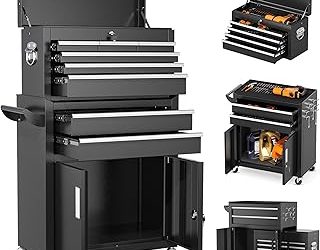
8-Drawer 42″ Rolling Tool Chest, Heavy Duty (Black)
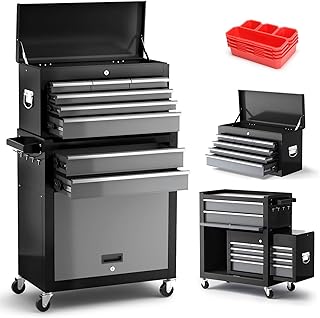
This is the well-rounded pick for most home garages: eight drawers, a detachable top box, and a kit that arrives with liners, a tray divider, and side hooks already included. The 42-inch footprint gives you a usable work surface without eating a full parking bay.
8-Drawer 3-in-1 Rolling Tool Chest with Bottom Cart
The three-section layout — detachable top box, mid-cabinet, and bottom storage cart — is the most flexible configuration here, and the lockable steel body holds up to daily opening and closing. Choose this one if you want the option to separate a portable module and leave the rest parked.
LDHTHOPI 8-Drawer Rolling Tool Chest (Red)
Arriving assembled is a genuine advantage: no evening spent with an Allen key and a printed diagram. The sliding drawers run smoothly on their glides and lock as a set, and the detachable top box makes it easy to bring only what a job needs.
12-Drawer 46″ Rolling Tool Chest (Black)
For serious collections, the 46-inch, twelve-drawer build offers the most granular organization in this group, with dividers and liners supplied. The two-in-one lockable design and side hooks make it the best choice if you’re consolidating several bins and bags into one home.
Goplus 3-in-1 Rolling 6-Drawer Tool Cabinet
A smart compact option with an auto-lock system and universal lockable casters, so it stays put while you work and stays shut while you push it. Protective liners come standard, which keeps drawer noise low in shared or attached garages.
Frequently Asked Questions
How many drawers do I actually need?
Five to eight drawers suits most homeowners and weekend mechanics. Move to a twelve-drawer chest only if you already own enough tools that categories are competing for space — empty drawers tend to collect clutter rather than organization.
Are rolling tool chests stable on uneven concrete?
Quality models are, provided you engage the caster locks. On a sloped garage floor, position the chest with its long side across the slope and lock both front wheels before opening loaded drawers.
Do I need a lock if I live alone?
Locks still earn their place. They prevent drawers from opening while the chest is being moved, which protects both your tools and your floor, and they add security if the garage door is ever left open.
How do I keep a tool chest quiet at night?
Use the supplied liners, avoid overfilling drawers so tools can’t shift, and roll the chest on locked-out casters only when necessary. Closing drawers with a hand on the face rather than a shove eliminates most of the sound that carries upstairs.
Final Thoughts
For most buyers, the 8-Drawer 42″ Rolling Tool Chest strikes the best balance of capacity, included accessories, and footprint, while the 8-Drawer 3-in-1 with bottom cart is the pick if modularity matters more than raw drawer count. Those with large collections should step up to the 12-Drawer 46″ chest — and whichever you choose, keep the liners in place so late-night repairs stay a private matter between you and the tools.