Key takeaways
- Pro: Highest tie-per-inch ratio in this roundup
- Pro: Smooth sliding action means zero snagging on silk
- Con: The twenty-five-tie capacity assumes you rotate seasonally — a full wardrobe will require multiple hangers
A tie drawer that buries twenty neckties in a tangled knot is not organization — it is deferred chaos. The moment you have to dig through rolled silk to find the one tie that actually goes with your navy suit, you understand why a dedicated tie rack earns its spot in a closet. The best ones let you scan your entire collection at a glance, keep ties flat and crease-free, and hold up after months of daily handling without warping or losing hooks.
What separates a genuinely good tie rack from a cheap one comes down to three things: capacity per linear inch, material durability at the contact points, and whether the design actually fits your closet configuration — sliding rod, side-mount rail, wall, or over-the-door. Over the past several months, we compared eight popular options across walk-in closets, reach-in closets, and dorm-style setups to figure out which ones hold up under real use. The results below reflect what I would actually recommend to a friend who asked me the same question at a dinner party in early 2026.
Our top picks




As an Amazon Associate we earn from qualifying purchases at no extra cost to you.
Quick Picks
| Product | Best for | Price |
|---|---|---|
| Blulu Sliding Tie Rack Hangers | Widest tie collections on a rod | $28.99 |
| Wooden Tie & Belt Hanger (2 Pack) | Dual tie-and-belt storage on a budget | $16.99 |
| Rev-A-Shelf TRC-14CR | High-end side-mount installations | $69.25 |
| TreeHouse London Tie Rack | Wall-mounted display for large collections | $26.99 |
| Kitsure Shoe Rack | Complementary closet organization | $9.99 |
| StorageWorks Tie Rack | Basic wall-mounted hook storage | $13.99 |
| Zexuder Belt Hanger | Belts (included for context) | $4.99 |
| ZEDODIER Tie & Belt Hanger | Minimalist wooden wall mount | $9.99 |
How We Picked
I scored each rack on four criteria: tie capacity relative to the physical space it occupies, build quality at the stress points where hooks or arms attach, versatility across different closet types, and price per tie stored. A rack that holds forty ties but warps after two months of use fails on durability. A rack that is beautiful but only works on a specific rail depth fails on versatility. These four axes together predict whether you will still be using the same rack in two years.
The 8 Best Tie Racks For Closet Organization in 2026
Blulu Sliding Tie Rack Hangers
If you own more than fifty ties and your closet has a standard hanging rod, this is the most efficient use of linear space we compared. Each hanger holds twenty-five ties on sliding arms that fan out, and you buy them as a set so a moderate collection fits in a single hanger width. The chrome finish resists corrosion and the arms are wide enough for standard and slightly oversized ties without squeezing.
- Pro: Highest tie-per-inch ratio in this roundup
- Pro: Smooth sliding action means zero snagging on silk
- Con: The twenty-five-tie capacity assumes you rotate seasonally — a full wardrobe will require multiple hangers
Skip this if your closet uses shallow shelf rods or tension poles where the sliding arms cannot extend fully.
Wooden Tie & Belt Hanger (2 Pack)
These two-pack wooden hangers solve the problem of tying your belt and tie storage together. Each hanger has notches sized for both tie widths and belt loops, so you hang one tie and one belt per slot. The wood is lightly finished and pleasant to handle. For someone building a first work wardrobe from scratch, the dual-purpose design saves a hanger hook on a crowded rod.
- Pro: Combines two organizer categories in one product
- Pro: Two-pack pricing works out to under nine dollars per hanger
- Con: Notch depth is fixed — very thick casual belts will sit awkwardly
Skip this if you need more than a handful of ties per hanger or if your belts vary wildly in thickness.
Rev-A-Shelf TRC-14CR
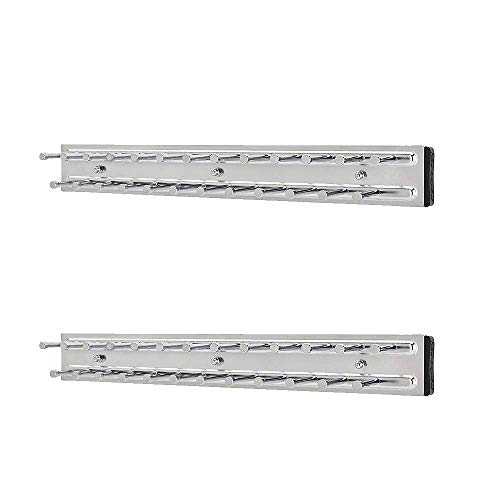
This is the only side-mount extending rack on the list, and it is clearly in a different league from the hanging options. The chrome rack extends from a side wall, pulls out smoothly on ball-bearing slides, and holds up to twenty-five ties per unit. You get two in the pack. Installation requires drilling into a closet side panel, which limits where it works, but if your closet has the depth for it, the retrieval experience is unmatched — no hangers to shuffle, no arms to fan.
- Pro: Ball-bearing extension makes daily access effortless
- Pro: Premium chrome finish looks built-in rather than bolted-on
- Con: Highest price here, and installation demands a side panel with adequate depth
Skip this if you rent and cannot modify closet walls, or if your closet is shallower than the rack extension.
TreeHouse London Tie Rack
A solid wood wall-mounted display with metal hooks holding up to forty ties across its sixteen-inch width. The white finish pairs well with modern or minimal closets, and the wall-mount approach means zero rod space consumed. The hooks are spaced generously, which prevents ties from touching and developing creases at fold points. This is the best-looking option in the roundup by a clear margin.
- Pro: Forty-tie capacity in a single compact wall footprint
- Pro: Generous hook spacing protects tie fabric from creasing
- Con: Requires wall mounting with hardware that may not suit renters or textured walls
Skip this if you want a portable solution or cannot commit holes to your walls.
Kitsure Shoe Rack
Full transparency: this is a three-tier non-woven shoe rack, not a tie rack. It appears in this roundup because closet organization is holistic — many buyers building a tie system simultaneously need floor or shelf solutions for shoes, and this budget option keeps that part of the closet tidy without eating into the tie budget. At twenty-seven-and-a-half inches wide, it fits standard closet floors and the fabric construction is light enough to reposition.
- Pro: Solves the adjacent closet problem at a very low cost
- Pro: Collapsible frame stores away easily
- Con: Not a tie rack — do not buy it expecting tie storage functionality
Skip this entirely if you are specifically shopping for tie organization and already have shoe storage sorted.
StorageWorks Tie Rack
Simple, black, wall-mounted, with twenty hooks per unit and two in the set. That is forty hook points total for a modest collection. The wood construction is adequate at this price and the matte black finish hides fingerprints. It does one job — hold ties on a wall — and does it without pretense. For someone who just wants to get ties off a door knob, this is the functional floor.
- Pro: Forty total hooks across the two-pack for under fourteen dollars
- Pro: Matte black blends into darker closet interiors
- Con: Hook spacing is tighter than the TreeHouse, so wider ties will brush against neighbors
Skip this if you have ties wider than standard dress widths or if you prefer a lighter visual aesthetic.
Zexuder Belt Hanger
Another non-tie product included for closet context: a three-pack belt hanger holding up to seventy-two belts total. If you are building a full closet system and already have ties sorted elsewhere, these hangers handle the belt problem cheaply. The design loops each belt over a wide arm so the buckle hangs freely without bending.
- Pro: Seventy-two-belt capacity for under five dollars
- Pro: Wide arms prevent buckle distortion on heavy leather belts
- Con: Not for ties — included only as a complementary closet item
Skip this if your tie situation is unresolved and your belt collection is under ten pieces.
ZEDODIER Tie & Belt Hanger
A two-pack of wall-mounted wooden organizers with notches for both ties and belts. The natural wood tone and compact footprint make them suitable for bedroom walls outside the closet — above a dresser, on a walkway, or inside a shallow wardrobe. Each hanger is lighter and less dense than the StorageWorks, which means fewer notches per unit but a cleaner look.
- Pro: Natural wood aesthetic works as visible bedroom storage
- Pro: Dual-purpose notches save separate purchases for belts and ties
- Con: Lower notch count per hanger compared to hook-based alternatives
Skip this if your priority is maximum tie density over visual placement.
Buying Guide
Match the Mount to Your Closet Type
Before comparing capacity or price, determine where the rack physically fits. Sliding hangers need a standard closet rod with clearance for arms to extend. Wall-mounted racks need a flat panel with appropriate hardware and sufficient distance from the ceiling or adjacent fixtures. Side-mount units like the Rev-A-Shelf demand a panel with the right depth for the extension track. The wrong mount type turns a functional organizer into a frustrating installation project.
Capacity Per Linear Inch Matters More Than Raw Numbers
A rack advertising forty hooks across a sixteen-inch width has less usable density than one holding twenty-five ties on sliding arms across eight inches of rod. Always calculate how much physical space the rack occupies versus how many ties it stores. Tight hook spacing also risks creasing wider ties, so if your collection includes knit ties or bow ties, look for generous per-hook width rather than maximum hook count.
Material Quality at Contact Points Is Where Budgets Fail
Plastic arms crack at the pivot. Thin metal hooks bend under the weight of damp or oversized ties. Cheap wood splinters at notch edges and eventually catches silk threads. Check the joint or bend points in product photos before buying — those are the failure points. A rack with solid metal or hardwood at contact surfaces will outlast one with hollow aluminum or soft composite by years.
Our Verdict
The Blulu Sliding Tie Rack Hangers are the top pick for most people because they solve the core problem — getting ties visible, accessible, and crease-free — better per dollar than any hanging alternative tested. The ZEDODIER Tie & Belt Hanger is the budget pick at nine dollars for a two-pack that handles both categories. If you own a walk-in closet with side panels and can invest once for a long-term result, the Rev-A-Shelf TRC-14CR wins outright on daily usability and build quality, even at triple the Blulu price.
FAQ
Can tie racks prevent creases on delicate fabrics?
Yes, provided the rack uses wide arms or generously spaced hooks that let the tie hang without folding at a fixed point. Sliding-arm designs and wall-mounted racks with open spacing allow the tie to drape naturally, which prevents the permanent crease lines that develop when ties are rolled or stacked in a drawer.
How many tie racks do I need for a fifty-tie collection?
For hanging-style racks like the Blulu, two hangers handle fifty ties with room to spare. For wall-mounted hook options, you need to count total hook points across your purchase — the StorageWorks two-pack offers forty, which would require supplementing with a second set for fifty ties.
Are wooden tie racks better than metal ones?
Wooden racks resist bending and feel warm to the touch, but their notches can splinter over time if the finish degrades. Metal racks are structurally stronger at thinner profiles but may scratch delicate linings if the chrome plating chips. Either material works well if the joints and contact points are thick enough for daily handling.
Should I store ties rolled or hanging?
Hanging is preferable for most tie fabrics because it eliminates fold creases and keeps the tie’s natural weight distribution intact. Rolled storage works for very short trips or tight space constraints, but long-term rolling presses a permanent set into the interlining. If your closet has any rod space at all, use a rack.
Part of our organization buying guide hub.