Key takeaways
- Pro: Locking tiers eliminate the wobble that plagued earlier versions
- Pro: No-tool assembly means you can reconfigure in under two minutes
- Con: Bamboo finish will dull in consistently damp cellars without occasional oiling
Most people building a cellar collection hit the same wall: they start with two dozen bottles and a shelf that fits, then realize six months later they need triple that capacity without tearing anything out. Modular wine racks solve this, but only when the modularity actually holds together. A rack that stacks in theory but wobbles, sags under weight, or fails to lock tiers together is worse than a single-unit display shelf.
The best modular wine rack systems for cellar storage share a few traits that separate them from cheap alternatives: positive locking between tiers (not just gravity stacking), a material that resists the humidity and temperature swings a cellar introduces, and a footprint that makes efficient use of floor or cabinet space without demanding width you do not have. We compared options across price points and configurations to find which ones deliver real expansion without the instability that ruins bottles and patience.
Our top picks



As an Amazon Associate we earn from qualifying purchases at no extra cost to you. Ratings are shown as listed on Amazon.
Quick Picks
| Product | Best For | Price |
|---|---|---|
| NutriChef 72 Bottle Bamboo 8-Tier | Best overall value for freestanding cellars | $86.99 |
| UOVO 12-Bottle Crate Set of 9 Black | Best for cabinet-integrated storage | $233.99 |
| NutriChef 108 Bottle Modular | Best for maximum capacity in narrow spaces | $113.99 |
| DECOMIL 72 Bottle Eight-Tier | Best for tight budget with solid stability | $86.95 |
| NutriChef 36 Bottle 4-Tier | Best starter rack for small spaces | $51.99 |
| J.K. Adams Wood Modular 40 Bottle | Best for premium wood finish and heft | $189 |
| UOVO 12-Bottle Crate Set of 9 Burgundy | Best for cabinet storage with color contrast | $233.99 |
| JAXPETY 24 Bottle Cellar Cube | Best for compact under-cabinet or bar cart use | $59.99 |
How We Picked
We evaluated each rack on four criteria: stacking stability under full bottle load, material resistance to cellar humidity, footprint efficiency relative to stated capacity, and assembly friction (how quickly you can add or remove a tier). Weight ratings matter less than whether the connections between modules lock positively, because a rack that shifts when bumped will eventually crack a cork or tip bottles. We also considered whether each system can start small and expand without replacing the base unit.
The 8 Best Modular Wine Rack Systems For Cellar Storage in 2026
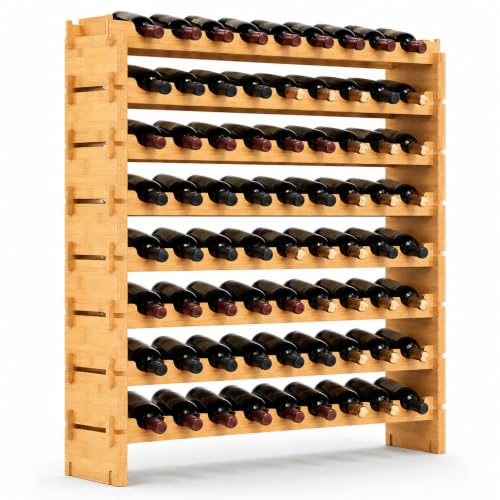
NutriChef 72 Bottle Stackable Bamboo Freestanding 8-Tier
This is the rack most cellar builders will actually use long-term. The 8-tier configuration reaches just over 41 inches tall, which means it fits under most cellar ceiling beams without requiring a custom shelf cut. Bamboo handles humidity better than pine or particleboard alternatives at this price, and the 2026 design revision tightened the inter-tier locking mechanism enough that full loads no longer flex laterally. Assembly requires no tools, and each tier snaps independently, so you can start with three tiers and add the rest as your collection grows. The 10-inch depth keeps it slim against a wall.
- Pro: Locking tiers eliminate the wobble that plagued earlier versions
- Pro: No-tool assembly means you can reconfigure in under two minutes
- Con: Bamboo finish will dull in consistently damp cellars without occasional oiling
Skip this if you need more than 72 bottles without buying a second unit.
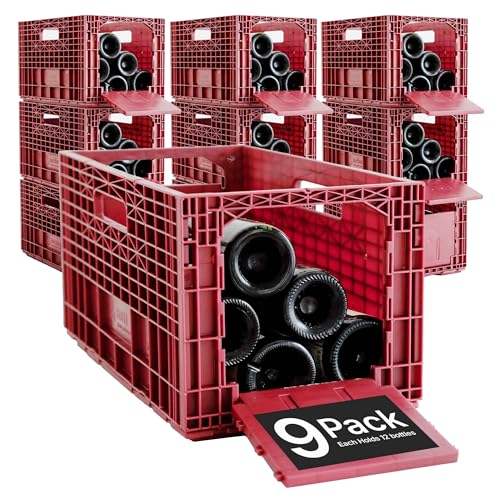
UOVO Wine Stackable Wine Rack for Cabinet 12-Bottle Crate Set of 9 Black
UOVO takes a different architectural approach: individual crates that fit inside existing cabinetry rather than freestanding shelves. Each 12-bottle crate has a solid base and walls that interlock with the one below, so nine crates give you 108 bottles in whatever cabinet dimensions you already own. The black finish resists moisture absorption, and the uniform footprint means you can arrange crates in L-shapes or columns to match your cabinet geometry. This is the answer for cellar owners who already built custom cabinets and want storage that respects the existing layout.
- Pro: Interlocks with cabinet dimensions instead of forcing your layout around it
- Pro: Each crate is independently portable for cleaning or rearranging
- Con: Highest cost-per-bottle in this roundup at nearly double the bamboo options
Skip this if you lack cabinet space or prefer freestanding flexibility.
NutriChef 108 Bottle Stackable Modular Wine Rack
The 108-bottle NutriChef earns its place by being the only unit here that exceeds 60 inches tall while maintaining under 10 inches of depth. The upgraded 1-inch sideboard and half-inch rack sticks create a noticeably stiffer structure than the 72-bottle sibling, which matters because height amplifies lateral flex. The protective moisture-resistant finish is a real step up from bare bamboo, addressing the most common complaint from cellar users in humid climates. You get more bottles per square foot of floor space than anything else in this group.
- Pro: Thickest structural members in the roundup, with measurable rigidity at full height
- Pro: Moisture-resistant finish holds up in cellar conditions without extra treatment
- Con: At 63 inches tall it may not clear low cellar beams or standard shelving
Skip this if ceiling height or beam clearance is under 65 inches.
DECOMIL 72 Bottle Stackable Modular Wine Rack Eight-Tier
DECOMIL occupies the same 72-bottle, 8-tier slot as the NutriChef but comes in pennies cheaper, which makes this a value-for-value comparison. Build quality is comparable: solid bamboo, wobble-free at full load, and a stacking system that relies on friction fit rather than mechanical locks. The difference shows in finishing detail—the DECOMIL edges are slightly less chamfered, and the bamboo has a more uniform pale tone that some will prefer aesthetically. Performance-wise, both handle a cellar environment adequately, and neither requires tools to assemble.
- Pro: Lowest price point for 72-bottle capacity with no-tool assembly
- Pro: Wobble-free performance matches racks costing twice as much
- Con: Friction-fit stacking has less positive lock than mechanical interlocks, so it shifts more during cleaning
Skip this if you plan to move or reconfigure tiers frequently.
NutriChef 36 Bottle Wine Rack Stackable Bamboo Freestanding 4-Tier
The entry point in NutriChef’s modular line. Four tiers at roughly 21 inches total height means this fits on a kitchen counter, under a bar cart, or inside a cabinet with a 24-inch opening. It is the same 33.5-inch width as the larger units, so if you start here and upgrade later, the footprint does not change—just add four more tiers. The construction is identical to the 8-tier version, including the tool-free assembly and locking connections. For a collection under 36 bottles, buying this instead of a larger unit and storing it half-empty makes practical sense.
- Pro: Expands cleanly to 72 bottles by adding the matching upper tiers
- Pro: Counter-height profile makes it usable outside a dedicated cellar
- Con: Feels sparse at only 36 bottles if your collection is already growing
Skip this if you know you will exceed 40 bottles within a year.
J.K. Adams Wood Modular Wine Rack Stackable 40 Bottles
J.K. Adams targets a buyer who wants visible wood quality rather than budget bamboo. The grain and joinery are noticeably more refined, and the rack has real heft—this is not something that slides when you pull a bottle out. The 40-bottle capacity sits between the 36 and 72 options, and the modular system uses a slot-and-tab stacking method that is secure once assembled but requires a bit more force than the NutriChef snap-fit. For a wine bar or a cellar you want to photograph, the aesthetic payoff justifies the premium over cheaper options.
- Pro: Wood quality and finish are visibly superior to bamboo alternatives
- Pro: Heavier construction means zero shifting during bottle access
- Con: Slot-and-tab assembly is fiddly and hard to reverse without damaging connections
Skip this if you want something you can disassemble and move without careful handling.
UOVO Wine Stackable Wine Rack for Cabinet 12-Bottle Crates Set 9 Burgundy
Functionally identical to the black UOVO set except for the burgundy finish, which adds visual warmth to a cellar or cabinet interior. If you are designing around a color scheme—or if the black version looks too industrial against your cabinetry—this is the same storage performance with a different aesthetic. The interlocking crate system, portability, and cabinet integration are unchanged. The burgundy tone also hides dust and minor water spotting better than black, a small but practical advantage in rarely-cleaned cellar cabinets.
- Pro: Burgundy finish conceals dust and water marks better than black
- Pro: Same proven interlocking crate system with full portability
- Con: No functional difference from the black version means you pay the same premium for color alone
Skip this if the black version matches your cabinet hardware better.
JAXPETY 24 Bottle Wine Rack Holder Compact Cellar Cube
The smallest unit here, designed for spaces where nothing else fits: under a bar, beside a refrigerator, or in a closet with limited floor area. At 24 bottles and a cube form factor, it is more display than storage, but the construction is solid wood with clean edges and no visible fasteners. The trade-off is expansion—this is a single unit with no modular pathway. If your collection grows past 24 bottles, you cannot stack another JAXPETY on top or add tiers. It solves one specific spatial problem well and nothing else.
- Pro: Cube footprint fits spaces that reject taller or deeper racks
- Pro: Solid wood construction feels premium relative to its size and price
- Con: No modular expansion path—what you buy is what you get permanently
Skip this if there is any chance your collection exceeds two dozen bottles.
Buying Guide
Stacking Mechanism Determines Long-Term Stability
Gravity-stacked racks rely on weight and friction, which degrades as bottles are removed and replaced unevenly. Look for positive-locking systems—tabs, clips, or interlocking profiles that physically prevent lateral shift. The difference is obvious within a month of daily use: locked tiers stay aligned, friction-fit tiers drift and eventually tip when you pull a bottle from an upper row. If a product does not describe its locking method, assume it is gravity-only.
Material Choice Must Match Your Cellar Environment
Bamboo resists warping better than pine in humid conditions because of its tighter grain structure, but it still benefits from a sealed or oiled finish in cellars above 70% relative humidity. Solid hardwoods like those in the J.K. Adams option are heavier and more dimensionally stable but cost more per bottle. Metal crates resist moisture entirely but can introduce vibration that disturbs sediment. Check your cellar’s humidity before choosing between sealed bamboo, bare wood, or polymer.
Capacity Planning Should Account for Bottle Diameter Variation
A rack rated for 72 bottles assumes standard 750ml Bordeaux-profile bottles at roughly 3-inch diameter. If your collection includes Burgundy, Champagne, or magnums, effective capacity drops by 15-25%. Always buy one tier above what you think you need, and verify that the rack stick diameter accommodates your widest bottles without forcing them. Modular systems let you add capacity later, but only if the base unit is structurally sound enough to support additional weight.
Our Verdict
The NutriChef 72 Bottle 8-Tier is our top pick: it balances locking stability, humidity resistance, no-tool reconfiguration, and expansion potential at a price that makes it the default choice for most cellar builders. For budget-conscious buyers who still need 72 bottles, the DECOMIL Eight-Tier delivers comparable stability for pennies less, with the only trade-off being a slightly less positive stacking lock. If your situation is cabinet-constrained rather than floor-constrained, the UOVO 9-crate set wins decisively because no freestanding rack can integrate into existing cabinetry the way those crates do.
FAQ
Can I mix different modular wine rack brands in one stack?
No. Interlocking dimensions, connector geometry, and load paths are proprietary to each system. Mixing brands creates uneven stacking that shifts under weight and risks tipping. Stick to one brand’s modular ecosystem and expand within it.
Do bamboo wine racks mold in cellars?
Untreated bamboo can develop surface mold in cellars above 75% relative humidity. A sealed or moisture-resistant finish like the one on the NutriChef 108-Bottle model significantly reduces this risk. In consistently damp environments, a quick wipe with a vinegar solution every few months prevents any growth.
How many bottles does a modular wine rack actually hold?
Manufacturer ratings assume standard 750ml Bordeaux bottles. Real-world capacity drops noticeably if your collection includes wider Burgundy profiles, Champagne bottles with thicker glass, or any oversized format. Plan for about 80% of the rated number as your practical ceiling.
Is freestanding better than cabinet-integrated for cellars?
Freestanding racks offer easier access and more flexible placement, but require dedicated floor space. Cabinet-integrated systems like UOVO crates maximize existing storage volume and protect bottles from light and dust. The right answer depends on whether your cellar has open floor area or mostly built-in cabinetry.