The best wood shelving unit for most rooms is a solid wood or plywood bookcase with fixed or well-supported adjustable shelves, 11 to 12 inches deep, and a wall anchor kit included. Shelf thickness and span decide whether it sags: aim for shelves at least 3/4 inch thick spanning no more than 30 to 32 inches between supports. Here is how to pick the right material, size and style for a living room, home office, kids’ room or entryway.
Our top picks
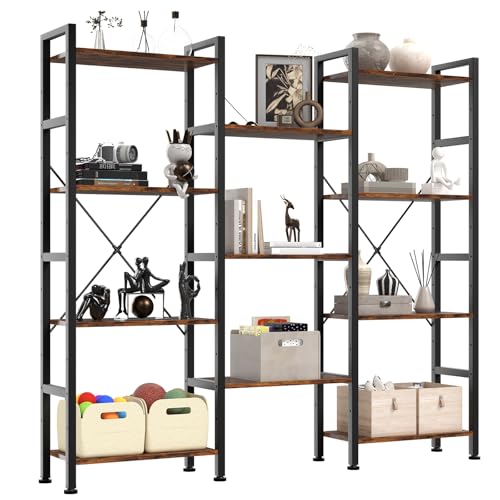
 NUMENN Bookshelf
- 5 Tier Open Multifunctional Bookshelf: This five shelf…
- Metal Frame Wooden Baffle: Constructed by premium metal…
- Elegant Modern Style: This bookshelf perfectly combines the…

As an Amazon Associate we earn from qualifying purchases at no extra cost to you.
Quick Picks by Room
- Living room display: Open bookcase, 72 inches tall, 30 to 36 inches wide, 5 shelves.
- Home office: 12 inch deep unit with at least one 14 inch-high shelf for binders and monitors.
- Small apartment: Narrow 24 inch wide ladder shelf that leans against the wall.
- Heavy book collection: Solid hardwood or plywood bookcase with a rated load per shelf.
- Kids’ room: Low unit under 36 inches tall, anchored to the wall.
- Budget: Solid pine bookcases, which are widely available and paintable.
Materials and Construction
| Material | Shelf load (30 inch span) | Pros | Cons |
|---|---|---|---|
| Solid hardwood (oak, maple, walnut) | Often 40 to 60 lb | Strongest, refinishable | Heavy, higher cost |
| Solid pine | About 25 to 40 lb | Affordable, light, paintable | Dents, may bow if thin |
| Hardwood plywood | About 30 to 50 lb | Stable, resists sagging | Visible edge unless banded |
| MDF or particleboard with veneer | About 15 to 25 lb | Cheapest, smooth finish | Sags, swells with moisture |
| Wood and metal hybrid | Varies | Slim profile, industrial look | Wood shelves still limit load |
These numbers are typical ranges, not guarantees. Always check the maker’s stated per-shelf capacity. A single full row of hardcover books can weigh 25 to 40 pounds per linear 30 inches.
Dimensions That Matter
- Depth: 11 to 12 inches fits paperbacks and most books; 14 to 16 inches suits storage bins and large decor.
- Shelf spacing: 10 to 12 inches for paperbacks, 12 to 14 for hardcovers and 14 or more for binders.
- Height: 72 inches is the standard tall option; 30 to 42 inches works as a low room divider or under windows.
- Back panel: A solid back adds rigidity. Open backs show off the wall but wobble more.
- Floor load: A fully loaded 72 inch bookcase can weigh well over 150 pounds, so it should sit flat on a level floor.
Style Choices
Standard bookcase
Best all-purpose design with fixed or adjustable shelves. Adjustable shelves let you resize storage; look for metal pins rather than plastic.
Ladder shelf
Leans against the wall at a slope. It uses little floor space at the base but is usually less stable and less suited to heavy loads.
Cube or grid shelf
Good for bins and baskets, and it can function as a room divider. Square cubes of 13 inches work with common fabric bins.
Floating or wall-mounted
Saves floor space but requires studs or proper anchors. Load depends entirely on wall fastening.
Assembly and Moving Realities
| Factor | What to expect |
|---|---|
| Box weight (72 inch bookcase) | About 50 to 100 pounds for engineered wood, more for solid wood |
| Assembly time | Roughly 1 to 2 hours; two people recommended |
| Doorway clearance | Flat-pack boxes are usually 12 to 16 inches wide, easy; assembled units may not fit through a 28 inch door when upright |
| Wall anchoring | Required for tall units; use a stud finder |
| What wears first | Cam locks and cheap pins on lightweight models |
Assemble the unit in the room where it will live, since fully built bookcases are awkward to carry. Check that the ceiling and baseboards leave enough space to tilt it upright.
Safety and Stability
- Anchor any unit over 30 inches tall to a wall stud, especially in homes with children or pets.
- Put heavier items on lower shelves.
- Do not exceed the stated shelf rating.
- Use shelf supports in the middle of long shelves if you see bowing.
Finish and Care
Dust with a dry microfiber cloth. Natural oil finishes can be renewed; painted or laminate finishes should only be wiped with a damp cloth. Keep units away from radiators and humid bathrooms, which can warp boards.
Mistakes to Avoid
- Choosing depth based on looks, then finding books overhang or bins do not fit.
- Skipping wall anchors.
- Assuming all wood-look units are solid wood.
- Overloading long spans of 36 inches or more with heavy books.
FAQ
How deep should a bookshelf be?
11 to 12 inches for books, 14 to 16 inches for baskets or decor.
How much weight can a wood shelf hold?
It depends on span and thickness. A 3/4 inch plywood shelf spanning 30 inches may hold around 30 to 50 pounds evenly spread.
Is solid wood better than veneer?
For heavy loads and longevity, yes. For light decor, veneer can be fine.
Do I need to anchor a short shelf?
Units under about 30 inches are lower risk, but anchoring is still wise around small children.
Planning Shelf Layout and Load
A shelf only works if the layout matches what goes on it. Measure the items first, then pick spacing and total width accordingly. The table gives common item sizes so you can plan.
| Item | Typical height | Typical depth | Shelf clearance needed |
|---|---|---|---|
| Paperback books | 7 to 8 inches | 5 inches | 9 to 10 inches |
| Hardcover books | 9 to 11 inches | 7 to 8 inches | 12 inches |
| Oversized art books | 12 to 16 inches | 10 to 12 inches | 16 inches |
| Storage bins (cube size) | 11 to 13 inches | 11 to 13 inches | 13 inches |
| Printer or small speaker | 8 to 12 inches | 10 to 14 inches | 14 inches |
Reducing sag
If a shelf has begun to curve, flip it so the bow faces upward, add a center support, or glue and screw a 1 by 2 inch strip along the front edge. A thicker shelf of 1 inch or more resists sagging far better than a thin one. Heavy items should sit near the vertical supports rather than at the center of a span.
Styling the unit
Mix books stacked vertically and horizontally, leave about a third of the surface empty, and place larger objects on lower shelves for visual balance. Matching baskets conceal cords and clutter. In a dining or living room, a back panel in contrasting paint adds depth without changing furniture.
Which Wood Shelving Unit Should You Buy?
Book lovers should choose solid hardwood or plywood with thick shelves. Renters and small spaces suit a 24 inch ladder or cube unit. Families with kids should favor a low, anchored bookcase. If budget matters, solid pine delivers the best value.
More from Amazon
Programs that pair well with the guide above. Offers and eligibility are set by Amazon and may change.
Collect the home and kitchen items you want in one registry that guests can shop from.
Create a wedding registrySet up recurring deliveries of everyday items on eligible products. Terms and savings are set by Amazon.
Explore Subscribe & SaveFree shipping on eligible items, Prime Video and more. Eligible new members can start with a free trial.
Start a Prime free trialAudiobooks and podcasts to listen to on the go. Eligible new members can start with a free trial.
Try Audible freeAs an Amazon Associate we earn from qualifying purchases.