Key takeaways
- Read the dBA figure critically: Decibels are logarithmic, so a 68 dBA unit is not “slightly louder” than a 60 dBA one — it releases roughly six times the sound energy. Manufacturer ratings are also measured at a set distance in open air; expect a few points higher in a reflective concrete garage.
- Match tank size to duty, not ambition: A larger tank means fewer motor starts, and motor starts are the loudest, most sleep-disruptive part of the cycle. For inflation and brad nailing, 1–2 gallons is plenty; for sanders, spray guns, or impact wrenches, look at 8–20 gallons.
- Prioritise CFM at 90 PSI: This is the only air-delivery number that predicts real tool performance. Peak horsepower claims are marketing; sustained CFM is engineering.
- Choose oil-free for low maintenance, and accept the trade: Oil-free pumps skip drain intervals and never leak onto a garage floor, but they wear faster under heavy continuous use. For weekend work, the convenience wins comfortably.
- Plan for vibration transfer: Structure-borne noise travels further than airborne noise. Set any compressor on a dense rubber mat, keep it off a shared wall, and if the garage sits beneath a bedroom, add a decoupling pad under the feet.
What's inside
Noise is not just an annoyance in a home garage — it is a physiological event. A conventional oil-lubricated compressor firing off at 90 dBA sends a pressure spike through shared walls, up the stairwell, and into the room where someone is trying to hold onto their last sleep cycle of the morning. As a sleep-wellness practitioner, I spend most of my week helping people quiet their bedrooms. Increasingly, the culprit is not traffic or a snoring partner but a workshop on the other side of a stud wall. Intermittent, unpredictable noise is the kind the nervous system refuses to habituate to, which is why a compressor that kicks on twice an hour can fragment rest even when the sleeper never fully wakes.
The encouraging news is that the quiet-compressor category has matured considerably. Brushless and low-RPM induction motors now deliver usable air at 60–68 dBA, roughly the level of an ordinary conversation, and oil-free pumps have closed most of the durability gap that once made them a compromise. This guide looks at the models worth your money in 2026, evaluated on measured noise, tank capacity, recovery speed, and how forgiving they are to run in a garage that shares structure with living space. Below you will find the current standouts, followed by a selection framework and answers to the questions I hear most often.
As an Amazon Associate we earn from qualifying purchases.



🛒 Best Price Today on Amazon
Prime members get fast, free shipping on everything above, plus member-only deals. New members get a 30-day free trial — cancel anytime.
How to Choose a Quiet Air Compressor For Home Garage (2026)
- Read the dBA figure critically: Decibels are logarithmic, so a 68 dBA unit is not “slightly louder” than a 60 dBA one — it releases roughly six times the sound energy. Manufacturer ratings are also measured at a set distance in open air; expect a few points higher in a reflective concrete garage.
- Match tank size to duty, not ambition: A larger tank means fewer motor starts, and motor starts are the loudest, most sleep-disruptive part of the cycle. For inflation and brad nailing, 1–2 gallons is plenty; for sanders, spray guns, or impact wrenches, look at 8–20 gallons.
- Prioritise CFM at 90 PSI: This is the only air-delivery number that predicts real tool performance. Peak horsepower claims are marketing; sustained CFM is engineering.
- Choose oil-free for low maintenance, and accept the trade: Oil-free pumps skip drain intervals and never leak onto a garage floor, but they wear faster under heavy continuous use. For weekend work, the convenience wins comfortably.
- Plan for vibration transfer: Structure-borne noise travels further than airborne noise. Set any compressor on a dense rubber mat, keep it off a shared wall, and if the garage sits beneath a bedroom, add a decoupling pad under the feet.
The Best Quiet Air Compressor For Home Garage (2026)s Reviewed
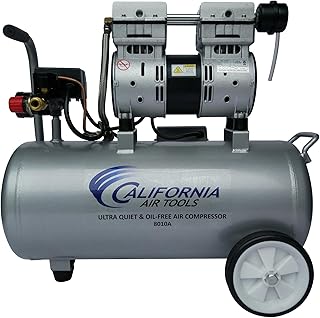
California Air Tools 8010A
The 8-gallon aluminium-tank 8010A remains the reference point for genuinely low-noise operation, holding a measured 60 dBA thanks to a slow-turning 1.0 HP motor that avoids the sharp high-frequency content our ears find most intrusive. It fills more slowly than higher-horsepower rivals, but that gentler ramp is precisely what makes it tolerable near occupied rooms.
Stealth 20 Gallon Ultra Quiet
At 68 dBA this is the loudest unit I would still call neighbour-friendly, and the 20-gallon reservoir with 5 CFM at 90 PSI earns the compromise by keeping the motor idle for long stretches between cycles. It is the sensible choice if you run air tools that would leave a smaller compressor running almost continuously.
Klutch 20-Gallon
The Klutch pairs a 175 PSI ceiling and 75% duty cycle with a vertical footprint that fits alongside a workbench rather than in front of it. Recovery is quick and the tank drain is genuinely accessible — a small detail that determines whether you actually maintain the machine.
Stealth 2 Gallon (SAQ-1234)
Under 60 dB and small enough to carry one-handed, this 3/4 HP model is the one I recommend for apartment-attached garages and late-evening projects. It handles tyre inflation and finish nailing without complaint; ask it to feed a sander and it will disappoint you.
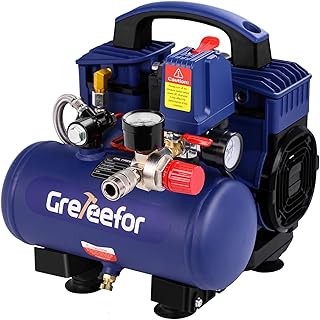
1 Gallon Ultra Quiet Portable (60 dB)
A 13-second fill from a 1.5 HP oil-free pump makes this compact unit surprisingly practical for quick jobs where hauling out a larger tank is not worth the effort. Consider it a supplement to a shop compressor rather than a replacement.
Frequently Asked Questions
Is 60 dBA really quiet enough to run near a bedroom?
It is quiet enough not to wake most adults through a closed door and an insulated wall, but it can still cause micro-arousals in light sleepers. If someone is sleeping directly above the garage, keep work to waking hours regardless of the rating.
Do oil-free compressors last long enough to justify buying one?
For typical home use — a few hours a month — yes. The wear differential only becomes meaningful under near-continuous professional duty cycles.
Will a 20-gallon tank make the noise problem worse?
Usually the opposite. A larger tank cycles less often, and fewer motor starts mean fewer of the abrupt onsets that disturb sleep and concentration.
What can I do to reduce noise beyond buying a quieter model?
Isolate the feet on rubber, position the unit away from shared walls, add an inline muffler on the pressure-relief outlet, and use a longer hose so you can shut the compressor in a corner while you work.
Final Thoughts
For most home garages sharing a wall with living space, the California Air Tools 8010A is still the model I point people toward first — 60 dBA and 8 gallons is a genuinely liveable combination. If your tool list is more demanding, the Stealth 20 Gallon buys you real air delivery for a modest noise penalty, while the Stealth 2 Gallon is the pick for anyone working in the evening who would rather not explain themselves in the morning.