Key takeaways
- Pressure rating with headroom: Match or exceed your machine’s maximum PSI, then add a margin. A 3,100 PSI hose is fine for most electric and entry gas units, but if your washer is rated near 3,000 PSI, stepping up to a 4,000–4,200 PSI hose buys you a real safety and longevity buffer, especially as fittings age.
- Inner diameter matches your machine: Most residential washers use 1/4″ hose. Step up to 3/8″ only for higher-flow gas units or long runs, where the wider bore reduces pressure loss. Oversizing on a small electric machine adds weight and stiffness without any performance gain.
- Jacket material and flexibility: Steel-braided rubber resists abrasion and stays supple in cold weather; polyurethane hybrids like Flexzilla are lighter and lie flat without memory coils. Cheap PVC is the stuff you’re replacing — it hardens, kinks, and takes a permanent bend.
- Fittings you can actually connect: M22 threaded ends come in 14mm and 15mm inner-diameter versions, and they are not interchangeable. Check your washer and wand before buying, and favor kits that include quick-connect adapters or solid brass ends over plated zinc.
- Length versus manageability: Fifty feet covers most homes without repositioning the unit. One hundred feet is genuinely useful for two-story siding, long driveways, and fence lines, but expect meaningful pressure drop on 1/4″ line and plan on coiling discipline to avoid tangles.
What's inside
Most people blame the machine when a pressure washing session turns into a wrestling match. In reality, the pump is usually fine — it’s the hose that’s fighting you. The stiff, coiled length of vinyl that shipped in the box takes a set in cold weather, snags on every planter and downspout, and folds into a kink the moment you step around a corner. Flow stutters, the wand pulses, and a job that should take forty minutes stretches into a sweaty afternoon of tugging and re-straightening. A driveway or deck should be a quiet, satisfying Saturday task — the kind you finish feeling accomplished rather than wrung out and sore that night.
Upgrading the hose is the single cheapest way to make a pressure washer feel like a better machine. This guide covers what actually matters when choosing a replacement or extension hose in 2026 — pressure ratings, inner diameter, jacket material, fitting standards, and length trade-offs — and then reviews the models that consistently hold up to real homeowner and light-commercial use. Whether you need a limp, cold-tolerant 50-footer for a compact electric unit or 100 feet of steel-braided line for a gas machine, there’s a right answer below.
As an Amazon Associate we earn from qualifying purchases.


🛒 Best Price Today on Amazon
Prime members get fast, free shipping on everything above, plus member-only deals. New members get a 30-day free trial — cancel anytime.
How to Choose a/an Pressure Washer Hoses (2026)
- Pressure rating with headroom: Match or exceed your machine’s maximum PSI, then add a margin. A 3,100 PSI hose is fine for most electric and entry gas units, but if your washer is rated near 3,000 PSI, stepping up to a 4,000–4,200 PSI hose buys you a real safety and longevity buffer, especially as fittings age.
- Inner diameter matches your machine: Most residential washers use 1/4″ hose. Step up to 3/8″ only for higher-flow gas units or long runs, where the wider bore reduces pressure loss. Oversizing on a small electric machine adds weight and stiffness without any performance gain.
- Jacket material and flexibility: Steel-braided rubber resists abrasion and stays supple in cold weather; polyurethane hybrids like Flexzilla are lighter and lie flat without memory coils. Cheap PVC is the stuff you’re replacing — it hardens, kinks, and takes a permanent bend.
- Fittings you can actually connect: M22 threaded ends come in 14mm and 15mm inner-diameter versions, and they are not interchangeable. Check your washer and wand before buying, and favor kits that include quick-connect adapters or solid brass ends over plated zinc.
- Length versus manageability: Fifty feet covers most homes without repositioning the unit. One hundred feet is genuinely useful for two-story siding, long driveways, and fence lines, but expect meaningful pressure drop on 1/4″ line and plan on coiling discipline to avoid tangles.
The Best Pressure Washer Hoses (2026)s Reviewed
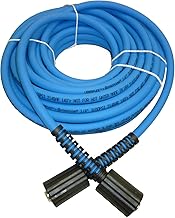
UBERFLEX Kink Resistant Hose, 1/4″ x 50 ft.
The UBERFLEX is the flexibility benchmark — it drapes rather than coils, so it follows you around obstacles instead of dragging planters along. Made in the USA with two 22mm fittings included, it’s the pick for anyone whose main complaint is fighting the hose rather than lacking pressure.
YAMATIC 3/8 in. Hose, 4000 PSI, 50 ft.
Built for higher-flow gas machines, this steel-braided rubber hose handles water from 15°F to 212°F, which matters if you run hot-water detergent cycles or wash in winter. The 360° swivel quick connect is the standout feature, eliminating the twist that slowly strangles a fixed-fitting hose.
100 ft. Steel Braid Hose, 4200 PSI, 3/8″ QC
A commercial-grade extension for people covering serious ground — second-story siding, long fences, RV roofs — with an adapter set that bridges 3/8″ and 1/4″ connections. The steel braid keeps it from ballooning under pressure, though at 100 feet you’ll want a reel or a disciplined coiling habit.
Flexzilla Replacement Hose, 1/4″ x 50 ft., 3100 PSI
Flexzilla’s hybrid polymer jacket has essentially no coil memory, so it lies flat straight out of storage and stays pliable in the cold. It’s the lightest of the 50-footers here and the easiest to recommend to someone with wrist or shoulder issues; the M22 fittings fit most consumer washers directly.
YAMATIC 50 ft. 1/4″ Hose, 3200 PSI, M22-14mm
This is the sensible one-for-one upgrade for Ryobi, Greenworks, Troy-Bilt, and Craftsman electric units, with solid brass M22-14mm female ends that seal reliably and resist stripping. Kink resistance is good rather than exceptional, but the value is hard to argue with.
Frequently Asked Questions
Can I use a longer hose without losing pressure?
Some loss is unavoidable, but it’s modest. Doubling from 50 to 100 feet of 1/4″ hose typically costs a small percentage of working pressure — noticeable on delicate rinsing, rarely on concrete. Moving to 3/8″ bore minimizes the drop on longer runs.
How do I tell 14mm from 15mm M22 fittings?
Look at the inner opening of the female end. The 14mm version has a narrower hole and a visible internal shoulder; 15mm is wider and common on many gas washers. Adapters exist, but buying the correct size avoids leaks.
Will a hot-water-rated hose help with a cold-water machine?
Indirectly, yes. Higher temperature ratings usually indicate better rubber compounds and reinforcement, which translate into longer service life and better cold-weather flexibility even if you never run hot water.
How should I store a pressure washer hose?
Drain it, coil it loosely in wide loops, and keep it out of direct sun and freezing garages when possible. Tight figure-eight cramming is what creates permanent kinks and eventual jacket cracks.
Final Thoughts
For most homeowners, the UBERFLEX 50-foot hose is the upgrade that changes how the whole job feels, with the Flexzilla 1/4″ x 50 ft. running a close second if lightweight handling and cold-weather flexibility top your list. If you’re running a gas machine or covering long distances, the YAMATIC 3/8″ 4000 PSI hose delivers the flow and durability the bigger pumps deserve.