Key takeaways
- Pressure ceiling, not peak numbers: Softwoods like pine and cedar start furring and etching above roughly 1,500 PSI, and composite boards have their own manufacturer limits. A machine rated far higher is fine — you simply throttle down with a wider nozzle and more distance — but never assume the biggest number is the best deck number.
- Nozzle range over raw force: A 25° and 40° tip will do nearly all of your decking work; the 0° pencil jet has no business touching wood. Kits with four or five quick-connect tips give you the range to move from deck boards to railing hardware to the concrete pad below.
- Flow rate for rinse speed: GPM determines how fast you clear loosened grime, and on a large deck it matters more to your finish time than PSI does. Around 1.7–1.8 GPM is comfortable for electric units; 3.5+ GPM is genuinely faster on big jobs.
- Noise and timing: Gas engines run loud enough to carry across several properties, so schedule them mid-morning to late afternoon and skip early weekend starts. Electric units are quiet enough to use without disturbing a sleeping household — a real consideration if you have shift workers or young children.
- Detergent delivery and stability: An onboard soap tank or foam cannon lets a wood-safe cleaner dwell on algae before you rinse, which is what protects the board surface. Four-wheel or anti-tipping bases matter more than they sound: a unit that topples mid-pass while you’re on a wet deck is a fall risk.
What's inside
Most people think of a deck as a place to eat, entertain, or grow tomatoes in pots. As someone who spends their working life on sleep behavior, I think of it as one of the most underused sleep tools a house has: a defined outdoor space where you can catch morning light, wind down at dusk without a screen, and let your body clock take its cues from the sky instead of a ceiling fixture. The trouble is that a deck coated in green algae film, pollen crust, and last winter’s tannin stains doesn’t invite anyone outside. It gets slippery, it looks neglected, and the wind-down ritual quietly stops happening.
This guide is about the tool that fixes that faster than any scrub brush: the pressure washer. Below I’ve broken down what actually matters when you’re cleaning softwood, hardwood, or composite decking — where too much pressure does permanent damage — plus how to think about noise, timing, and runtime so your Saturday cleanup doesn’t wreck your neighbor’s nap or your own evening. Then I review five machines worth your money in 2026, from lightweight electric units to a commercial-grade gas model for large multi-level decks.
As an Amazon Associate we earn from qualifying purchases.




🛒 Best Price Today on Amazon
Prime members get fast, free shipping on everything above, plus member-only deals. New members get a 30-day free trial — cancel anytime.
How to Choose a/an Pressure Washer For Deck Cleaning (2026)
- Pressure ceiling, not peak numbers: Softwoods like pine and cedar start furring and etching above roughly 1,500 PSI, and composite boards have their own manufacturer limits. A machine rated far higher is fine — you simply throttle down with a wider nozzle and more distance — but never assume the biggest number is the best deck number.
- Nozzle range over raw force: A 25° and 40° tip will do nearly all of your decking work; the 0° pencil jet has no business touching wood. Kits with four or five quick-connect tips give you the range to move from deck boards to railing hardware to the concrete pad below.
- Flow rate for rinse speed: GPM determines how fast you clear loosened grime, and on a large deck it matters more to your finish time than PSI does. Around 1.7–1.8 GPM is comfortable for electric units; 3.5+ GPM is genuinely faster on big jobs.
- Noise and timing: Gas engines run loud enough to carry across several properties, so schedule them mid-morning to late afternoon and skip early weekend starts. Electric units are quiet enough to use without disturbing a sleeping household — a real consideration if you have shift workers or young children.
- Detergent delivery and stability: An onboard soap tank or foam cannon lets a wood-safe cleaner dwell on algae before you rinse, which is what protects the board surface. Four-wheel or anti-tipping bases matter more than they sound: a unit that topples mid-pass while you’re on a wet deck is a fall risk.
The Best Pressure Washer For Deck Cleaning (2026)s Reviewed
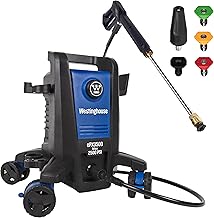
Westinghouse ePX3500
The most complete electric pick here for deck work: 2,500 max PSI with 1.76 GPM gives you real cleaning authority while remaining easy to dial back with a 40° tip, and the onboard soap tank plus pro-style steel wand make dwell-and-rinse cycles straightforward. Anti-tipping construction and quiet operation mean you can run it early without waking anyone.
AIVOLT 4800PSI Electric Pressure Washer
An unusually powerful electric unit with a four-wheel anti-tipping base, foam cannon, and generous 36ft cable and 25ft hose — the reach alone saves constant repositioning on a wraparound deck. Treat its top-end rating as headroom for concrete and siding, and stay on the wider nozzles for wood.
4200PSI Gas Pressure Washer, 212CC
With 4.0 GPM and a 32ft hose, this is the machine for large, badly weathered, or multi-level decks where electric units start to feel slow. It’s loud and heavier to maneuver, so plan your session for daytime hours and keep a light hand on the trigger over softwood.
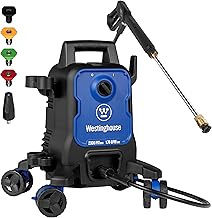
Westinghouse ePX3100
Effectively the ePX3500’s sensible sibling at 2,300 max PSI and the same 1.76 GPM, with the identical five-nozzle set, soap tank, and anti-tipping base. For an average 300–400 sq ft deck, most people will never notice the pressure difference.
Westinghouse ePX3100v
At 2,100 max PSI with a built-in carry handle and detachable foam cannon, this is the grab-and-go option for small decks, balconies, and railings. The three-nozzle set is lean but includes what deck cleaning actually requires.
Frequently Asked Questions
What PSI is safe for a wood deck?
Aim for roughly 500–1,200 PSI on softwoods and up to about 1,500 on hardwoods, controlled with a 25° or 40° nozzle held 12–18 inches away. Test an inconspicuous board first and keep the wand moving with the grain.
Can I pressure wash composite decking?
Usually yes, but check your manufacturer’s limit — many cap it near 1,500 PSI and void warranty coverage above that. Use a wide fan tip, low pressure, and a composite-safe cleaner rather than force.
Electric or gas for deck cleaning?
Electric is the better default: quieter, lighter, no fumes, and more than enough pressure for wood. Choose gas only if you’re cleaning very large areas or combining deck work with driveways and masonry.
Does washing at night make sense in hot climates?
Late afternoon or early evening avoids fast-drying streaks, but I’d stop well before bedtime. Vigorous physical work and bright work lights in the last hour or two before sleep push back your wind-down and make it harder to fall asleep.
Final Thoughts
For most homeowners restoring a deck into a genuinely inviting evening space, the Westinghouse ePX3500 is the pick I’d hand over first — enough pressure, the right nozzles, a soap tank, and quiet enough for any hour of the day. Step down to the ePX3100 if your deck is modest, or reach for the AIVOLT 4800PSI unit when you want extra hose reach and headroom for concrete and siding on the same afternoon.