The best portable field recorders for music are the Zoom H6essential for flexible multitrack recording, the Tascam Portacapture X8 for the strongest all-round microphone and input package, and the Sony PCM-D10 for exceptionally clean stereo recordings.
For musicians, the important differences are not just brand names or maximum sample rate. Microphone quality, input count, preamp noise, bit depth, battery life, storage, and physical size determine whether a recorder suits a solo rehearsal, acoustic concert, band demo, or home-studio session. The table below compares the most useful choices by recording situation.
Our top picks
 Zoom F3 Professional Field Recorder for Filmmakers
- The Zoom F3 is built for real-world recording…
- Capture everything from quiet dialogue to sudden peaks…
- Dual locking XLR inputs keep connections secure when…
 Zoom H1essential 2-Track 32-Bit Float Portable Audio
- THE WORLD’S EASIEST RECORDER: With the push of…
- With 32-bit float recording, you never have to…
- The Essential Series was designed with Accessibility for…
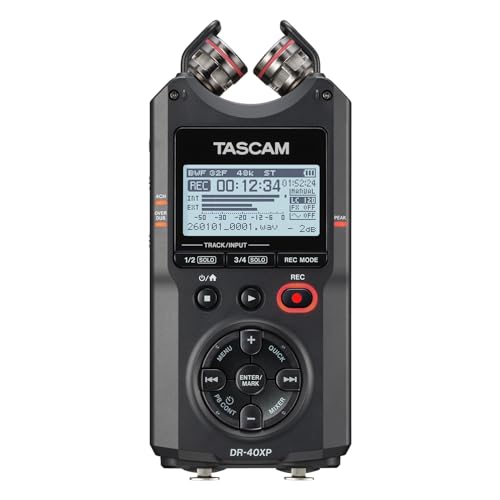 TASCAM DR-40XP 4-Channel 32-Bit Float Portable Handheld
- Built for musicians and creators, the DR-40XP is…
- Adjustable A-B or X-Y unidirectional condenser microphones handle…
- 4-channel recording lets you capture the built-in microphones…
| Product | Key specs | |
|---|---|---|
| Zoom F3 Professional Field Recorder for Filmmakers | The Zoom F3 is built for real-world recording… Capture everything from quiet dialogue to sudden peaks… Dual locking XLR inputs keep connections secure when… | Check price |
| Zoom H1essential 2-Track 32-Bit Float Portable Audio | THE WORLD’S EASIEST RECORDER: With the push of… With 32-bit float recording, you never have to… The Essential Series was designed with Accessibility for… | Check price |
| TASCAM DR-40XP 4-Channel 32-Bit Float Portable Handheld | Built for musicians and creators, the DR-40XP is… Adjustable A-B or X-Y unidirectional condenser microphones handle… 4-channel recording lets you capture the built-in microphones… | Check price |
 Xvive XV1-R Portable Stereo Audio Recorder with Xvive XV1-R Portable Stereo Audio Recorder with | Stereo 32-bit Float Recording: Supports 32-bit float recording,… High-Quality X/Y Microphones: Equipped with X/Y directional microphones… High Sample Rate Recording: Supports up to 96… | Check price |
As an Amazon Associate we earn from qualifying purchases at no extra cost to you.
Best portable field recorders for music at a glance
| Recorder | Best for | Microphones and inputs | Recording format | Approximate battery life | Approximate weight |
|---|---|---|---|---|---|
| Zoom H6essential | Bands, ensembles, and multitrack demos | Interchangeable stereo mic capsule plus 4 XLR/TRS inputs | 32-bit float, up to 96 kHz | About 18 hours with AA batteries, depending on use | About 381 g without batteries |
| Tascam Portacapture X8 | High-quality stereo and small ensemble recording | Built-in adjustable stereo microphones plus 4 XLR/TRS inputs | 32-bit float, up to 192 kHz | About 11–15 hours with AA batteries, depending on phantom power | About 472 g without batteries |
| Zoom H5essential | Solo musicians and compact overdub setups | Interchangeable stereo mic capsule plus 2 XLR/TRS inputs | 32-bit float, up to 96 kHz | About 15–18 hours with AA batteries | About 310 g without batteries |
| Sony PCM-D10 | Clean stereo recording and classical or acoustic music | Built-in adjustable stereo microphones plus 2 combo inputs | Up to 24-bit/192 kHz | About 15 hours with four AA batteries during high-quality recording | About 480 g with batteries |
| Zoom H1essential | Song ideas, rehearsals, and pocket portability | Fixed stereo microphones and 3.5 mm microphone input | 32-bit float, up to 96 kHz | About 10–11 hours with two AAA batteries | About 92 g without batteries |
Battery figures are manufacturer estimates and can drop substantially when phantom-powered microphones, headphones, high screen brightness, or USB features are used. Carry spare batteries or a compatible power bank for important sessions.
Head-to-head: which recorder fits your music?
Zoom H6essential: the most versatile band recorder
The H6essential is the strongest choice when several musicians must be recorded at once. Its four XLR/TRS inputs can accept microphones or line-level sources, while the interchangeable stereo capsule handles room ambience, rehearsals, or a quick live recording. Four separate inputs let you record a vocal, guitar, bass, and keyboard feed independently rather than committing to one stereo mix.
Its 32-bit float recording gives more practical protection against unexpected peaks than conventional 24-bit recording. It does not make a badly placed microphone sound good, and it cannot repair clipping in an analog preamp, but it reduces the need to set an exact recording level before a performance. The H6essential is a good fit beside a desk or in a compact home studio because it offers substantial routing flexibility without the size of a rack recorder.
Tascam Portacapture X8: best microphone and input package
The Portacapture X8 is the premium pick for musicians who want capable built-in microphones and four external inputs in one unit. Its adjustable stereo microphones can be positioned for a narrower or wider stereo image, which is useful when recording a piano, drum kit, acoustic ensemble, or room sound.
The large touchscreen makes multitrack setup easier than on many button-driven recorders. It records 32-bit float audio and supports sample rates up to 192 kHz, although 44.1 or 48 kHz is usually sufficient for music production and conserves storage. The X8 is physically larger and heavier than the H5essential, so it is better for a bag-based setup than a pocket.
Zoom H5essential: the sensible compact multitrack option
The H5essential suits a singer-songwriter, small acoustic duo, or musician who wants two external microphone inputs without carrying a larger recorder. Its capsule system allows the built-in stereo microphone arrangement to be replaced with another compatible Zoom capsule, giving it more flexibility than a fixed-microphone pocket recorder.
Two XLR/TRS inputs are enough for a stereo pair, vocal and guitar, or two close microphones. They are not enough for a full drum kit or a four-piece band unless some instruments are mixed before reaching the recorder. Choose the H5essential over the H6essential when size and cost matter more than input count.
Sony PCM-D10: best for quiet, detailed stereo capture
The PCM-D10 uses a conventional 24-bit recording workflow rather than 32-bit float. Its preamps are valued for low noise, and its built-in microphones provide a detailed stereo image for acoustic music, concerts, nature ambiences, and room recordings. For a careful engineer who monitors levels and leaves sensible headroom, 24-bit recording remains entirely capable of professional results.
The recorder is longer and heavier than the Zoom H-series alternatives, but that extra size accommodates a robust control layout, a large display, and four AA batteries. It is particularly appealing when the recording is primarily stereo and microphone self-noise matters more than having four independent tracks.
Zoom H1essential: best when you will actually carry it
The H1essential is the easiest recorder to keep in a coat pocket or instrument case. Its fixed stereo microphones are suitable for rehearsals, lessons, songwriting ideas, and quick room recordings. It has no XLR inputs and cannot provide phantom power, so it is not a substitute for a full multitrack recorder.
Its value is availability: a recorder that is always with you can capture more useful performances than a larger model left at home. Use a small tripod or place it on a stable table rather than holding it, because handling noise can overwhelm a quiet acoustic recording.
How the key specifications affect musical results
Microphone quality
Built-in microphones are convenient, but placement usually matters more than a modest difference in capsule specification. Place a recorder roughly 1–2 metres from an acoustic ensemble for a balanced room sound, then move closer if the room is too reverberant. A fixed stereo recorder such as the H1essential is quick; adjustable microphones on the X8 give more control over stereo width.
Input count
Count the sources you need to record independently, then add one spare input if possible. A solo vocalist with a guitar may need two inputs. A drum kit can consume four or more, and a band may need one input per microphone or a feed from an external mixer. Remember that a stereo capsule does not always equal two independently positionable external microphones.
Preamp noise and headroom
Preamp noise becomes more noticeable with quiet sources, distant microphones, ribbon microphones, and large amounts of gain. The Sony PCM-D10 is a strong stereo choice for low-noise recording, while the H5essential and H6essential are more attractive when input flexibility is the priority. Keep microphones as close as the musical balance allows; distance often adds more noise than the recorder itself.
Bit depth: 32-bit float versus 24-bit
32-bit float is useful for unpredictable volume, such as a rehearsal that may suddenly become loud. It provides generous digital headroom after recording, but microphone distortion or an overloaded analog input cannot be undone. A 24-bit recorder such as the PCM-D10 works well when levels are checked and peaks are kept below clipping. Do not select a recorder solely because its box lists a higher bit depth.
Storage and file management
Most of these recorders use removable microSD or SD media. A 32-bit float stereo file at 48 kHz uses roughly 1.3 GB per hour; four mono tracks use about 2.6 GB per hour. Higher sample rates and additional tracks consume space quickly. A 64 GB card is ample for many sessions, while 128 GB provides more room for multitrack work. Format the card in the recorder and maintain a second copy of important recordings.
A decision matrix for common recording situations
| Your situation | Best fit | Why | Main compromise |
|---|---|---|---|
| Solo singer-songwriter in a small apartment | Zoom H5essential | Two external inputs, interchangeable stereo capsule, manageable size | Limited for future full-band sessions |
| Four-source band demo | Zoom H6essential | Four XLR/TRS inputs and 32-bit float recording | Larger than pocket recorders |
| Acoustic ensemble or piano in a good room | Tascam Portacapture X8 | Adjustable stereo microphones and detailed touchscreen control | Heavier and more expensive |
| Quiet classical or acoustic stereo recording | Sony PCM-D10 | Low-noise preamps and high-quality built-in stereo microphones | No 32-bit float workflow |
| Rehearsal notes and songwriting ideas | Zoom H1essential | Very light, inexpensive, and quick to operate | No XLR inputs or phantom power |
Practical placement and portability advice
Use a small stand or tripod whenever possible. A recorder placed on a resonant desk can pick up tapping, chair movement, and low-frequency vibration; a folded cloth or isolation mount helps, though it should not block the microphones. Leave roughly 30–60 cm of clearance from a wall when recording a room or ensemble to reduce strong early reflections, and avoid placing the recorder directly beside a hard table edge.
For transport, measure the recorder, windscreen, batteries, stand, and cables as one kit. A larger model such as the X8 or PCM-D10 needs a dedicated compartment, while the H1essential can fit with a notebook and instrument accessories. Keep the recorder away from loose metal objects and use a foam windscreen outdoors. The first accessories worth buying are a stand, wind protection, spare batteries, and a reliable memory card—not an unnecessarily expensive cable.
What these recorders usually cost
In 2026, pocket stereo recorders such as the Zoom H1essential usually cost about $100–$150. Compact two-input models such as the Zoom H5essential are commonly around $200–$300. Four-input recorders such as the Zoom H6essential generally fall near $300–$400, while the Tascam Portacapture X8 is usually about $450–$550. The Sony PCM-D10 commonly sits around $400–$550, depending on availability and included accessories.
For most musicians, choose the H5essential if you need two microphones, the H6essential if you need four independent sources, the X8 if built-in microphone quality and touchscreen operation lead your priorities, and the PCM-D10 if clean stereo recording is more important than 32-bit float convenience.