Key takeaways
- Scent timing: Some vines release fragrance on a schedule. Jasmine intensifies after sundown, which makes it ideal if your pergola is an evening space; heavier daytime bloomers may go unnoticed if you only sit outside after work.
- Mature load: A wisteria at ten years can twist a cedar beam out of true. Check your pergola’s post size and joinery before committing to a woody, heavy climber, and reinforce if you’re working with a lightweight kit.
- Seeds versus live plants: Seeds are inexpensive and satisfying, but wisteria grown from seed can take seven to fifteen years to flower. Live rooted plants shorten that wait dramatically — pay for the head start if you want blooms this decade.
- Shade density you actually want: Dappled light beats a solid canopy. Full shade traps humidity and encourages mildew on the frame; aim for a vine that filters light rather than one that blocks it entirely.
- Climate honesty: Match hardiness zones rather than hoping. Tropical climbers will grow beautifully as annuals or container plants in cooler regions, but they won’t return, and replanting every spring gets old fast.
What's inside
As a sleep-wellness practitioner, I spend most of my time talking about mattresses, light exposure, and evening wind-down routines — and almost none of it about gardening. That changed once I started asking clients where they actually relax before bed. The answer, over and over, was outside: a back patio, a covered deck, a pergola with a bare frame and nothing overhead but the neighbour’s floodlight. The problem is that most people build the structure and then stall. They want dappled shade, evening fragrance, and a sense of enclosure, but the plant aisle is full of vines that either strangle the frame or sulk for three seasons and never bloom.
This guide approaches pergola planting the way I approach a bedroom: as a sensory environment that either supports rest or quietly undermines it. Below you’ll find the climbers worth your money in 2026, chosen for scent profile, growth speed, structural weight, and how well they perform in the hours that matter most — dusk through nightfall. I’ve also included a selection framework so you can match a vine to your climate and your frame rather than to a photograph.
As an Amazon Associate we earn from qualifying purchases.


🛒 Best Price Today on Amazon
Prime members get fast, free shipping on everything above, plus member-only deals. New members get a 30-day free trial — cancel anytime.
How to Choose a/an Pergola Plants (2026)
- Scent timing: Some vines release fragrance on a schedule. Jasmine intensifies after sundown, which makes it ideal if your pergola is an evening space; heavier daytime bloomers may go unnoticed if you only sit outside after work.
- Mature load: A wisteria at ten years can twist a cedar beam out of true. Check your pergola’s post size and joinery before committing to a woody, heavy climber, and reinforce if you’re working with a lightweight kit.
- Seeds versus live plants: Seeds are inexpensive and satisfying, but wisteria grown from seed can take seven to fifteen years to flower. Live rooted plants shorten that wait dramatically — pay for the head start if you want blooms this decade.
- Shade density you actually want: Dappled light beats a solid canopy. Full shade traps humidity and encourages mildew on the frame; aim for a vine that filters light rather than one that blocks it entirely.
- Climate honesty: Match hardiness zones rather than hoping. Tropical climbers will grow beautifully as annuals or container plants in cooler regions, but they won’t return, and replanting every spring gets old fast.
The Best Pergola Plants (2026)s Reviewed
410 Climbing Jasmine Seeds — Fragrant White Flowering Vine
If your pergola is primarily an evening retreat, this is where I’d start: jasmine’s scent peaks precisely when you’re winding down, and the association between a consistent fragrance and sleep onset is genuinely useful as a wind-down cue. The seed count is generous enough to allow for germination losses, and the evergreen habit means the frame doesn’t look skeletal in winter.
Thunbergia Grandiflora — Blue Trumpet Vine, Pack of 2
Sky vine is the fastest route to real coverage I know of, throwing out large sky-blue trumpets on a vigorous frame within a single warm season. Fragrance is minimal, so treat this as your privacy-and-shade workhorse rather than your scent plant, and be prepared to prune assertively.
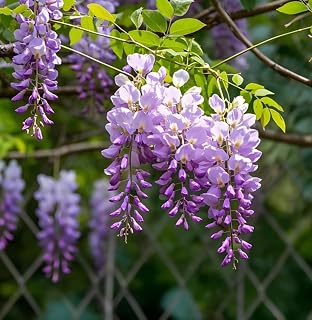
3 Wisteria Live Plants (1–2 Ft, Wisteria Floribunda)
Three rooted starts give you enough material to train across a full pergola span, and Japanese wisteria’s long flower racemes produce that hanging-curtain effect people picture when they imagine a pergola. Buy live rather than seed if flowering timeline matters, and commit to twice-yearly pruning from year one.
Wisteria Seeds — 20 Heirloom Non-GMO
A rewarding project for patient gardeners and an excellent value for bonsai training, where the flowering delay is beside the point. I wouldn’t rely on these as your only pergola planting; run them alongside a faster climber so the structure isn’t bare while you wait.
2 Wisteria Live Plants (1–2 Ft, Wisteria Floribunda)
The two-plant pack suits smaller pergolas, single-post training, or gardeners who want to test wisteria’s vigour before scaling up. Same quality and head start as the larger pack, with less risk of overwhelming a compact frame.
Frequently Asked Questions
Does fragrance from a vine really affect sleep?
Not as a sedative. What it does reliably is act as a conditioned cue — a consistent scent tied to a consistent wind-down routine helps the body anticipate sleep. Jasmine is a good candidate simply because it’s most fragrant at night.
Will wisteria damage my pergola?
It can, over time. Mature wisteria develops thick woody stems that exert real force on timber. Use substantial posts, avoid letting stems wrap load-bearing joints, and prune twice a year to control mass.
How long until I get meaningful shade?
Thunbergia can cover a modest pergola in one to two seasons. Jasmine typically takes two to three. Wisteria from live plants gives structure quickly but flowers later; from seed, expect a long wait.
Can I grow these in containers?
Yes, with caveats. Jasmine and thunbergia container-grow well and can be overwintered indoors in cold zones. Wisteria will survive in a large pot but stays smaller and flowers less freely.
Final Thoughts
For an evening pergola built around rest, I’d pair the Climbing Jasmine for its after-dark fragrance with the Thunbergia Grandiflora two-pack for fast, generous shade — between them you get scent and structure within a couple of seasons. If you want the classic cascading spectacle and you’re planning for the long term, the 3-pack of Wisteria Floribunda live plants is the honest choice over seed, provided your frame can carry the weight.