Key takeaways
- Acoustic footprint: Motor wattage is a rough proxy for noise, but housing and cooling method matter more. Water-cooled units with enclosed fans generally hum rather than clatter, and a rubber mat or paving slab underneath will stop low-frequency vibration from traveling through joists into bedrooms overhead.
- Pressure ceiling and honest headroom: A 4500 PSI unit filling to 4500 PSI works hard at the top of its range. If you regularly fill large tanks, a 5800 PSI compressor loafs through the same job, runs cooler, and lasts longer.
- Auto shut-off: Non-negotiable if you value your attention or your evenings. Manual-stop models require you to stand and watch a gauge; automatic models let you walk away and mean you’ll never fall asleep with a compressor running.
- Cooling and duty cycle: Look for a stated continuous run time. Five hours is generous; anything under thirty minutes means repeated cool-down pauses and a much longer session overall.
- Power flexibility: Dual 12V DC and 110/220V AC support with a built-in converter lets you fill in the garage or from a vehicle without hunting for a separate transformer — one less box to store and trip over.
What's inside
Anyone who has ever tried to top off an air rifle tank at ten o’clock at night knows the real problem with PCP compressors: they are loud, they vibrate, and they radiate heat into whatever room you put them in. In a house where bedrooms sit above a garage or beside a hobby room, that combination does more than annoy the neighbors — it fragments the light, early-cycle sleep that determines how rested you feel the next morning. As someone who spends most of my working life helping people quiet their sleep environments, I’ve come to treat a compressor as a piece of household equipment first and a shooting accessory second.
This guide looks at the 2026 crop of portable PCP compressors through that lens. I’ve weighed fill speed and pressure ceiling, of course, but also the things that decide whether a unit belongs in a home rather than a shed: cooling design, running duration, auto shut-off reliability, dual-power flexibility, and how much structure-borne noise the housing transmits into floors and walls. Below you’ll find my picks, a short buying framework, and answers to the questions readers send me most often.
As an Amazon Associate we earn from qualifying purchases.


🛒 Best Price Today on Amazon
Prime members get fast, free shipping on everything above, plus member-only deals. New members get a 30-day free trial — cancel anytime.
How to Choose a Pcp Air Compressor (2026)
- Acoustic footprint: Motor wattage is a rough proxy for noise, but housing and cooling method matter more. Water-cooled units with enclosed fans generally hum rather than clatter, and a rubber mat or paving slab underneath will stop low-frequency vibration from traveling through joists into bedrooms overhead.
- Pressure ceiling and honest headroom: A 4500 PSI unit filling to 4500 PSI works hard at the top of its range. If you regularly fill large tanks, a 5800 PSI compressor loafs through the same job, runs cooler, and lasts longer.
- Auto shut-off: Non-negotiable if you value your attention or your evenings. Manual-stop models require you to stand and watch a gauge; automatic models let you walk away and mean you’ll never fall asleep with a compressor running.
- Cooling and duty cycle: Look for a stated continuous run time. Five hours is generous; anything under thirty minutes means repeated cool-down pauses and a much longer session overall.
- Power flexibility: Dual 12V DC and 110/220V AC support with a built-in converter lets you fill in the garage or from a vehicle without hunting for a separate transformer — one less box to store and trip over.
The Best Pcp Air Compressor (2026)s Reviewed
GX-E-CS4-I Super Quiet PCP Compressor
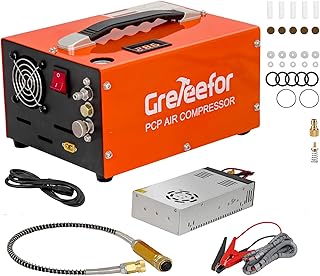
This is the unit I’d recommend to anyone filling tanks in a home with sleeping occupants: combined water and fan cooling, a genuinely restrained acoustic signature, and a 5800 PSI ceiling that means it rarely strains. The built-in 12V converter and five-hour continuous rating make it the most house-friendly compressor on this list.
GX-E-CS4 PCP Air Compressor
Mechanically the same well-engineered platform — 350W motor, 40 MPa maximum, dual cooling, five hours of continuous work — without the extra sound insulation of the “I” variant. If your fill station lives in a detached garage or workshop, this is the better value.
SMACO 4500 PSI Oil-Free Compressor
A sensibly specified 350W oil-free unit with auto-stop, a built-in converter, and a spare filter included, which tells you the maker expects you to maintain it properly. Oil-free operation keeps air quality clean and eliminates the mess that makes people banish compressors to inconvenient corners.
350W PCP Compressor with LCD Display
The LCD readout is more than a novelty: being able to read exact pressure at a glance shortens sessions and removes guesswork. With a 600W built-in adapter, water- and oil-free design, and reliable auto stop, it’s a strong all-rounder for mixed airgun and paintball use.
GOYOJO 4500 PSI Dual-Power Compressor
At 300W this is the lightest-duty pick here, but the auto shut-off, built-in cooling fan, and 12V/120V flexibility make it a tidy choice for topping off rifles rather than filling large scuba tanks. Expect shorter run windows and plan cool-down breaks accordingly.
Frequently Asked Questions
How loud is a PCP compressor, really?
Most portable units sit in the 70–85 dB range at one metre — comparable to a vacuum cleaner. That’s fine during the day, but it’s well above the 30–35 dB threshold recommended for bedrooms, so avoid running one late at night in an attached space.
Can I keep one in a bedroom or nursery closet?
No. These machines produce heat, some moisture at the drain, and enough vibration to be felt through flooring. A garage, utility room, or workshop with ventilation is the right home.
Is a manual-stop model ever the right choice?
Only if you’re attentive and budget-limited. The manual-stop 250W model with the retractable handle is compact and portable, but it demands supervision throughout every fill.
How often should I service it?
Drain moisture after every session, change the desiccant or filter element on the maker’s schedule, and check seals annually. Neglected filters are the main cause of premature failure.
Final Thoughts
If quiet matters — and in a home with bedrooms nearby it should — the GX-E-CS4-I is the clear pick, with the standard GX-E-CS4 offering the same durable 5800 PSI platform for detached spaces. For a lighter-duty, cleanly built alternative, the SMACO 4500 PSI oil-free compressor remains an easy recommendation.