Key takeaways
- Silence, not “quiet”: A true oil-filled radiator is fanless and should be effectively inaudible. The only sounds you may hear are faint thermal ticks as the fins expand and the click of a mechanical thermostat. If a listing mentions a blower or turbo fan, it will pull you out of light sleep — skip it.
- Thermostat precision: Digital thermostats hold within a degree or so; simple dial thermostats can swing three to five degrees, which is enough to trigger the sweating-then-shivering cycle that fragments deep sleep. If you’re heating a bedroom, prioritize digital control and an ECO mode that modulates rather than hard-cycles.
- Fin count and room size: More fins mean more thermal mass and gentler output. Seven fins suit a small bedroom or study up to roughly 150 square feet; 9 to 11 fins are better for open bedrooms, basements, and rooms above 200 square feet where you want the heater loafing along rather than running flat out.
- Light discipline: Look for dim, non-blinking indicators — ideally an LED display that fades or shuts off. Bright blue or white status lights suppress melatonin and are a common reason people sleep worse with an otherwise excellent heater. A remote and a timer let you make adjustments without turning on the bedside lamp.
- Layered safety: Non-negotiables are tip-over cutoff, overheat protection, and ETL or UL certification. Add child lock if you have kids or pets, and remember that oil-filled surfaces still reach hot-to-the-touch temperatures — leave clearance and never drape fabric over the fins.
What's inside
Anyone who has woken at 3 a.m. to the clank of a radiator or the sudden roar of a forced-air furnace understands the real problem with winter heating: it isn’t a lack of warmth, it’s the interruption. Bedroom temperature is one of the strongest environmental levers on sleep quality — the body needs to shed roughly a degree of core heat to fall asleep and stay asleep, and it does that best in a room that holds steady somewhere in the low-to-mid 60s Fahrenheit. Most portable heaters sabotage that by cycling hard: blasting hot dry air, clicking off, letting the room drop, then blasting again. The result is a night of micro-arousals you may never consciously remember but will absolutely feel the next morning.
Oil-filled radiators solve this differently. There’s no fan, no glowing element, no moving air to dry out your sinuses — just thermal fluid sealed inside steel fins that absorbs heat slowly and keeps releasing it long after the element shuts off. That thermal mass is what makes them the quietest and most stable option for bedrooms, nurseries, and home offices where you sit still for hours. Below, I’ve assessed the leading 2026 models on the criteria that actually matter for rest: acoustic behavior, temperature stability, light emission, safety engineering, and how well each one holds a room overnight without waking you up.
As an Amazon Associate we earn from qualifying purchases.




🛒 Best Price Today on Amazon
Prime members get fast, free shipping on everything above, plus member-only deals. New members get a 30-day free trial — cancel anytime.
How to Choose a/an Oil-Filled Space Heater (2026)
- Silence, not “quiet”: A true oil-filled radiator is fanless and should be effectively inaudible. The only sounds you may hear are faint thermal ticks as the fins expand and the click of a mechanical thermostat. If a listing mentions a blower or turbo fan, it will pull you out of light sleep — skip it.
- Thermostat precision: Digital thermostats hold within a degree or so; simple dial thermostats can swing three to five degrees, which is enough to trigger the sweating-then-shivering cycle that fragments deep sleep. If you’re heating a bedroom, prioritize digital control and an ECO mode that modulates rather than hard-cycles.
- Fin count and room size: More fins mean more thermal mass and gentler output. Seven fins suit a small bedroom or study up to roughly 150 square feet; 9 to 11 fins are better for open bedrooms, basements, and rooms above 200 square feet where you want the heater loafing along rather than running flat out.
- Light discipline: Look for dim, non-blinking indicators — ideally an LED display that fades or shuts off. Bright blue or white status lights suppress melatonin and are a common reason people sleep worse with an otherwise excellent heater. A remote and a timer let you make adjustments without turning on the bedside lamp.
- Layered safety: Non-negotiables are tip-over cutoff, overheat protection, and ETL or UL certification. Add child lock if you have kids or pets, and remember that oil-filled surfaces still reach hot-to-the-touch temperatures — leave clearance and never drape fabric over the fins.
The Best Oil-Filled Space Heater (2026)s Reviewed
DREO Oil-Filled Radiator Heater
This is the one I’d put in a bedroom without hesitation: the digital thermostat, ECO mode, and 24-hour timer let you program a gentle overnight setpoint and a pre-dawn warm-up, and the remote plus child lock mean no fumbling or bright screens at 2 a.m. Four modes give you real granularity over how much heat you’re adding, which is the difference between stable sleep and overheating.
Pelonis Oil-Filled Radiator, 2025 Upgraded
Pelonis’s revised large-room model pairs an adjustable thermostat with three heating modes and a substantial fin stack, so it holds a bigger bedroom or finished basement steady without straining. The matte black housing also emits almost no stray light, which matters more than most buyers expect.
PELONIS Radiator Heater for Large Space
The dual-knob version is the analog purist’s pick: nothing to program, nothing to glow, just set the mode and thermostat once and leave it. Expect slightly wider temperature swings than a digital unit, but excellent reliability and genuinely silent operation.
Amazon Basics Portable Oil Radiator Heater
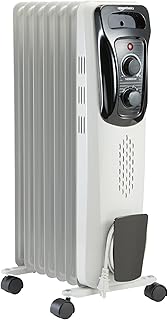
Seven fins, three heat settings, ETL certification, and a compact 25-inch footprint make this the sensible choice for a nursery, guest room, or small office. It’s the budget entry that doesn’t compromise on the safety layers that actually matter.
CAYNEL Oil-Filled Radiator Heater
A well-rounded middle option with a 24-hour timer and adjustable thermostat in a slim black cabinet that disappears against dark furniture. Good for home offices where you want set-and-forget warmth through a long workday.
Frequently Asked Questions
Is it safe to run an oil-filled heater all night?
Yes, provided the unit has tip-over and overheat cutoffs and independent safety certification, and you give it at least three feet of clearance from bedding, curtains, and furniture. Plug it directly into a wall outlet — never a power strip or extension cord.
What temperature should I set for the best sleep?
Aim for roughly 62–68°F, and err toward the cooler end. The goal isn’t a warm room but a stable one; a cool, unchanging bedroom supports the natural drop in core body temperature that initiates sleep.
Will it dry out the air like other heaters?
Much less. Because there’s no fan pushing air across a hot element, oil-filled radiators don’t circulate dust or strip moisture as aggressively, which usually means fewer dry throats and less morning congestion.
Do you ever need to refill or maintain the oil?
No. The thermal fluid is permanently sealed and never consumed. Maintenance is limited to vacuuming dust from between the fins a couple of times each season.
Final Thoughts
For bedrooms, the DREO Oil-Filled Radiator is the clear pick — its digital thermostat, ECO mode, and 24-hour timer give you the temperature stability that undisturbed sleep depends on, with a remote so you never have to break the dark. For larger rooms or basements, the upgraded Pelonis Oil-Filled Radiator has the thermal mass to hold a setpoint without working hard, while the Amazon Basics Portable Oil Radiator covers nurseries and small offices affordably without cutting corners on safety.