Key takeaways
- Match the mat to your floor, not your budget: Hard-floor mats have a smooth underside with grip texture or a light adhesive backing; carpet mats have downward-facing cleats that anchor into pile. Using a carpet mat on hardwood will scratch it, and a hard-floor mat on carpet will slide unpredictably every time you push back.
- Measure your true chair envelope: Sit down, roll through a normal workday, and mark where the casters actually travel. Most people need more depth than they expect. A 36″ x 48″ mat suits a compact desk; anything with a keyboard tray, side return, or standing-desk shuffle wants 47″ x 60″ or wider.
- Prioritize thickness over gloss: Roughly 1/5″ is the sweet spot for hard floors and low-pile carpet — thick enough to resist caster indentation, thin enough to avoid a lip your foot catches. Thin economy mats crack at stress points within a year, usually right where you pivot most.
- Think about the air in the room: If your desk shares space with where you sleep, look for mats that ship rolled rather than folded and that state low-odor or phthalate-free PVC. Any new mat benefits from 48 hours of airing in a ventilated space before it enters a bedroom.
- Check the lip geometry: A lipped mat tucks under a desk to save floor space, but only if the cutout matches your desk’s footprint. Rectangular mats are more forgiving and easier to reposition when your layout changes.
What's inside
As a sleep-wellness specialist, I spend most of my day asking people about their nights — and a surprising number of answers point back to their desks. Rolling chairs that grind against hardwood create a low-frequency rumble that keeps a partner’s nervous system on alert through a late work session. Chairs that sink into carpet force micro-adjustments in the hips and lumbar spine for eight hours, and that accumulated tension shows up at 11 p.m. as an inability to settle. A chair mat sounds like a purely practical purchase. Functionally, it’s a recovery tool.
This guide looks at chair mats through that lens: how quietly they let a chair travel, how stable they feel underfoot, whether they off-gas anything you’d rather not breathe in a room that doubles as a bedroom, and whether they’ll stay flat instead of curling into a nightly tripping hazard. Below are the mats worth your money in 2026, plus the specifications that actually matter once you’ve stopped reading marketing copy.
As an Amazon Associate we earn from qualifying purchases.


![[Upgraded Version] Crystal Clear 1/5" Thick 54" x 32" Heavy Duty Hard Chair Mat, Can be Used on Carpet or Hard Floor](https://m.media-amazon.com/images/I/71lmM3s++QL._AC_UL320_.jpg)


🛒 Best Price Today on Amazon
Prime members get fast, free shipping on everything above, plus member-only deals. New members get a 30-day free trial — cancel anytime.
How to Choose an Office Chair Mat (2026)
- Match the mat to your floor, not your budget: Hard-floor mats have a smooth underside with grip texture or a light adhesive backing; carpet mats have downward-facing cleats that anchor into pile. Using a carpet mat on hardwood will scratch it, and a hard-floor mat on carpet will slide unpredictably every time you push back.
- Measure your true chair envelope: Sit down, roll through a normal workday, and mark where the casters actually travel. Most people need more depth than they expect. A 36″ x 48″ mat suits a compact desk; anything with a keyboard tray, side return, or standing-desk shuffle wants 47″ x 60″ or wider.
- Prioritize thickness over gloss: Roughly 1/5″ is the sweet spot for hard floors and low-pile carpet — thick enough to resist caster indentation, thin enough to avoid a lip your foot catches. Thin economy mats crack at stress points within a year, usually right where you pivot most.
- Think about the air in the room: If your desk shares space with where you sleep, look for mats that ship rolled rather than folded and that state low-odor or phthalate-free PVC. Any new mat benefits from 48 hours of airing in a ventilated space before it enters a bedroom.
- Check the lip geometry: A lipped mat tucks under a desk to save floor space, but only if the cutout matches your desk’s footprint. Rectangular mats are more forgiving and easier to reposition when your layout changes.
The Best Office Chair Mats (2026) Reviewed
Baroyal Hard Floor Chair Mat, 36″ x 48″ (Espresso)
The espresso finish is the practical standout here — it disguises the scuffs and caster marks that make clear mats look tired within months, which matters in a room you also want to feel restful in. Heavy-duty PVC with a genuinely grippy underside, and the compact footprint suits a single-monitor desk in a bedroom corner.
Blvornl Anti-Slip Chair Mat, 36″ x 48″ (Dark Grey Rattan)
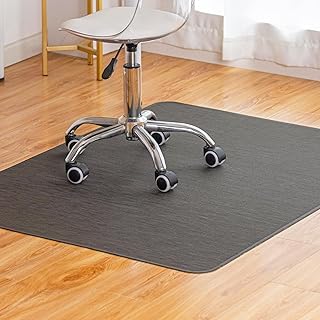
My pick when the mat needs to read as decor rather than equipment: the woven rattan texture visually softens a workspace, and the surface wipes clean with a damp cloth. Solid PVC construction means it holds its shape without the memory creases cheaper mats develop.
Blvornl Ultra Large Chair Mat, 47.2″ x 60″ (Black)
The best choice for wide or L-shaped desks, and the one I recommend to anyone who works at a sit-stand setup and drifts across a large area. Coverage this generous means your casters never find bare floor, which is where the noise and scratching start.
Crystal Clear Heavy Duty Chair Mat, 54″ x 32″ (1/5″ Thick)
The dual-surface flexibility is unusual and useful — it performs on both hard floors and carpet, so it survives a move or a room reshuffle. At a full 1/5″ thick it resists the dimpling that ruins thinner clear mats, and the transparency keeps small rooms feeling open.
Chair Mat for Low-Pile Carpet (1/4″ Thick, with Lip)
Purpose-built for carpet, and the difference is immediate: the cleated underside stops the mat from creeping and gives your chair the firm, predictable roll that keeps your hips and lower back from constantly compensating. The lip lets it slide neatly under a desk in tight rooms.
Frequently Asked Questions
Can a chair mat really affect how I sleep?
Indirectly, yes — in two ways. It removes a persistent low-frequency noise source from a room where someone may be trying to wind down, and it stabilizes your seated posture so you carry less accumulated muscular tension into the evening.
Will a mat damage my hardwood floors?
A hard-floor mat with a smooth or lightly textured underside will not. Problems arise from using a carpet mat with gripper cleats on wood, or from trapping grit beneath any mat — sweep the floor before installation and occasionally lift the mat to clean underneath.
How do I flatten a mat that arrived curled?
Unroll it in a warm room and leave it for 24 to 48 hours, weighting the corners with books. Never use a heat gun or hot water on PVC; it deforms permanently and you’ll never get a flat surface back.
Do I need the lipped version?
Only if your desk has a rectangular cutout your mat can nest into and floor space is tight. Otherwise a plain rectangle is easier to fit, easier to reposition, and eliminates an edge you could catch a foot on in dim light.
Final Thoughts
For most home offices on hardwood or tile, the Baroyal 36″ x 48″ mat in espresso delivers the best balance of durability, grip, and a finish that ages gracefully. If your desk sprawls or you alternate between sitting and standing, size up to the Blvornl Ultra Large 47.2″ x 60″. And for carpeted rooms, the low-pile carpet mat with lip is the one that will actually stay put — which is the whole point of buying a mat in the first place.