The best murphy bed for home office use in 2026 is a vertical wall bed with an integrated fold-down desk for rooms 10×12 ft or larger, and a horizontal desk-bed combo for narrow rooms under 10 feet wide — the right choice depends on your wall length, ceiling height, and whether you need to keep your desk setup in place when the bed is down.
Our top picks
 Bestar Queen Murphy Bed with Closet Organizer
- Queen Murphy bed can be folded away into…
- The dual-mount wall bed mechanism attaches to both…
- The mattress support features flexible slats that follow…
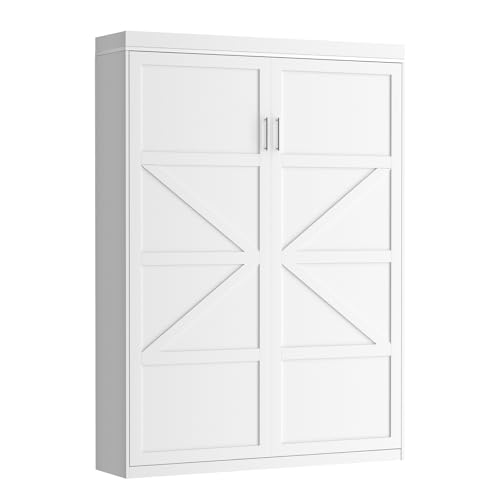 ROOMTEC Queen Murphy Bed with Smooth Pneumatic
- Durable Materials and Strong Support:This queen Murphy bed…
- Clean and Modern Cabinet Design:With a simple and…
- Smart Space Saving for Small Homes:Designed for compact…
 Bestar Queen Murphy Bed with Closet Organizer
- Queen Murphy bed can be folded away into…
- Dual-mount wall bed mechanism attaches to floor and…
- Murphy bed mattress support uses flexible slats that…
| Product | Key specs | |
|---|---|---|
| Bestar Queen Murphy Bed with Closet Organizer | Queen Murphy bed can be folded away into… The dual-mount wall bed mechanism attaches to both… The mattress support features flexible slats that follow… | Check price |
| ROOMTEC Queen Murphy Bed with Smooth Pneumatic | Durable Materials and Strong Support:This queen Murphy bed… Clean and Modern Cabinet Design:With a simple and… Smart Space Saving for Small Homes:Designed for compact… | Check price |
| Bestar Queen Murphy Bed with Closet Organizer | Queen Murphy bed can be folded away into… Dual-mount wall bed mechanism attaches to floor and… Murphy bed mattress support uses flexible slats that… | Check price |
 Bestar Queen Murphy Bed with Storage Cabinet Bestar Queen Murphy Bed with Storage Cabinet | This queen Murphy bed can be folded away… The dual-mount wall bed mechanism attaches to both… The mattress support features flexible slats that follow… | Check price |
As an Amazon Associate we earn from qualifying purchases at no extra cost to you.
Vertical vs. Horizontal Murphy Beds for a Home Office: Which Fits Your Layout?
This is the first decision to make, and it is purely about measurements, not style.
| Configuration | Footprint When Closed | Footprint When Open | Clearance Needed In Front | Best For |
|---|---|---|---|---|
| Vertical Murphy Bed (Queen) | 65″W x 18-24″D | 65″W x 85″ L from wall | 86-90″ deep total, plus 30″ for walking/work chair | Standard 10×12 ft or larger home office, 8 ft+ ceilings |
| Vertical Murphy Bed (Full) | 58″W x 18-24″D | 58″W x 80″ L from wall | 81-84″ deep total, plus 30″ walkway | Small offices where queen is too wide |
| Horizontal Murphy Bed (Queen) | 86″W x 18-24″D | 86″W x 65″ L from wall | 66-70″ deep total, plus 30″ walkway | Narrow rooms, attic offices, rooms with low ceilings (under 7.5 ft) |
| Horizontal Murphy Bed (Twin XL) | 83″W x 18-24″D | 83″W x 42″ L from wall | 43-46″ deep total, plus 30″ walkway | Very small offices / guest nooks under 100 sq ft |
How to measure: Tape the open footprint on your floor. A queen vertical bed needs a clear rectangular zone of at least 65 inches wide by 115 inches deep to open fully and still let you pull out a desk chair. A horizontal queen only needs about 86 inches wide by 95 inches deep, which is why it works better when your desk is on the opposite wall in a long, narrow room. You also need 7-8 feet of uninterrupted wall width for vertical and 7 feet of ceiling height for vertical to pivot safely — horizontal models pivot sideways and work with ceilings as low as 7 feet.
Desk-Bed Combos: The Three Types That Actually Work for Daily Work
Not all murphy beds with desks are designed for a real 8-hour workday.
- Fixed-Desktop Fold-Over: The desk surface is attached to the face of the bed cabinet and folds out or stays level when the bed comes down. Your monitor, laptop, and desk items stay on the desk or slide slightly. Best for people who work from this office daily and do not want to clear their desk every night. Usually $1,800–$3,500 for a queen with engineered wood cabinet.
- Roll-Out / Freestanding Desk: The bed cabinet looks like a wardrobe, and a separate desk on casters tucks underneath or rolls away when you need to lower the bed. Best for renters or anyone who wants a standard desk height (29-30 inches) and full legroom. You will need to move your chair and store the desk nearby, which adds 20-30 seconds to the transition.
- Tabletop Flip-Down: A small 18-24 inch deep tabletop is hinged to the front of the bed frame and flips up for laptop work. It is not a true office desk. Works for occasional guest use or hybrid schedules where you only need a laptop for 2-3 hours. Usually the most affordable option, generally $1,200–$2,200 for a full size.
For a daily workflow, choose a fixed-desktop model with a weight-rated desk surface (look for 50-75 lbs capacity) and a cable management cutout. Standard desk height should be 29-30 inches from the floor, with at least 25 inches of knee clearance underneath. If the included desk is 28 inches high or less, you will feel the difference during long typing sessions.
Decision Matrix: Match Your Situation to the Right Bed
Use your primary constraint to filter first.
| Your Situation | Recommended Choice | Why |
|---|---|---|
| Room is 10×10 ft or smaller, door on short wall | Horizontal Twin XL or Full with side desk | Leaves 36-48″ for a bookshelf or filing cabinet on the remaining wall |
| You work 5 days/week in this room + host guests 2-4 nights/month | Vertical Queen with fixed fold-over desk | No daily clearing of desk; fastest transition (under 30 seconds) |
| You are a renter and cannot anchor to wall studs | Freestanding horizontal bed with roll-out desk | Requires no wall anchoring if it has a floor-standing cabinet; check lease for tip-over safety rules |
| Back pain or heavy mattress preference | Vertical bed with slat or solid platform foundation rated for 800-1,000 lbs total | Supports heavier hybrid or latex mattresses (70-110 lbs) plus two sleepers without sagging |
| Kids or pets use the office as a play area by day | Vertical bed with bi-fold or tri-fold mechanism and leg lock | Keeps floor 100% open by day; locking legs prevent accidental folding |
What to Check Before You Buy: Measurements and Real-World Specs
1. Weight Limits and Mattress Rules
Most murphy beds require a mattress no thicker than 10-12 inches and no heavier than 60-80 lbs for a twin/full and 70-90 lbs for a queen. Piston and spring mechanisms are balanced for that weight. If you add a 14-inch pillow-top that weighs 100 lbs, the bed will not stay closed or will slam down. Weight limits for the sleep surface itself are typically 500 lbs for twin and 800-1,000 lbs for queen, including mattress and occupants.
2. Construction and Material Trade-Offs
| Material | Durability / Lifespan | Weight of Cabinet | Best For | Watch Out For |
|---|---|---|---|---|
| Solid Hardwood (e.g., maple, birch, alder) | 15-25 years, resists sagging and screw pull-out | 450-650 lbs total (queen) | Daily use office + nightly bed | Heaviest to move, usually $2,500–$5,000+ |
| Engineered Wood / MDF with laminate | 7-12 years with careful use | 350-500 lbs total (queen) | Budget-conscious guest office | Chips at corners, swells with moisture, screws loosen if moved often |
| Metal Frame with Wood Panels | 10-20 years for mechanism | 300-400 lbs total | Modern look, renters who may move | Can be noisier, welds and pistons need periodic tightening |
Foam density matters if the model includes a mattress: look for 1.8 lbs/cu ft or higher for polyfoam support layers. Anything lower will body-imprint within 2 years under daily sleeping use.
3. Assembly, Moving, and What Wears First
A queen murphy bed ships in 3-5 boxes totaling 400-600 lbs. The largest box is typically 80-87 inches long and will not fit through a 28-inch interior doorway without unpacking. You need a 30-inch minimum doorway and a 60-inch wide hallway turn. Assembly takes two people 4-8 hours with a drill and level; wall anchoring requires locating at least two studs with 2.5-3 inch lag bolts. The most common failure points are not the pistons but the particleboard screw joints around the hinge and the desk hinges. If you move within 2-3 years, choose a solid wood or metal frame with bolt-through hardware rather than cam-lock MDF.
For durability, check the piston rating — quality mechanisms are rated for 10,000-15,000 open/close cycles — and ensure there is a leg support that folds automatically. Beds without a dedicated support leg transfer all weight to the piston and cabinet, which shortens lifespan.
Workflow Tips to Keep Your Office Functional
- Keep your monitor on a single arm clamp if you have a fixed-desktop model. It allows you to swing the screen flat against the desk surface before folding, avoiding pressure on the screen.
- Use a wireless keyboard and mouse. Store them in a shallow drawer (3 inches deep is enough) so the desk surface is clear for the fold transition.
- Leave 36 inches minimum between the open bed edge and your desk or opposite wall. This is the ergonomic clearance for making the bed and getting in/out without side-shuffling.
- If you meet on video from this room, position the bed on the wall behind your camera, not behind you. A closed murphy cabinet looks like built-in storage on camera.
- Ventilation: murphy cabinets trap heat. Leave the bed down for 20-30 minutes after sleeping to air the mattress before closing, especially with memory foam.
How Much to Budget in 2026
For a home office murphy bed that will be used weekly or more: desk-bed combos with a fixed desk generally range from $1,800 to $3,800 for engineered wood and $3,000 to $5,500 for solid wood. Horizontal models and freestanding roll-out desk versions are typically $1,200 to $2,800. Wall-mounted vertical beds without a desk start around $1,400 to $2,500, but you will need to add a separate wall-mounted folding desk ($200–$600) to keep the space usable. Professional installation usually adds $300–$700 and is worth it for wall-anchored vertical units.
Frequently Asked Questions
Can I use my own mattress on a murphy bed for a home office?
Yes, if it meets the thickness and weight limit for your specific mechanism, usually 10-12 inches thick and under 90 lbs for a queen. Measure your mattress before ordering and avoid very heavy innerspring models over 100 lbs.
Do murphy beds damage walls or floors?
Wall-anchored models require 4-6 lag bolts into studs, leaving small holes that can be patched. Floor pressure from the cabinet when open is spread across the base, but use felt pads under legs to prevent indentations on hardwood or LVP flooring.
Is a murphy bed comfortable for every night use?
With a platform foundation and a standard 10-12 inch medium-firm mattress, yes. Choose a slat spacing of 3 inches or less or a solid platform to prevent sagging, and avoid thin 6-8 inch folding mattresses sold for occasional-use cabinets if you will sleep on it nightly.