Key takeaways
- Recline geometry over recline range: A chair that tilts far but hinges at the wrong point folds you at the stomach rather than opening the hips. Look for a smooth, locking tilt that moves seat and back together, and test whether your lumbar curve stays supported at the angle you’d actually rest in.
- Leather grade, stated plainly: Top grain genuine leather breathes, softens along your own contours, and tolerates a decade of daily friction. Quality PU leather is a legitimate budget choice with easier upkeep, but listings that say only “leather” or “leatherette” are telling you something by omission.
- Weight capacity as a durability signal: A 400 lb rating is not only for larger bodies. It indicates a heavier gauge frame, denser foam, and a stronger gas lift — meaning less seat sag and less wobble after two years of use, whatever your build.
- Base material and caster quality: A polished aluminium base outlasts nylon under weight and heat, resists cracking, and rolls with less resistance. Cheap casters transmit judder into your spine every time you shift, which quietly encourages you to stop shifting at all.
- Footrest execution, not just presence: A retractable footrest is genuinely restorative during afternoon dips — it drains the legs and unloads the low back. But it must extend at a height that supports your calves without hyperextending your knees, and it must retract flush enough that you forget it’s there.
What's inside
As someone who spends their working life studying recovery — how bodies wind down, how tissue decompresses, how a nervous system decides whether it is safe to rest — I’ve come to see the office chair as a sleep product in disguise. The eight or nine hours you spend seated set the mechanical stage for the seven or eight you spend horizontal. Compressed hip flexors, a slumped thoracic spine, and a jaw held tight against low-grade discomfort don’t vanish at 6 p.m. They follow you to bed as restlessness, 3 a.m. lower-back aches, and that peculiar exhaustion that sleep doesn’t seem to fix.
The trouble is that “luxury executive chair” has become a phrase that means almost nothing. Thick padding photographs beautifully and collapses within a season. Genuine leather appears in listings that contain very little of it. Reclining mechanisms lock at angles no human spine requested. This guide narrows the 2026 field to chairs that hold up under long-hours use, with attention to the details that actually govern how your body feels by evening: seat depth, recline geometry, lumbar contact, footrest quality, and whether the frame beneath all that upholstery is built to last.
As an Amazon Associate we earn from qualifying purchases.


🛒 Best Price Today on Amazon
Prime members get fast, free shipping on everything above, plus member-only deals. New members get a 30-day free trial — cancel anytime.
How to Choose a Luxury Executive Office Chair (2026)
- Recline geometry over recline range: A chair that tilts far but hinges at the wrong point folds you at the stomach rather than opening the hips. Look for a smooth, locking tilt that moves seat and back together, and test whether your lumbar curve stays supported at the angle you’d actually rest in.
- Leather grade, stated plainly: Top grain genuine leather breathes, softens along your own contours, and tolerates a decade of daily friction. Quality PU leather is a legitimate budget choice with easier upkeep, but listings that say only “leather” or “leatherette” are telling you something by omission.
- Weight capacity as a durability signal: A 400 lb rating is not only for larger bodies. It indicates a heavier gauge frame, denser foam, and a stronger gas lift — meaning less seat sag and less wobble after two years of use, whatever your build.
- Base material and caster quality: A polished aluminium base outlasts nylon under weight and heat, resists cracking, and rolls with less resistance. Cheap casters transmit judder into your spine every time you shift, which quietly encourages you to stop shifting at all.
- Footrest execution, not just presence: A retractable footrest is genuinely restorative during afternoon dips — it drains the legs and unloads the low back. But it must extend at a height that supports your calves without hyperextending your knees, and it must retract flush enough that you forget it’s there.
The Best Luxury Executive Office Chairs (2026), Reviewed
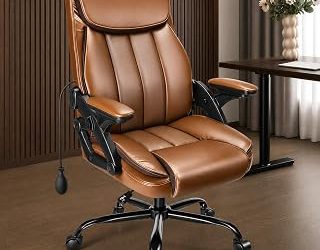
TOMU Top Grain Genuine Leather Executive Chair (Brown)
This is the chair I’d point most people toward for genuinely long sittings: real top grain hide over a substantial aluminium base, with a recline that stays supportive rather than simply collapsing backward. The leather softens noticeably in the first month, which is exactly what you want from material that will be pressed against your back for years.
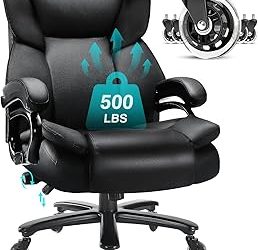
TOMU Genuine Leather Executive Chair with Headrest (Black)
The integrated headrest is the meaningful difference here, and it matters more than it sounds — supporting the skull relieves the cervical muscles that tend to stay clenched through evening and into sleep. A restrained, modern silhouette makes it the easiest of the three TOMU models to place in a home office that isn’t trying to look like a boardroom.
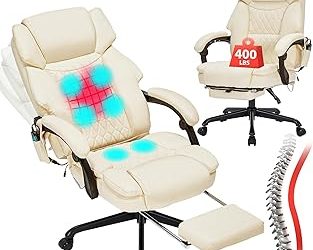
TOMU Executive Chair with Foot Rest (Beige)
Same top grain leather and aluminium underpinnings, with a footrest that turns the chair into a legitimate short-recovery station for mid-afternoon slumps. The beige finish reads warmer and less corporate, though pale leather asks for more diligent wiping if you eat at your desk.
EXCEBET Big and Tall Executive Chair with Footrest (Brown)
A 400 lb rating, thick cushioning, and pronounced lumbar support make this the strongest value pick for anyone who needs a wide, generously padded seat without a four-figure spend. Expect PU leather rather than hide — cooler-feeling at first, simpler to clean, and less forgiving of dry indoor air over the long run.
EXCEBET Big and Tall High Back Chair (Brown PU)
Closely related to its sibling but with a taller back and slightly firmer lumbar shaping, which suits taller frames and anyone who tends to slide forward as the day wears on. The footrest and deep recline combination is unusually capable at this price.
Frequently Asked Questions
Can a chair really affect how well I sleep?
Not directly, but indirectly and substantially. Sustained postural loading leaves muscle tension and joint irritation that surface once you’re still, and pain is one of the most reliable disruptors of deep sleep. Reducing daytime compression tends to show up as fewer position changes overnight.
Is genuine leather worth the premium over PU?
If you sit for six or more hours daily, yes. Top grain leather manages heat and moisture far better across a long session and ages rather than degrades. For lighter use, or in households where spills are frequent, quality PU is a sensible and defensible choice.
Should I nap in my office chair?
A reclined 15 to 20 minute rest with the footrest deployed is genuinely useful and won’t undermine your night. Longer than about 30 minutes, or later than mid-afternoon, and you start borrowing from the sleep pressure you need at bedtime.
How much recline do I actually need?
Most people work best at a slight backward tilt — roughly 100 to 110 degrees — because it shares load between spine and backrest. A deeper lock to around 135 degrees is worth having for breaks, but it shouldn’t be your working position.
Final Thoughts
For most buyers, the TOMU Top Grain Genuine Leather Executive Chair in Brown is the soundest long-term investment: real leather, an aluminium base, and recline geometry that supports rather than merely tilts. Choose the TOMU Black model with headrest if neck tension is your particular complaint, and the EXCEBET Big and Tall with Footrest if you need a wider, heavily cushioned seat and a footrest without stretching the budget. Any of the three will treat your spine — and, by extension, your nights — considerably better than the chair you’re probably sitting in now.