Key takeaways
- Finish and edge quality: Look closely at how the surface meets the edge. Wrapped laminates with a continuous edge band resist chipping and read far more like real furniture than exposed particleboard seams. Maple, walnut, and true matte white photograph well but behave differently in a room — warm woods soften a space, while white and glass expand a small one visually.
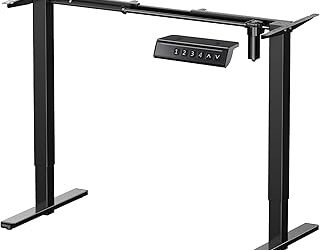
- Frame silhouette: Two-stage legs are more common and more affordable; three-stage legs retract shorter and extend taller, which matters if you’re under 5’4″ or over 6’2″. Squared columns look more architectural, rounded ones more forgiving. Check that the crossbar doesn’t sit where your shins will.
- Memory presets and motor noise: Presets are the difference between changing position four times a day and doing it once. Anything under roughly 50 dB won’t disrupt a call or wake a partner sleeping nearby — worth confirming if the desk shares a room with a bed.
- Surface area versus footprint: A 48-inch top handles a laptop and single monitor comfortably. Dual monitors want 55 inches or more, and 28 to 30 inches of depth keeps screens far enough back that you’re not straining your accommodative range all afternoon.
- Light and glare positioning: This is the sleep-specific one. Position matters more than most buyers realize, so choose a size and shape that lets the desk sit perpendicular to a window rather than facing away from it. Morning daylight on your face is the single strongest anchor for your circadian clock, and glossy or glass tops need thought here to avoid bounce glare.
What's inside
As a sleep-wellness practitioner, I spend most of my day talking about what happens in the eight hours people spend horizontal — but the truth is that the other sixteen decide the outcome. Circadian rhythm is built by light exposure, movement, and posture during daylight hours, and a desk that pins you to a chair from 9 to 6 quietly flattens the physiological signals your body relies on to feel alert by mid-morning and genuinely tired by 10 p.m. The frustration I hear from clients is rarely about ergonomics in the abstract. It’s that they want a desk that helps them move more without turning a bedroom corner or living-room nook into something that looks like a rented cubicle.
That’s a legitimate concern, and not a shallow one. A workstation you find visually jarring is a workstation you’ll psychologically resist, and resistance means you stop raising it. This guide covers the standing desks that actually earn their place in a home — the grain-matched laminates, the glass tops, the walnut finishes — alongside the mechanical details that determine whether the thing still glides smoothly in year three. I’ve weighted appearance and daily livability equally, because the desk you enjoy looking at is the desk you’ll keep using.
As an Amazon Associate we earn from qualifying purchases.


How to Choose a Looking Standing Desk (2026)
- Finish and edge quality: Look closely at how the surface meets the edge. Wrapped laminates with a continuous edge band resist chipping and read far more like real furniture than exposed particleboard seams. Maple, walnut, and true matte white photograph well but behave differently in a room — warm woods soften a space, while white and glass expand a small one visually.
- Frame silhouette: Two-stage legs are more common and more affordable; three-stage legs retract shorter and extend taller, which matters if you’re under 5’4″ or over 6’2″. Squared columns look more architectural, rounded ones more forgiving. Check that the crossbar doesn’t sit where your shins will.
- Memory presets and motor noise: Presets are the difference between changing position four times a day and doing it once. Anything under roughly 50 dB won’t disrupt a call or wake a partner sleeping nearby — worth confirming if the desk shares a room with a bed.
- Surface area versus footprint: A 48-inch top handles a laptop and single monitor comfortably. Dual monitors want 55 inches or more, and 28 to 30 inches of depth keeps screens far enough back that you’re not straining your accommodative range all afternoon.
- Light and glare positioning: This is the sleep-specific one. Position matters more than most buyers realize, so choose a size and shape that lets the desk sit perpendicular to a window rather than facing away from it. Morning daylight on your face is the single strongest anchor for your circadian clock, and glossy or glass tops need thought here to avoid bounce glare.
The Best Looking Standing Desk (2026)s Reviewed
Vari Classic Electric – 72×30 Walnut/Slate
This is the one that stops looking like a standing desk and starts looking like a desk. The walnut-over-slate pairing is genuinely handsome, the 72-inch span swallows dual monitors with room to write longhand, and Vari’s stability at full extension is among the best I’ve tested — no wobble when you lean in to type. Priciest here, and worth it if the desk lives somewhere visible.
Marsail Glass Standing Desk with Drawer
A tempered glass top over a white frame reads light and modern, which makes it the strongest choice for a small apartment or a bedroom where visual bulk works against you. The integrated drawer and USB ports reduce cable sprawl, and less clutter in a sleep space is a real, measurable benefit.
ErGear 55 x 28 Vintage Brown
The vintage brown finish has a convincing warmth that flatters older or more traditional rooms, and 55 by 28 inches is arguably the sweet spot for depth and screen distance. Solid motor performance and quiet operation for the money.
FEZIBO 48 x 24 Maple
Pale maple is underrated for home offices — it reflects daylight rather than absorbing it, keeping a corner brighter through the afternoon. Three memory presets and a compact footprint make this my usual recommendation for a spare bedroom or a narrow alcove.
Veken 55 Inch Large Electric Desk
Crisp white, generous surface, straightforward build — a sensible pick for shared study spaces or anyone who wants width without visual weight. Assembly is uncomplicated and the frame holds steady at standing height.
Frequently Asked Questions
Can a standing desk actually improve my sleep?
Indirectly, yes. Standing and light movement across the day increase daytime energy expenditure and strengthen the contrast between your active and resting states, which tends to shorten the time it takes to fall asleep. It’s a supporting factor, not a cure for insomnia.
How long should I stand each day?
Aim for roughly 15 to 20 minutes of standing per hour, spread out rather than banked. Long unbroken standing blocks cause leg fatigue and often lead people to abandon the habit entirely.
Is it a problem to put a standing desk in the bedroom?
Only if you work there late. The bedroom should stay associated with rest, so if space forces the arrangement, stop working at least 90 minutes before bed and keep screens off the desk overnight.
Do glass tops scratch easily?
Tempered glass resists scratching well but shows fingerprints and dust readily. A desk pad under your keyboard and mouse solves both issues.
Final Thoughts
If budget allows, the Vari Classic in walnut is the most furniture-like option here and the one I’d put in a room people see. For small or light-limited spaces, the Marsail glass desk keeps the footprint visually weightless, while the FEZIBO maple offers the best balance of price, brightness, and daily usability for a compact home office.