Key takeaways
- Color temperature you can change: A fixed 5000K daylight head is excellent for prep work and unhelpful at 9 p.m. Look for selectable-CCT kits that let you drop to 3000K or warmer in the evening, or plan to swap in warm E26 or GU10 bulbs yourself. Adjustability beats any single “perfect” number.
- Genuine dimming, not just an on/off switch: Dimming is the single most useful feature for evening use, but it only works if the driver and your wall dimmer are compatible. Confirm the kit is listed as dimmable, then match it to a matching LED-rated dimmer — otherwise you get flicker and buzz, both of which are quietly fatiguing.
- Head rotation and beam aim: Heads that pivot widely let you bounce light off a ceiling or wall instead of firing it straight down into your eyes. This is how you get a bright work surface without a bright room, which is exactly the balance you want after dinner.
- Track length and head count for the actual room: A 13-foot run with a dozen heads is right for a long galley or open-plan island; a 6.6-foot four- or six-head kit suits a standard kitchen or a hallway. Over-lighting a small room is more common than under-lighting one.
- Color rendering and bulb standard: CRI90+ makes food, produce, and finishes look like themselves rather than like a supermarket aisle. Standard E26 or GU10 sockets also mean you can retune the light later — a real advantage over sealed integrated fixtures.
What's inside
Most people shop for kitchen lighting the same way they shop for a paint color: they walk into a showroom at two in the afternoon, pick whatever looks crisp and bright, and install it. Then they wonder why the last hour of the evening feels so hard to wind down from. As someone who spends most of my working life talking to people about why their sleep has gone sideways, I can tell you that the kitchen is the room I ask about first. It’s where we eat late, load the dishwasher at ten, and stand around finishing conversations — all under fixtures chosen with no thought to what time of day it is. A ceiling full of 5000K spotlights aimed at a glossy countertop is, functionally, a very small noon.
Track lighting is quietly one of the better answers to this problem, because it gives you something a single flush-mount never will: control over direction. You can wash the counter where you’re chopping, leave the seating area softer, and keep raw light out of your line of sight. This guide covers what actually matters when you’re buying a kitchen track system in 2026 — color temperature, dimming behavior, head adjustability, bulb standards, and glare control — and then walks through the kits I’d point a client toward, with notes on which rooms and routines each one suits.
As an Amazon Associate we earn from qualifying purchases.



🛒 Best Price Today on Amazon
Prime members get fast, free shipping on everything above, plus member-only deals. New members get a 30-day free trial — cancel anytime.
How to Choose a Kitchen Track Lighting (2026)
- Color temperature you can change: A fixed 5000K daylight head is excellent for prep work and unhelpful at 9 p.m. Look for selectable-CCT kits that let you drop to 3000K or warmer in the evening, or plan to swap in warm E26 or GU10 bulbs yourself. Adjustability beats any single “perfect” number.
- Genuine dimming, not just an on/off switch: Dimming is the single most useful feature for evening use, but it only works if the driver and your wall dimmer are compatible. Confirm the kit is listed as dimmable, then match it to a matching LED-rated dimmer — otherwise you get flicker and buzz, both of which are quietly fatiguing.
- Head rotation and beam aim: Heads that pivot widely let you bounce light off a ceiling or wall instead of firing it straight down into your eyes. This is how you get a bright work surface without a bright room, which is exactly the balance you want after dinner.
- Track length and head count for the actual room: A 13-foot run with a dozen heads is right for a long galley or open-plan island; a 6.6-foot four- or six-head kit suits a standard kitchen or a hallway. Over-lighting a small room is more common than under-lighting one.
- Color rendering and bulb standard: CRI90+ makes food, produce, and finishes look like themselves rather than like a supermarket aisle. Standard E26 or GU10 sockets also mean you can retune the light later — a real advantage over sealed integrated fixtures.
The Best Kitchen Track Lighting (2026) Reviewed
VANoopee 5-Color 12-Light Kit, 13FT Rails
The most flexible option here for larger open-plan kitchens: five selectable color temperatures, dimmable heads, CRI90+ output, and enough rail to cover an island and a run of counter. If you want one system that can go bright at breakfast and genuinely warm at night, this is where I’d start.
VANoopee 5-Color 6-Light Kit, 6.6FT Rails (White)
Same selectable-CCT and dimming behavior in a shorter, white-finish package that disappears into a pale ceiling. My default recommendation for a normal-sized kitchen where the goal is control rather than coverage.
AUQUEE 8-Light Matte Black Track Lighting
Eight rotatable heads on a matte black rail, sold without bulbs — which I consider a feature, not an omission, because it lets you choose your own color temperature from day one. Pair with warm-dim GU10 bulbs if the kitchen doubles as an evening gathering space.
KEESFU 6-Light Track Lighting
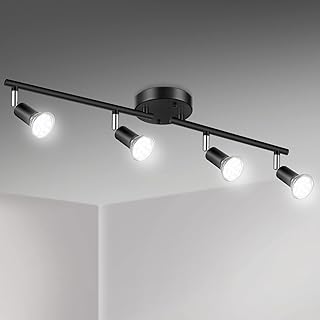
An industrial-leaning six-head fixture with generous head rotation, well suited to kitchens with exposed hardware or darker cabinetry. Aim two heads at the ceiling and you’ll get soft ambient fill alongside your task light.
3-Light Farmhouse Island Track Light (E26)
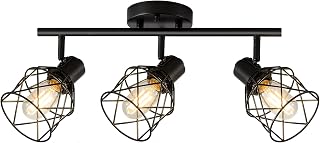
A compact three-head option on a standard E26 base, ideal above a modest island, a hallway, or a breakfast nook. The E26 socket is the real draw: warm filament-style LEDs make this the gentlest choice for late-evening use.
Frequently Asked Questions
What color temperature should kitchen lighting be?
Around 4000K works well for daytime prep, but you want the option to drop to 2700–3000K in the evening. Bright, blue-rich light late at night can delay melatonin release and push your body clock later, so a selectable or dimmable system beats any fixed choice.
Is track lighting bright enough for a whole kitchen?
Yes, if you match head count to room size and aim thoughtfully. Roughly 800 lumens per head across six to eight heads covers a typical kitchen comfortably, and directional aiming often makes it feel brighter than an equivalent flush-mount.
Can I install a track light kit myself?
Many kits mount to an existing ceiling box with basic tools, but wiring work should follow local electrical codes. If you’re adding a dimmer or a new circuit, hire an electrician.
Does dimming reduce the quality of the light?
Good dimmable LEDs hold their color rendering well as they dim. Poor pairings between driver and dimmer cause flicker, which some people perceive as eye strain or headache even when they can’t consciously see it — so match components carefully.
Final Thoughts
For most kitchens, the VANoopee 6-Light 6.6FT kit is the smartest buy, because selectable color temperature and real dimming give you a fixture that behaves differently at 7 a.m. than it does at 10 p.m. Scale up to the VANoopee 12-Light 13FT version for open-plan spaces, and consider the AUQUEE 8-Light if you’d rather choose your own bulbs and tune the light exactly to your evenings.