Key takeaways
- One-way vs. two-way regulation: A sponge-based humidifier only adds moisture, which is ideal for dry winter climates. Two-way packet systems both release and absorb, holding a target range without you doing the math — worth the higher cost in regions with wild seasonal swings.
- Where the guitar actually lives: Case-based systems are dramatically more efficient because they treat a small sealed volume. If your guitar hangs on a wall or sits on a stand, expect to top off far more often, and consider humidifying the room itself as your primary defense.
- Built-in monitoring: A hygrometer is not optional. Combination units that pair a humidifier with a gauge remove the guesswork, and analog no-battery gauges avoid the dead-coin-cell problem that quietly ends most monitoring habits.
- Leak and drip protection: Look for sealed reservoirs, non-drip membranes, and clamshell housings. Water contacting a finish or an unfinished interior brace does more damage than the dryness you were trying to prevent.
- Refill interval and honesty about maintenance: Choose the system you’ll actually service. A unit needing attention every three weeks that you check reliably beats a superior design you forget until spring.
What's inside
Anyone who has spent years thinking about bedroom air knows that humidity is the quietest variable in a room and the most consequential. It shapes how you breathe at 3 a.m., whether your floorboards creak in February, and — as guitar owners discover the hard way — whether a spruce top stays flat or develops a hairline crack across the lower bout. Wood that shares your home shares your climate, and most homes swing from a damp 60% in August to a desert-dry 22% the week the furnace kicks on. An acoustic guitar resting on a stand beside your bed is essentially a very expensive humidity sensor with strings.
This guide approaches guitar humidification the way we approach sleep environments: as a matter of stable, monitored, low-maintenance conditions rather than emergency intervention. Below you’ll find our picks for 2026, covering two-way case systems, soundhole humidifiers, and combination units with built-in gauges — plus a short framework for matching a system to your climate, your storage habits, and how often you’re realistically willing to top off a sponge.
As an Amazon Associate we earn from qualifying purchases.




🛒 Best Price Today on Amazon
Prime members get fast, free shipping on everything above, plus member-only deals. New members get a 30-day free trial — cancel anytime.
How to Choose a Humidifier For Guitars (2026)
- One-way vs. two-way regulation: A sponge-based humidifier only adds moisture, which is ideal for dry winter climates. Two-way packet systems both release and absorb, holding a target range without you doing the math — worth the higher cost in regions with wild seasonal swings.
- Where the guitar actually lives: Case-based systems are dramatically more efficient because they treat a small sealed volume. If your guitar hangs on a wall or sits on a stand, expect to top off far more often, and consider humidifying the room itself as your primary defense.
- Built-in monitoring: A hygrometer is not optional. Combination units that pair a humidifier with a gauge remove the guesswork, and analog no-battery gauges avoid the dead-coin-cell problem that quietly ends most monitoring habits.
- Leak and drip protection: Look for sealed reservoirs, non-drip membranes, and clamshell housings. Water contacting a finish or an unfinished interior brace does more damage than the dryness you were trying to prevent.
- Refill interval and honesty about maintenance: Choose the system you’ll actually service. A unit needing attention every three weeks that you check reliably beats a superior design you forget until spring.
The Best Humidifiers For Guitars (2026) Reviewed
D’Addario Humidipak Maintain Kit
The most forgiving option available: sealed two-way packets hold a case at roughly 45–50% relative humidity with no filling, no measuring, and no risk of overshooting during a mild spell. It’s the closest thing to a set-and-forget system, and the obvious choice for anyone storing a valuable instrument in a case long-term.
Oasis OH-1 Soundhole Humidifier
A crystal-gel tube that visibly shrinks as it depletes — a genuinely useful at-a-glance indicator. Output is generous, evaporation stays slow and even, and the Oasis remains the enthusiast’s benchmark for soundhole humidification in aggressively dry climates.
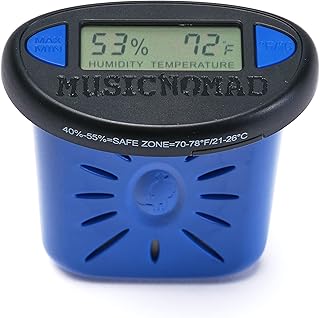
MusicNomad Humitar ONE (MN311)
Pairing a soundhole humidifier with an integrated hygrometer in one clip-on unit, the Humitar ONE removes the most common failure point: humidifying without measuring. The anti-drip sponge housing is well sealed, and the gauge sits where you’ll actually see it when you reach for the guitar.
Oasis OH-5 for Acoustic Guitars
A refined take on the Oasis formula, tuned for standard acoustic bodies and easy soundhole seating. Expect the same slow, controlled release with slightly less fuss during refills — a strong pick if the OH-1’s tube profile has ever felt fiddly to you.
GUITTO GHD-01 2-in-1
Excellent value in a clip-on housing that combines a refillable sponge with a battery-free analog gauge, so there’s nothing to replace but water. Accuracy is respectable rather than laboratory-grade, making it ideal for a second guitar, a travel case, or a first foray into humidity control.
Frequently Asked Questions
What humidity level should a guitar be kept at?
Aim for 45–55% relative humidity and, more importantly, avoid rapid changes. Wood tolerates a steady 40% far better than repeated swings between 30% and 60%.
Can a bedroom humidifier protect my guitar instead?
Partly. A room humidifier helps everything in the space, including your sinuses and your hardwood floors, but output varies with ventilation and door position. Use it alongside a case or soundhole unit rather than in place of one.
How often do I refill a soundhole humidifier?
Typically every one to three weeks in winter, depending on climate and case seal. Let the hygrometer set your schedule instead of the calendar.
Can a guitar be over-humidified?
Yes — above roughly 60% you’ll see a swollen top, raised action, muddy tone, and eventually glue and fret issues. Two-way systems are the simplest safeguard against this.
Final Thoughts
For cased storage and genuine peace of mind, the D’Addario Humidipak Maintain Kit is the most reliable system here. If your guitar lives out in the room and you want humidification and monitoring in a single piece of kit, the MusicNomad Humitar ONE is the smarter buy, while the Oasis OH-1 remains the choice for very dry climates where sheer output matters most.