Key takeaways
- Measured noise level: Look for a published dBA figure rather than vague “quiet” marketing. Anything at or below roughly 60 dBA sits near conversational volume and won’t carry through drywall; direct-drive pancake units typically run 78–90 dBA and belong in a detached garage or shed.
- Tank size versus your actual tasks: Tires and inflatables need almost no reservoir. Trim nailing is happy with 6 gallons. Sustained work — sanders, spray guns, framing nailers — wants 20-plus gallons so the motor cycles less often, which incidentally means fewer noise events.
- CFM at 90 PSI, not peak PSI: Airflow is what runs tools. Compare CFM at 90 PSI across models and match it to the highest-demand tool you own, with a little headroom.
- Oil-free versus oil-lubricated: Oil-free pumps are maintenance-light and fine for intermittent household use. Oil-lubricated units run cooler, quieter and longer, but require checking and changing oil.
- Where it will physically live: Weight, wheels and cord or battery format determine whether the compressor stays put or travels. A cordless inflator can be stored in a car trunk; a 26-gallon vertical tank needs a permanent, ideally sound-isolated corner.
What's inside
Anyone who has been jolted awake at 6 a.m. by a compressor kicking on in the garage understands the problem: household air tools are wonderfully useful and acoustically brutal. As someone who spends most of my working hours helping people protect their sleep architecture, I’ve come to see the humble air compressor as an unlikely bedroom-adjacent appliance. A 90-decibel motor two walls away from a nursery or a shift worker’s bedroom is not a minor inconvenience — it’s a measurable sleep disruption, and repeated nighttime or early-morning arousals fragment the deep-sleep stages that do the heavy lifting for physical recovery.
That’s the lens I’m applying to this guide. Below you’ll find the household compressors worth owning in 2026, evaluated not only on pressure, tank volume and duty cycle, but on how loudly and how often they intrude on the quiet your household actually needs. I’ve weighted noise output, motor type, portability and the practical question of whether the unit can live somewhere other than directly beneath a bedroom floor. Whether you’re topping off tires, running a brad nailer for a furniture build, or inflating an air mattress for weekend guests, there’s a sensible option here.
As an Amazon Associate we earn from qualifying purchases.




🛒 Best Price Today on Amazon
Prime members get fast, free shipping on everything above, plus member-only deals. New members get a 30-day free trial — cancel anytime.
How to Choose a/an Household Air Compressor (2026)
- Measured noise level: Look for a published dBA figure rather than vague “quiet” marketing. Anything at or below roughly 60 dBA sits near conversational volume and won’t carry through drywall; direct-drive pancake units typically run 78–90 dBA and belong in a detached garage or shed.
- Tank size versus your actual tasks: Tires and inflatables need almost no reservoir. Trim nailing is happy with 6 gallons. Sustained work — sanders, spray guns, framing nailers — wants 20-plus gallons so the motor cycles less often, which incidentally means fewer noise events.
- CFM at 90 PSI, not peak PSI: Airflow is what runs tools. Compare CFM at 90 PSI across models and match it to the highest-demand tool you own, with a little headroom.
- Oil-free versus oil-lubricated: Oil-free pumps are maintenance-light and fine for intermittent household use. Oil-lubricated units run cooler, quieter and longer, but require checking and changing oil.
- Where it will physically live: Weight, wheels and cord or battery format determine whether the compressor stays put or travels. A cordless inflator can be stored in a car trunk; a 26-gallon vertical tank needs a permanent, ideally sound-isolated corner.
The Best Household Air Compressor (2026)s Reviewed
California Air Tools 8010A Ultra Quiet
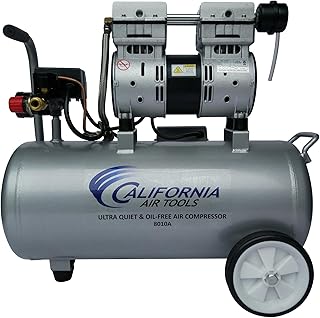
At a rated 60 dBA, this is the only compressor here I’d genuinely install in an attached garage below a bedroom without reservations — it hums rather than shrieks. The 8-gallon aluminum tank and oil-free 1.0 HP motor make it a sensible all-rounder for furniture assembly, trim work and household inflation duties.
DEWALT Pancake Compressor (DWFP55126)
The reference standard for a home pancake unit: 6 gallons, 165 max PSI, 2.6 SCFM at 90 PSI, and a maintenance-free oil-free pump that starts reliably in cold weather. It’s loud enough that I’d reserve it for daytime projects, but its capability-to-footprint ratio is hard to beat.
Craftsman 26 Gallon Portable (CMXECXA3332643)
If you’re running air tools for extended stretches, the 26-gallon reservoir and 5.0 CFM at 90 PSI mean far fewer motor cycles and a steadier air supply. The 1000-hour-rated oil-free induction motor is the workhorse choice — just give it a corner well away from sleeping spaces.
ETENWOLF VORTEX S6 Cordless Inflator
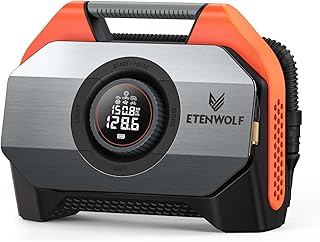
A 19200mAh battery, dual-cylinder design and 100% duty cycle put this well ahead of typical cordless inflators, and the LED backlight makes roadside use less miserable. Quiet, brief and portable — the least disruptive compressor in this roundup by a wide margin.
AstroAI Tire Inflator (12V/120V Dual Power)
Dual metal motors and a 150 PSI digital gauge with auto shut-off make short work of tires, bike tubes and air mattresses. The 12V/120V flexibility means one device covers both the driveway and the guest room.
Frequently Asked Questions
How loud is too loud for a home compressor?
Sustained exposure above roughly 70 dBA is worth avoiding, and anything above 60 dBA will likely be audible through interior walls. If you share the house with light sleepers, infants or night-shift workers, prioritise a rated-quiet model or confine loud units to daytime hours.
Can I use a compressor to inflate an air mattress?
Yes, with care. Use a low-pressure adapter and monitor manually — a 150 PSI compressor will overinflate and split bedding seams almost instantly. Digital gauges with auto shut-off, as on the AstroAI and VORTEX S6, make this considerably safer.
Do I need a large tank for occasional household use?
Rarely. For tires, inflatables and light nailing, a 6-gallon pancake or a cordless inflator is sufficient. Larger tanks earn their keep only when you’re running air-hungry tools continuously.
Where should I store a compressor in a small home?
A garage, utility room or outbuilding on a rubber anti-vibration mat, positioned away from shared bedroom walls. Vibration transmitted through joists travels further than airborne noise and is a common overlooked cause of nighttime waking.
Final Thoughts
For most households — particularly those where someone’s sleep is at stake — the California Air Tools 8010A is the standout, delivering real capability at a genuinely liveable 60 dBA. The DEWALT DWFP55126 remains the best-value pancake unit for daytime project work, and the ETENWOLF VORTEX S6 is the one to keep in the car for quiet, cordless top-ups wherever you happen to be.