Key takeaways
- Firmness over plushness: A cushion that feels heavenly when you press it with your palm will usually bottom out under your full torso weight. Look for high-density or handmade firm fills that resist compression, and treat “cloud-soft” claims as a warning rather than a selling point.
- Height and angle: Aim for a wedge that supports you from your tailbone to at least mid-shoulder-blade — roughly 20 inches of vertical rise for most adults. Too short and your upper back cantilevers backward; too tall and you’re pushed into a forward hunch.
- Neck support: If you read for more than twenty minutes at a stretch, a separate neck roll or bolster is the difference between a relaxed cervical spine and a stiff morning. Models with an attached roll save you from balancing a rolled towel behind your head.
- Width matched to your bed: Queen wedges typically span around 59 inches, twin versions considerably less. A cushion narrower than your mattress will slide sideways; get the size right and gravity does the stabilizing for you.
- Cover material and washability: Removable, zippered covers are non-negotiable for anything that touches your head nightly. Cotton velvet feels warmer and more furniture-like; smooth woven covers breathe better if you run hot. OEKO-TEX certified textiles are a sensible baseline if you’re sensitive to finishing chemicals.
If you spend your evenings propped against a wooden headboard with three pillows collapsing behind your lumbar spine, you already know the problem: the human back doesn’t fold neatly into a right angle. Rigid headboards force the neck forward, stacked pillows migrate within minutes, and by the time you’ve finished a chapter or a work email, your shoulders have crept up toward your ears. From a sleep-wellness standpoint, this matters more than comfort alone — an unsupported upright posture in bed trains tension into the very muscles you’re about to ask to relax for the night.
A dedicated headboard pillow solves this by replacing the flat vertical plane with an angled, stable wedge that meets your spine where it actually curves. This guide looks at the wedge-style headboard cushions worth considering in 2026, what separates a supportive one from a saggy one after six months of nightly use, and how to match firmness, height, and fill type to how you actually sit — reading, laptop work, nursing, or recovering from surgery.
Our top picks




As an Amazon Associate we earn from qualifying purchases at no extra cost to you. Ratings are shown as listed on Amazon.
🛒 Best Price Today on Amazon
Prime members get fast, free shipping on everything above, plus member-only deals. New members get a 30-day free trial — cancel anytime.
How to Choose a Headboard For Sitting Up In Bed (2026)
- Firmness over plushness: A cushion that feels heavenly when you press it with your palm will usually bottom out under your full torso weight. Look for high-density or handmade firm fills that resist compression, and treat “cloud-soft” claims as a warning rather than a selling point.
- Height and angle: Aim for a wedge that supports you from your tailbone to at least mid-shoulder-blade — roughly 20 inches of vertical rise for most adults. Too short and your upper back cantilevers backward; too tall and you’re pushed into a forward hunch.
- Neck support: If you read for more than twenty minutes at a stretch, a separate neck roll or bolster is the difference between a relaxed cervical spine and a stiff morning. Models with an attached roll save you from balancing a rolled towel behind your head.
- Width matched to your bed: Queen wedges typically span around 59 inches, twin versions considerably less. A cushion narrower than your mattress will slide sideways; get the size right and gravity does the stabilizing for you.
- Cover material and washability: Removable, zippered covers are non-negotiable for anything that touches your head nightly. Cotton velvet feels warmer and more furniture-like; smooth woven covers breathe better if you run hot. OEKO-TEX certified textiles are a sensible baseline if you’re sensitive to finishing chemicals.
The Best Headboard For Sitting Up In Bed (2026)s Reviewed
Sasttie Headboard Pillow Queen Wedge
The strongest all-rounder here: a down-alternative fill that holds its shape through long reading sessions, OEKO-TEX certified fabric, and side pockets that keep a phone or e-reader off the mattress. It’s the one I’d suggest to someone replacing a stack of pillows for the first time.
EUHAMS Headboard Pillow Queen with Neck Roll
At 59 x 8 x 20 inches with an integrated neck roll, this is the pick for anyone whose complaint is cervical strain rather than lower-back fatigue. The roll positions the head slightly back rather than forward, which meaningfully reduces the jaw and shoulder clenching that comes from craning over a screen.
WOWMAX Cotton Velvet Headboard Pillow
Handmade, genuinely firm, and finished in cotton velvet, this reads as furniture rather than bedding — a real advantage in a studio or on a daybed that doubles as seating. Choose it if you want lasting support and don’t mind that velvet retains a little more warmth.
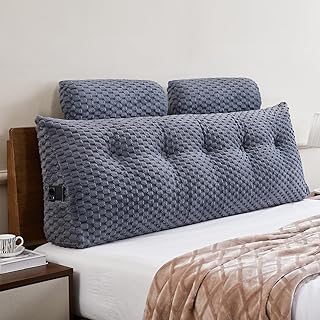
Dark Grey Triangle Backrest Headboard Pillow
A straightforward wedge with a removable cover and side pockets, in a grey that hides everyday wear. It’s the value option: less structured than the WOWMAX, but a clear upgrade over improvised pillow towers for occasional evening reading.
Twin Velvet Headboard Pillow for Dorm
Sized for twin and XL twin beds, this velvet wedge suits dorm rooms, guest beds, and narrow daybeds where a queen cushion would overhang. The positioning support is adequate for laptop work, and the removable cover matters in shared-housing conditions.
Frequently Asked Questions
Can a headboard pillow replace a real headboard?
Functionally, yes — for sitting up, it outperforms most solid headboards. Structurally it won’t stop a mattress from shifting away from the wall, so pair it with a bed frame that has a back rail if that’s an issue.
Will sitting up in bed disrupt my sleep?
It can, if the bed becomes your primary spot for work or scrolling — the association between bed and wakefulness weakens sleep pressure over time. Reading is generally fine; keep screens and work sessions shorter and earlier if you notice longer sleep onset.
How do I stop the wedge from sliding down?
Choose a width that matches your mattress, tuck the base under your pillows rather than in front of them, and avoid ultra-slick cover fabrics. Velvet and textured wovens grip bedding far better than sateen.
Are these suitable after surgery or during pregnancy?
An upright wedge is often recommended for recovery and for reflux relief, but the appropriate angle varies by condition. Confirm the specifics with your clinician before relying on one medically.
Final Thoughts
For most buyers, the Sasttie wedge is the sensible default — firm enough to last, certified fabric, useful pockets. If neck tension is your main complaint, the EUHAMS model with its integrated roll is worth the small premium, while the WOWMAX cotton velvet cushion is the one to choose when the bed doubles as seating and appearance matters as much as support.