Key takeaways
- Leather grade: Top-grain cowhide is the sweet spot for a chair you’ll sit in daily — it resists cracking at stress points and develops a patina instead of peeling. Treat vague “leather-look” labelling as a red flag.
- Lumbar contact, not lumbar branding: Press your hand into the backrest where your lower spine sits. You want firm, convex support that meets you before you slouch, ideally with a thickened backrest panel rather than a token foam bump.
- Recline that locks: A chair that tilts to 135 degrees and holds there gives you a genuine decompression position for calls or reading. Free-floating tilt with no lock forces micro-corrections all day, which is quietly exhausting.
- Seat depth and edge: Aim for two to three fingers of clearance behind your knees and a waterfall front edge. Pressure on the back of the thigh restricts circulation and produces the restless-leg feeling that follows people to bed.
- Base and casters: Aluminium bases outlast nylon and stay stable under recline. Quiet, smooth casters matter more than people expect — an abrupt roll or a grinding wheel is a small stress signal repeated hundreds of times a day.
What's inside
Fatigue at a desk rarely announces itself. It shows up as the 3 p.m. slump, the shallow breathing, the low-grade ache under the shoulder blades that follows you to bed and quietly fragments your sleep. As someone who spends most of my working life helping people troubleshoot poor rest, I’ve learned that the chair someone sits in for nine hours is often a bigger factor than the mattress they lie on for seven. Sustained postural strain keeps the nervous system mildly braced, and a braced body does not wind down on command.
Genuine leather earns its place in this conversation for practical reasons, not just aesthetic ones: it breathes better than bonded vinyl, it doesn’t trap the heat that makes long sessions clammy, and it softens to your shape instead of fighting it. Below, I’ve assessed six real leather office chairs on the criteria that actually affect how your body feels by evening — lumbar geometry, recline range, seat depth, and arm support — so you can choose one that lets you finish the day genuinely tired rather than tense.
As an Amazon Associate we earn from qualifying purchases.


🛒 Best Price Today on Amazon
Prime members get fast, free shipping on everything above, plus member-only deals. New members get a 30-day free trial — cancel anytime.
How to Choose a Genuine Leather Office Chair (2026)
- Leather grade: Top-grain cowhide is the sweet spot for a chair you’ll sit in daily — it resists cracking at stress points and develops a patina instead of peeling. Treat vague “leather-look” labelling as a red flag.
- Lumbar contact, not lumbar branding: Press your hand into the backrest where your lower spine sits. You want firm, convex support that meets you before you slouch, ideally with a thickened backrest panel rather than a token foam bump.
- Recline that locks: A chair that tilts to 135 degrees and holds there gives you a genuine decompression position for calls or reading. Free-floating tilt with no lock forces micro-corrections all day, which is quietly exhausting.
- Seat depth and edge: Aim for two to three fingers of clearance behind your knees and a waterfall front edge. Pressure on the back of the thigh restricts circulation and produces the restless-leg feeling that follows people to bed.
- Base and casters: Aluminium bases outlast nylon and stay stable under recline. Quiet, smooth casters matter more than people expect — an abrupt roll or a grinding wheel is a small stress signal repeated hundreds of times a day.
The Best Genuine Leather Office Chair (2026)s Reviewed
Genuine Leather Mid Back Conference Chair with Aluminium Arms
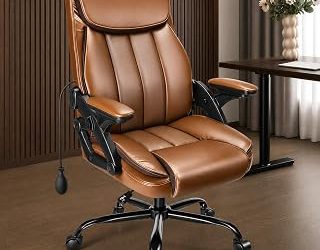
The thickened backrest and pronounced lumbar curve make this the most postural of the mid-back options, and the aluminium arms and legs keep it stable through a full day of swivelling. A sensible pick for anyone who works upright at a desk rather than reclining into deep focus sessions.
Genuine Leather Executive Chair, Top-Grain Cowhide
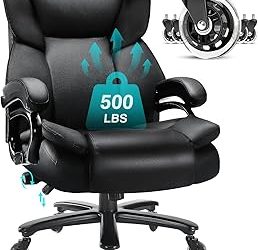
Adjustable seat and headrest heights are rarer than they should be, and here they let taller users get genuine cervical support instead of a headrest pressing awkwardly between the shoulder blades. The lockable three-position recline is the standout feature for anyone who wants a fixed, repeatable rest posture.
Genuine Leather High Back Chair with Flexible Footrest
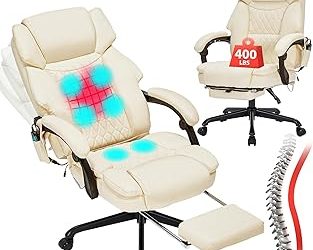
The retractable footrest plus adjustable tilt turns this into a legitimate recovery position — elevating the legs while reclining reduces the lower-limb heaviness that builds through a sedentary afternoon. The 400 lb capacity also signals substantial internal framing.
TOMU Executive Chair with Foot Rest
Top-grain leather over well-judged padding, with an aluminium base and cushioned armrests that support the forearm rather than just the elbow. The beige finish reads as furniture rather than office equipment, which matters if your desk shares a room you also relax in.
Genuine Leather High Back Chair with 135° Recline
The most generous recline in this group, paired with adjustable armrests and quiet casters — a genuinely useful combination for long thinking work punctuated by short rest breaks. Mid-century styling keeps the bulk visually restrained.
Frequently Asked Questions
Can my office chair really affect my sleep?
Indirectly but meaningfully. Poor daytime posture creates muscular tension and referred pain that surface once you lie still, and discomfort is one of the most common causes of prolonged sleep onset and night waking.
Is a footrest worth paying extra for?
If you take breaks at your desk, yes. Briefly elevating the legs eases venous pooling and helps reset a stiff lower back — a five-minute reclined pause is far more restorative than another coffee.
Does real leather get too warm?
Genuine leather is more breathable than bonded or faux alternatives and stabilises to body temperature within minutes. Overheating is more often a padding-density problem than a leather problem.
How firm should the seat cushion be?
Firm enough that you don’t sink past level after an hour. Overly soft foam collapses, tilts the pelvis backward and pulls your lumbar spine out of the support the chair was designed to provide.
Final Thoughts
If you want the most complete postural package, the Top-Grain Cowhide Executive Chair offers the adjustability range that suits the widest variety of bodies, while the High Back Chair with Flexible Footrest is the one I’d recommend to anyone whose legs and lower back feel wrecked by evening. For a cleaner-looking option that still reclines properly, the 135° Recline Mid-Century model strikes a strong balance between support and living-room presence.