Key takeaways
- Core construction: Pocket springs are the meaningful upgrade for nightly sleepers, because individually wrapped coils flex under a shoulder without transmitting motion across the whole surface. Solid high-density foam is the better choice for floor futons, where coils have nothing to push against and tend to feel dead.
- Thickness versus deck: An 8-inch mattress on a slatted frame sleeps like far more than 8 inches; the same mattress on a rigid platform sleeps like less. Judge total thickness and support deck together, and treat anything under 6 inches on a hard surface as guest-only.
- Conversion mechanism: Traditional bi-fold frames create a hinge line near the lumbar region, which is fine for occasional use but noticeable nightly. Boneless modular designs flatten without a hinge, eliminating the seam that wakes light sleepers.
- Cover breathability: Corduroy and twill move air reasonably well; heavy microfiber traps it. If you sleep warm, plan on a breathable mattress protector regardless of the factory cover, since futon cores sit closer to the sleeper than a conventional mattress does.
- Weight and reconfiguration: Boneless units are heavy but tool-free, which suits apartments with tight stairwells. Wood frames require assembly but are far easier to move in pieces and to repair years later.
Most futons are bought for the wrong reason. Shoppers evaluate them the way they’d evaluate a couch — sitting down, bouncing once, checking whether the color works with the rug — and then discover months later that the surface they’ve been sleeping on every night has a metal support bar running directly beneath their hips. Futons occupy an unusual position in home furniture: they are the only piece expected to perform two contradictory jobs, since upright sitting rewards firmness at the edges while side sleeping rewards give at the shoulder and hip. When a futon is chosen purely as seating, sleep quality is what gets sacrificed.
This guide inverts that priority. Every pick below is assessed first as a sleep surface — how the core behaves under sustained load, whether the deck or floor beneath it interferes with spinal alignment, how the cover handles overnight heat — and only second as furniture. You’ll find full-size frame-and-mattress sets for daily use, modular convertible sofa beds that skip assembly entirely, and a Japanese-style floor futon for anyone whose sleeping arrangement is temporary or space-limited. Read the selection criteria first; it will tell you which category you actually belong in.
Our top picks


As an Amazon Associate we earn from qualifying purchases at no extra cost to you. Ratings are shown as listed on Amazon.
🛒 Best Price Today on Amazon
Prime members get fast, free shipping on everything above, plus member-only deals. New members get a 30-day free trial — cancel anytime.
How to Choose a Futon For Sleeping (2026)
- Core construction: Pocket springs are the meaningful upgrade for nightly sleepers, because individually wrapped coils flex under a shoulder without transmitting motion across the whole surface. Solid high-density foam is the better choice for floor futons, where coils have nothing to push against and tend to feel dead.
- Thickness versus deck: An 8-inch mattress on a slatted frame sleeps like far more than 8 inches; the same mattress on a rigid platform sleeps like less. Judge total thickness and support deck together, and treat anything under 6 inches on a hard surface as guest-only.
- Conversion mechanism: Traditional bi-fold frames create a hinge line near the lumbar region, which is fine for occasional use but noticeable nightly. Boneless modular designs flatten without a hinge, eliminating the seam that wakes light sleepers.
- Cover breathability: Corduroy and twill move air reasonably well; heavy microfiber traps it. If you sleep warm, plan on a breathable mattress protector regardless of the factory cover, since futon cores sit closer to the sleeper than a conventional mattress does.
- Weight and reconfiguration: Boneless units are heavy but tool-free, which suits apartments with tight stairwells. Wood frames require assembly but are far easier to move in pieces and to repair years later.
The Best Futons For Sleeping (2026), Reviewed
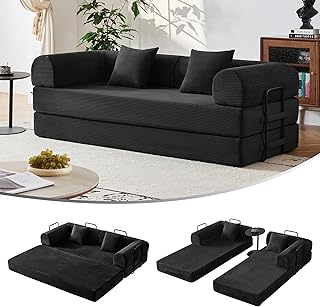
79″ Convertible Corduroy Sofa Bed with Pocket Springs (Black)
This is the strongest all-around nightly sleeper here: the pocket-spring layer gives genuine contouring at the hip and shoulder, and the boneless build means no hinge bar interrupts the surface when it’s laid flat. Arriving in a box with zero assembly makes it the practical answer for anyone furnishing a walk-up.
Stanford Futon Set — Full, 8″ Mattress, Twill Black
A conventional frame-and-mattress package that earns its place through balance: the 8-inch core is thick enough for regular adult sleep, and the twill cover breathes better than the microfiber alternatives at this tier. Best suited to buyers who want a true full-size sleeping footprint and don’t mind a straightforward build.
79″ Corduroy Boneless 5-in-1 Modular Futon (Olive Green)
Mechanically close to our top pick, with the added benefit of reconfigurable sections that let you shift between chaise, sofa, and flat bed as a room’s use changes. The olive corduroy is a more forgiving color for a piece that will see nightly bedding traffic.
78.8″ Convertible Loveseat Sleeper with Storage Pocket (Black)
The most compact of the boneless group, and the one to choose when a full 79 inches won’t clear the wall. Its slightly narrower footprint sleeps one adult comfortably; two will find it tight, so treat it as a single-sleeper or guest solution.
6th Gen Japanese Floor Futon Mattress (Twin, 9-Layer)
Nine layers of high-density foam deliver far more floor isolation than the thin shikibuton-style pads most buyers try first, which is what makes this viable for weeks rather than nights. Roll it up daily and air it regularly — floor futons accumulate moisture from below.
Frequently Asked Questions
Can a futon be used as a primary bed?
Yes, provided the core is at least 6 to 8 inches with spring or high-density foam support. What disqualifies a futon for nightly use is usually a thin cotton-batting core that compresses permanently within a few months.
Do futons cause back pain?
Poorly supported ones do. Pain most often traces to a hinge bar under the lumbar spine or to a core that has bottomed out, not to firmness itself — many sleepers do well on a firm surface once the support beneath it is continuous.
How long does a futon mattress last?
Expect three to five years of nightly use from a quality spring or foam core, and considerably longer with occasional use. Rotating the mattress every two to three months meaningfully extends that window.
Are boneless convertible sofa beds better than traditional frames?
For sleep, generally yes, because they avoid the mid-body hinge. Traditional frames still win on repairability, storage options, and long-term structural life.
Final Thoughts
For nightly sleeping, the 79″ pocket-spring convertible in black is the clearest recommendation — hinge-free, properly supportive, and ready to use out of the box. Choose the Stanford Futon Set if you want a traditional full-size frame with a real 8-inch mattress, or the 6th Generation Japanese floor futon if your setup needs to disappear into a closet each morning.