Key takeaways
- Weight capacity with margin: Rated capacity is measured under controlled static load, not a running teenager landing mid-step. Choose a rating well above your heaviest regular user — 300 lbs is adequate for light residential use, while 750 lb models absorb genuine abuse and stay rigid for years.
- Step width and profile: Wide steps of 4 inches or more distribute pressure across the arch instead of concentrating it on one narrow bar. Bare, cold, wet feet are unforgiving, and this single spec does more for comfort than any other.
- Alloy and hardware: Marine-grade aluminum resists corrosion, but the fasteners often fail first. Salt or brackish water demands stainless hardware and welded rather than riveted joints; freshwater owners have more latitude.
- Step count versus freeboard: Measure from your deck surface to the waterline at typical level, then add submerged depth. Low floating docks need 3–4 steps; high fixed docks over deep water often need 5–7 to avoid a hard reach at the top.
- Locking mechanism and one-handed use: A quick-release pin that holds the ladder both down and stowed matters most when you’re climbing out tired. Pull ropes and handrails let a swimmer deploy and exit without help.
What's inside
Anyone who spends real time on the water knows the ladder is the least glamorous piece of dock hardware and the one that gets used more than anything else. It takes the brunt of every cannonball, every wet-footed climb, every winter freeze — and when it starts to flex, rattle, or bite into bare feet, the whole shoreline experience turns from restorative to stressful. As someone who writes primarily about rest and recovery, I’d argue that matters more than it sounds: a lake afternoon is one of the most reliable circadian resets available to most people, combining morning light, cold-water immersion, and unstructured downtime. A ladder that makes you brace and wince undercuts all of it.
The flip-up design solves the practical half of the problem. Hinged at the deck, it lifts clear of the water so weeds, ice, and boat wake can’t work on it, then drops into place in a second when someone wants to swim. Below, I’ve compared the models most worth considering in 2026 across capacity, step width, corrosion resistance, and the small details — pull ropes, quick-release pins, handrails — that separate a ladder you trust from one you tolerate.
As an Amazon Associate we earn from qualifying purchases.


🛒 Best Price Today on Amazon
Prime members get fast, free shipping on everything above, plus member-only deals. New members get a 30-day free trial — cancel anytime.
How to Choose a Flip-Up Dock Ladder (2026)
- Weight capacity with margin: Rated capacity is measured under controlled static load, not a running teenager landing mid-step. Choose a rating well above your heaviest regular user — 300 lbs is adequate for light residential use, while 750 lb models absorb genuine abuse and stay rigid for years.
- Step width and profile: Wide steps of 4 inches or more distribute pressure across the arch instead of concentrating it on one narrow bar. Bare, cold, wet feet are unforgiving, and this single spec does more for comfort than any other.
- Alloy and hardware: Marine-grade aluminum resists corrosion, but the fasteners often fail first. Salt or brackish water demands stainless hardware and welded rather than riveted joints; freshwater owners have more latitude.
- Step count versus freeboard: Measure from your deck surface to the waterline at typical level, then add submerged depth. Low floating docks need 3–4 steps; high fixed docks over deep water often need 5–7 to avoid a hard reach at the top.
- Locking mechanism and one-handed use: A quick-release pin that holds the ladder both down and stowed matters most when you’re climbing out tired. Pull ropes and handrails let a swimmer deploy and exit without help.
The Best Flip-Up Dock Ladder (2026)s Reviewed
Extreme Max 3005.4227 Slanted 4-Step
The slanted geometry and round-tube frame make this the most natural-feeling climb of the group, closer to a staircase than a vertical ladder — a meaningful difference for older swimmers or anyone hauling gear. Its 300 lb rating is the lowest here, so treat it as a comfort-first pick for calm freshwater docks rather than a heavy-traffic workhorse.
VEVOR 4-Step Flip-Up Dock Ladder
A well-judged balance of price and specification: 350 lb capacity, genuinely wide non-slip steps, and a pull-rope assist that lets a swimmer bring the ladder down from the water. Assembly instructions are thin, but the aluminum alloy and fit-and-finish punch above the cost.
JIF Marine Hinged 4-Step
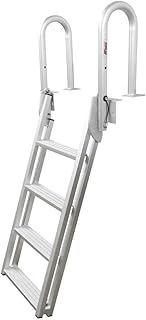
My value recommendation for most docks. You get 750 lb capacity, extra-wide 4-inch steps, and a quick-release safety pin in a compact four-step footprint — the same structural spec as far more expensive ladders, minus the handrails.
Dockmate Wide 5-Step
The most complete package: 750 lb capacity, 4-inch steps, integrated handrails, and corrosion resistance specified for salt water. The fifth step and grab rails make this the one I’d choose for a fixed dock with meaningful freeboard, or for households with mixed ages and abilities.
Dock Edge Flip Up Wide Step 7-Step
Fully welded aluminum and seven wide steps make this the answer for high dock decks and deep water where shorter ladders leave an awkward final haul. It’s heavy and overkill on a low floating dock, but the welded construction means almost nothing to loosen over time.
Frequently Asked Questions
How many steps do I actually need?
Count roughly two steps for every foot from deck to waterline, then ensure at least two steps sit below the surface. Submerged steps are what let you climb rather than pull yourself up.
Do flip-up ladders need to come off for winter?
That’s the main advantage — flipping the ladder onto the deck keeps it above ice formation. Removing the mounting hardware is unnecessary on most installations, though inspecting the hinge each spring is wise.
Are these ladders suitable for pontoon boats?
Some, including the VEVOR, are marketed for both, but boat mounting requires a solid, reinforced transom surface. Verify your mounting point can take the leverage before drilling.
Will aluminum corrode in salt water?
Marine-grade aluminum holds up well; mismatched steel fasteners are the usual failure point. Choose a model specified for salt water, such as the Dockmate, and rinse the hinge periodically.
Final Thoughts
For most waterfront homes, the JIF Marine 4-Step delivers the best combination of 750 lb rigidity and wide, foot-friendly steps at a sensible price. Upgrade to the Dockmate Wide 5-Step if you want handrails and salt-water durability, or the Dock Edge 7-Step if your deck sits high above the water — and consider RecPro’s 20-inch-wide 4-step if maximum standing width is your priority.