Key takeaways
- Abrasion tolerance: Dining seats absorb constant friction from sliding in and out. Look for tightly woven or bonded materials rather than loose, open weaves that pill and thin at the front edge within a year.
- Thermal comfort: Vinyl and coated fabrics feel cool at first contact but trap heat over long meals. Faux linen and short-pile velvet breathe better, which matters if your family actually sits for an hour.
- Yardage math: Budget roughly half a yard per standard drop-in seat, plus 15% for pattern matching and stapling allowance. Buying one continuous cut beats piecing together short orders from different dye lots.
- Cleanability over stain resistance: Nothing repels red wine forever. Prioritize fabrics you can blot, spot-clean, and dry without watermarking — solid mid-tones and textured weaves hide incidents far better than pale flat finishes.
- Stretch behavior: Fabric needs enough give to wrap a curved foam edge cleanly, but not so much that it sags. Fabrics with a composite or woven backing pull taut and stay that way.
What's inside
Most people think about rest in the bedroom and stop there. But as someone who spends their days studying how environments shape recovery, I’d argue the dining chair is one of the most overlooked comfort surfaces in a home. It’s where you linger over a slow breakfast, where evening conversation stretches past dessert, where the nervous system either downshifts or stays braced. A seat that’s slick, scratchy, or hard-edged keeps your body subtly working — shifting, gripping, never quite settling. Reupholstering is the cheapest fix available, and the fabric you choose does most of the heavy lifting.
The trouble is that upholstery listings are written for crafters, not for people who actually sit. Yardage, backing, weave density, cleanability — it’s a lot of specification with very little translation. Below I’ve broken down what genuinely matters for dining seats in 2026, then reviewed six fabrics that hold up to real households: crumbs, wine, elbows, and the occasional dog who believes chairs are negotiable.
As an Amazon Associate we earn from qualifying purchases.




🛒 Best Price Today on Amazon
Prime members get fast, free shipping on everything above, plus member-only deals. New members get a 30-day free trial — cancel anytime.
How to Choose a Fabric For Upholstering Dining Chairs (2026)
- Abrasion tolerance: Dining seats absorb constant friction from sliding in and out. Look for tightly woven or bonded materials rather than loose, open weaves that pill and thin at the front edge within a year.
- Thermal comfort: Vinyl and coated fabrics feel cool at first contact but trap heat over long meals. Faux linen and short-pile velvet breathe better, which matters if your family actually sits for an hour.
- Yardage math: Budget roughly half a yard per standard drop-in seat, plus 15% for pattern matching and stapling allowance. Buying one continuous cut beats piecing together short orders from different dye lots.
- Cleanability over stain resistance: Nothing repels red wine forever. Prioritize fabrics you can blot, spot-clean, and dry without watermarking — solid mid-tones and textured weaves hide incidents far better than pale flat finishes.
- Stretch behavior: Fabric needs enough give to wrap a curved foam edge cleanly, but not so much that it sags. Fabrics with a composite or woven backing pull taut and stay that way.
The Best Fabric For Upholstering Dining Chairs (2026) Reviewed
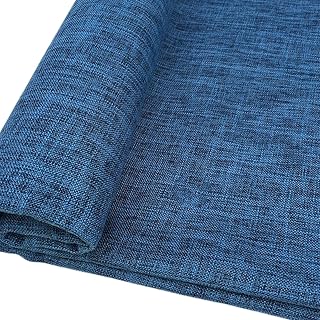
TinaKim Thick Upholstery Fabric, Faux Linen (Grey Blue)
This is my default recommendation for first-time reupholsterers: the weight is substantial enough to hide foam texture, and the faux linen surface stays temperate against skin instead of turning clammy. The two-yard cut covers four standard drop-in seats with a sensible margin for error.
Faux Linen Needlework Fabric, 3.3 Yards
A generous continuous length in the same restful grey-blue family, which solves the dye-lot problem when you’re doing a full six-chair set. Slightly softer hand than a dedicated upholstery weave, so I’d pair it with a firmer foam to keep the seat from reading as spongy.
TinaKim Upholstery Fabric, Linen Type (Navy Blue)
The one-yard cut makes this ideal for a two-chair refresh or a trial run before committing to a whole dining set. Navy is quietly practical — it absorbs light rather than reflecting it, which helps an evening table feel calmer, and it forgives spills that would ruin a lighter neutral.
TinaKim Velvet Upholstery Cloth (Light Green, 6 Yards)
Short-pile velvet is the most tactilely comfortable option here, and the soft green is genuinely restorative to look at without tipping into novelty. Six yards handles a large set, though I’d advise brushing the pile in a consistent direction across all chairs so the sheen matches under overhead light.
Faux Leather Vinyl Upholstery Fabric (Cocoa)
At 1.3mm with a composite backing, this wipes clean in seconds — the obvious pick for households with toddlers or frequent hosting. Accept the tradeoff: it runs warmer than woven fabric, so it suits shorter meals better than long, lingering ones.
Frequently Asked Questions
How much fabric do I need for four dining chairs?
For standard removable seat pads, two yards of 57-inch fabric is usually sufficient. Measure your seat, add four inches on every side for wrapping and stapling, then round up.
Is velvet impractical for a dining room?
Not anymore. Modern short-pile polyester velvets resist crushing and spot-clean well. Avoid true silk or cotton velvet, which watermarks permanently.
Do I need to remove the old fabric first?
Ideally yes, since layered fabric distorts the seat profile and dulls the edges. If the existing layer is clean, flat, and thin, you can staple over it.
Which fabric is easiest for beginners?
A mid-weight faux linen. It has enough structure to pull evenly, no pile direction to track, and no pattern to align across chairs.
Final Thoughts
For most dining rooms, the TinaKim Thick Faux Linen in grey blue is the best balance of durability, breathability, and forgiveness during installation. If comfort during long meals is your priority, the TinaKim Light Green Velvet delivers the most inviting surface at six yards of coverage; if your table sees daily mess, the Cocoa Faux Leather Vinyl is the low-maintenance answer that will still look intentional five years from now.