Key takeaways
- Fan rating, not fixture rating: Only boxes explicitly marked “ceiling fan rated” are tested for dynamic rotational load. A 4-inch box rated for a 75 lb static light fixture may only be certified for 50 lb of moving fan — check both numbers before you buy.
- New work vs. old work: If your ceiling is already drywalled, you need an “old work” retrofit box with an expanding brace that feeds through the existing hole. New construction or open ceilings allow simpler bar-hanger or pancake mounting directly to framing.
- Depth and cubic capacity: Every conductor, device, and clamp consumes volume under the electrical code. Shallow half-inch pancake boxes work beautifully with two-cable circuits but get crowded fast with three-way switching or added conductors.
- Joist span and adjustability: Brace-style boxes typically expand across 16 to 24 inches. Confirm your actual spacing first — older homes and truss ceilings frequently deviate from nominal framing, and a brace that bottoms out early will never seat properly.
- Location and enclosure type: Porches, sunrooms, and screened sleeping areas need weatherproof PVC housings with gasketing and reducer bushings. Steel boxes in damp locations corrode at the knockouts within a few seasons.
What's inside
A wobbling ceiling fan is more than a cosmetic annoyance — it is a sleep disruptor. In my work with clients chasing better sleep architecture, air movement is one of the most underrated levers: a steady breeze at 65–68°F helps the body shed core heat during the first sleep cycle, and consistent white noise masks the street sounds that fragment REM. But a fan mounted to the wrong box hums, ticks, and rattles at exactly the frequencies the sleeping brain refuses to ignore. Worse, a standard light-fixture box was never engineered to carry a spinning 40-pound load overhead.
This guide covers the fan-rated electrical boxes worth installing in 2026 — braced retrofit units for finished ceilings, pancake boxes for tight joist bays, and weatherproof housings for covered porches and sleeping decks. Below you’ll find how to match a box to your ceiling structure, honest notes on each option’s strengths, and answers to the questions that come up most often mid-installation.
As an Amazon Associate we earn from qualifying purchases.


How to Choose a/an Electrical Box For Ceiling Fan (2026)
- Fan rating, not fixture rating: Only boxes explicitly marked “ceiling fan rated” are tested for dynamic rotational load. A 4-inch box rated for a 75 lb static light fixture may only be certified for 50 lb of moving fan — check both numbers before you buy.
- New work vs. old work: If your ceiling is already drywalled, you need an “old work” retrofit box with an expanding brace that feeds through the existing hole. New construction or open ceilings allow simpler bar-hanger or pancake mounting directly to framing.
- Depth and cubic capacity: Every conductor, device, and clamp consumes volume under the electrical code. Shallow half-inch pancake boxes work beautifully with two-cable circuits but get crowded fast with three-way switching or added conductors.
- Joist span and adjustability: Brace-style boxes typically expand across 16 to 24 inches. Confirm your actual spacing first — older homes and truss ceilings frequently deviate from nominal framing, and a brace that bottoms out early will never seat properly.
- Location and enclosure type: Porches, sunrooms, and screened sleeping areas need weatherproof PVC housings with gasketing and reducer bushings. Steel boxes in damp locations corrode at the knockouts within a few seasons.
The Best Electrical Box For Ceiling Fan (2026)s Reviewed
Southwire MSBFAN Depth-Adjustable Fan Box
The depth adjustment is the quiet hero here — it lets you set the box flush with an uneven or plaster ceiling instead of shimming the canopy, which is where most late-night ticking noises originate. With 50 lb fan and 75 lb fixture support, it handles nearly every residential paddle fan on the market.
RACO RETRO-BRACE 936
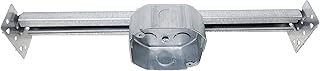
My default recommendation for retrofits into finished ceilings: the adjustable brace spans 16 to 24 inches and transfers load directly into joists rather than drywall, supporting 35 to 70 lb. The 1.5-inch depth gives you real wiring room, which matters if you’re adding a remote receiver or a separate light circuit.
Hubbell-Bell PRCF57550GY Outdoor Fan Box
For covered patios and screened porches — increasingly popular as warm-weather sleeping spaces — this weatherproof PVC box resists the corrosion that destroys steel enclosures. The 45-degree mounting option and three included reducer bushings make it flexible for angled or vaulted overhangs.
RACO 8293 4-Inch Round Ceiling Pan
A half-inch-deep pancake box for situations where there is simply no room between the ceiling surface and framing above. Mount it directly into solid wood and pair it with a fan-rated mounting screw set; verify your conductor count against its limited volume before committing.
4″ Round Shallow Electrical Boxes (2-Pack)
Sensible value if you’re outfitting two bedrooms in one weekend, with bottom and side knockouts for straightforward cable routing. Best suited to lighter fans and light fixtures where framing above is solid and accessible.
Frequently Asked Questions
Can I hang a ceiling fan from my existing light fixture box?
Almost never. Standard fixture boxes are rated for static weight only and are often nailed to a joist face or supported by drywall. Replace it with a fan-rated box — this is the single most common cause of wobble and eventual failure.
Does the box really affect how quietly a fan runs?
Yes, meaningfully. A loose or flexing box amplifies motor vibration into the ceiling cavity, producing a low hum and periodic click that the brain registers even in light sleep. A rigidly braced box turns the same fan into steady, unobtrusive airflow.
How much weight capacity do I actually need?
Most residential fans weigh 15 to 35 lb. A 50 lb rating provides comfortable margin; step up to a 70 lb-rated brace for large-diameter, damp-rated, or chandelier-style fans.
Do I need an electrician?
If you’re comfortable killing the circuit at the panel, verifying it with a non-contact tester, and working overhead, retrofit braces are DIY-friendly. Unfamiliar wiring colors, aluminum conductors, or knob-and-tube systems warrant a licensed pro.
Final Thoughts
For most bedrooms with finished ceilings, the RACO RETRO-BRACE 936 is the most reliable path to a silent, rock-solid fan. Choose the Southwire MSBFAN when ceiling depth is uneven and flush seating matters, and reach for the Hubbell-Bell PRCF57550GY for any covered outdoor sleeping space where moisture is a factor.