Key takeaways
- Crosscut and bevel capacity: Match the numbers to your real projects. Roughly 12–13 inches of crosscut handles 2×12 framing and most shelving, while 16 inches spans wide stair treads and glued panels. Confirm the bevel range runs a full 0–45° on both sides, since some “dual bevel” saws are asymmetrical.
- Cut-line guidance: Lasers are calibrated to the blade and drift over time; LED shadow systems cast the blade’s actual silhouette onto the stock, which stays accurate for the life of the saw and works in bright garages. If you’re choosing between two similar models, shadow-line is the better long-term bet.
- Motor and speed strategy: A 15-amp motor is the practical floor for a corded 10- or 12-inch saw. Speed matters as much as power — 3,800–4,000 RPM suits wood, while a two-speed saw dropping to around 3,200 RPM lets you cut aluminum and PVC without melting or grabbing.
- Detents, fence, and slide design: Nine positive stops cover common angles instantly, but check that the override lets you dial in odd numbers for out-of-square walls. Tall sliding fences support crown nested in position, and rail-free or compact-slide designs let the saw sit flush against a wall — useful in a shared garage.
- Dust control and noise: Bag collection captures a fraction of the fines. Look for a shrouded port that mates to a 2.5-inch shop vac hose, and plan cut sessions to end well before household bedtime — direct extraction plus earmuffs protects both hearing and everyone’s sleep.
What's inside
Most people don’t shop for a miter saw until a project stalls. The crown molding won’t close at the corner, the deck fascia leaves a hairline gap, and suddenly a chop saw that only tilts one direction feels less like a tool and more like an obstacle. Flipping heavy stock end-over-end to cut a matching bevel is where accuracy quietly dies — and where a weekend build turns into three evenings of sanding, shimming, and caulking over your own mistakes. A dual bevel sliding saw removes that step entirely: the head leans both left and right, so mirrored cuts happen without ever repositioning the workpiece.
There’s a second factor few buying guides mention, and as someone who spends most of my time helping people protect their rest, I’d argue it matters more than spec sheets suggest. A miter saw is one of the loudest, dustiest machines a homeowner will ever run indoors, and a garage build session that stretches past 9 p.m. bleeds into the household’s wind-down window — noise spikes and airborne particulate both degrade sleep quality for everyone under the roof. Faster, cleaner, first-try-accurate cuts mean shorter sessions and fewer late nights. This guide covers the specs that actually change results, then reviews five dual bevel sliding saws worth owning in 2026, from a value-forward 12-inch package to professional-grade cabinet-shop machines.
As an Amazon Associate we earn from qualifying purchases.




🛒 Best Price Today on Amazon
Prime members get fast, free shipping on everything above, plus member-only deals. New members get a 30-day free trial — cancel anytime.
How to Choose a Dual Bevel Sliding Miter Saw (2026)
- Crosscut and bevel capacity: Match the numbers to your real projects. Roughly 12–13 inches of crosscut handles 2×12 framing and most shelving, while 16 inches spans wide stair treads and glued panels. Confirm the bevel range runs a full 0–45° on both sides, since some “dual bevel” saws are asymmetrical.
- Cut-line guidance: Lasers are calibrated to the blade and drift over time; LED shadow systems cast the blade’s actual silhouette onto the stock, which stays accurate for the life of the saw and works in bright garages. If you’re choosing between two similar models, shadow-line is the better long-term bet.
- Motor and speed strategy: A 15-amp motor is the practical floor for a corded 10- or 12-inch saw. Speed matters as much as power — 3,800–4,000 RPM suits wood, while a two-speed saw dropping to around 3,200 RPM lets you cut aluminum and PVC without melting or grabbing.
- Detents, fence, and slide design: Nine positive stops cover common angles instantly, but check that the override lets you dial in odd numbers for out-of-square walls. Tall sliding fences support crown nested in position, and rail-free or compact-slide designs let the saw sit flush against a wall — useful in a shared garage.
- Dust control and noise: Bag collection captures a fraction of the fines. Look for a shrouded port that mates to a 2.5-inch shop vac hose, and plan cut sessions to end well before household bedtime — direct extraction plus earmuffs protects both hearing and everyone’s sleep.
The Best Dual Bevel Sliding Miter Saw (2026)s Reviewed
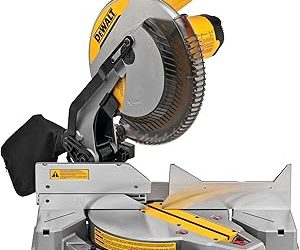
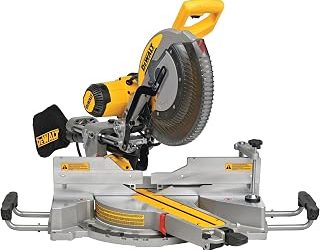
DEWALT DWS780 12-Inch Double Bevel Sliding Compound Miter Saw
The XPS LED shadow light is the reason this saw remains the reference point for trim carpenters — no calibration, no batteries, just a true blade line on your pencil mark. Detents are crisp, the bevel scale is readable from a standing position, and it arrives ready to work with a clamp, wrench, and bag included.
Makita LS1219L 12-Inch Dual-Bevel Sliding Compound Miter Saw
Makita’s compact dual-rail slide delivers a 13-plus-inch crosscut while allowing the saw to sit close to a wall, which reclaims real bench depth in a small shop. It’s the smoothest, quietest-feeling cut action in this group, with a laser and excellent soft-start motor control.
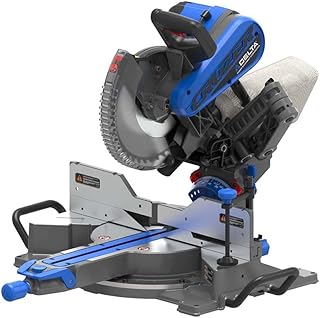
Delta 26-2310 10-Inch Dual Bevel Sliding Miter Saw
A 16-inch crosscut from a 10-inch blade is the standout figure here, making this the pick for stair treads, wide shelves, and panel work. The 15-amp, 4,000 RPM motor keeps thinner 10-inch blades cutting cleanly, and smaller blades cost less to replace.
DOVAMAN 12-Inch Dual-Bevel Sliding Miter Saw
Ambidextrous controls are genuinely useful for left-handed users and awkward site positions, and the 4.2 x 13-inch capacity with nine positive stops covers nearly all home furniture work. Strong value for a first serious saw.
DOVAMAN Dual Bevel 10-Inch Sliding Miter Saw
The two-speed motor and three included TCT blades make this the most versatile multi-material option, handling aluminum extrusion and PVC alongside hardwood. LED shadow-line guidance at this price point is unusual and welcome.
Frequently Asked Questions
Is dual bevel worth the extra cost over single bevel?
If you cut crown molding, baseboard returns, or any mirrored pair, yes. Dual bevel eliminates flipping stock, which is the single largest source of mismatched corners for DIY users.
Do I need a 12-inch blade?
Not always. A sliding 10-inch saw can out-crosscut a 12-inch chop saw; the 12-inch advantage shows up mainly in vertical capacity for tall baseboard and thick posts.
How loud are these saws, and can I use one in the evening?
Peak cutting noise typically lands in the 95–105 dB range, well above the threshold for hearing protection and far above what sleeping family members or neighbors tolerate. Wear muffs, and batch your cuts into daylight or early-evening blocks.
Is a shop vac better than the included dust bag?
Considerably. Bags catch chips but release fine dust that lingers in indoor air for hours, so connect a vac — ideally with a HEPA filter — if your shop shares air with living or sleeping space.
Final Thoughts
For most home furniture builders, the DEWALT DWS780 is the safest investment thanks to its shadow-line accuracy and long-term parts support. Choose the Makita LS1219L if shop space is tight and cut quality is your priority, or the Delta 26-2310 when wide crosscut capacity matters more than blade diameter. Whichever you pick, pair it with a shop vac and hearing protection — finish faster, cut cleaner, and keep the house sleeping.