Key takeaways
- Crosscut capacity: Measure your widest planned board before you shop. A 10-inch slider handling roughly 3.5 x 13.4 inches covers headboard rails, bed slats, and shelving; 12-inch models buy you depth for thick bed posts and wide trim.
- Single vs. dual bevel: Single-bevel saws tilt one way and force you to flip the workpiece. Dual-bevel saws tilt both directions, which pays off immediately on crown, plinths, and any project with mirrored miters on left and right.
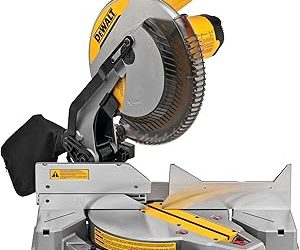
- Cut-line guidance: Lasers are helpful but drift out of calibration. LED shadow-line systems, like DEWALT’s XPS, cast the blade’s own silhouette onto the wood and need no adjusting — a genuine accuracy advantage.
- Detents and fence quality: Positive stops at common angles speed up repetitive work, but a tall, square, machined fence matters more. Check that it holds a 4-inch board upright without flexing.
- Dust and noise management: Bag collection is mediocre on every saw made; plan for a shop vac port. If you’re working in a garage attached to bedrooms, sound matters more than spec sheets admit — brushless and lower-RPM machines are noticeably less punishing.
What's inside
Anyone who has tried to build a bed frame, a headboard, or a run of floating nightstands knows the moment it all goes wrong: the miter joint that looks fine on the workbench and gapes open once the piece is standing upright in a bedroom. As someone who spends most of my working life thinking about sleep environments — and who has assembled, repaired, and rebuilt more bed frames than I care to count — I can tell you that the difference between furniture that quietly disappears into a restful room and furniture that squeaks, racks, and irritates you at 2 a.m. usually comes down to the accuracy of a handful of cuts. A sliding compound miter saw is the tool that makes those cuts repeatable.
The problem is that the category is crowded and the marketing is noisy. Fifteen amps, dual bevels, lasers, shadow lines, RPM figures — most of it is real, some of it is decoration, and very little of it is explained in terms of the work you actually plan to do at home. This guide cuts through that. Below you’ll find the saws worth considering in 2026, a short framework for choosing between them, honest notes on where each one earns its keep, and answers to the questions that come up most often from people building bedroom and living-room furniture rather than framing houses.
As an Amazon Associate we earn from qualifying purchases.




🛒 Best Price Today on Amazon
Prime members get fast, free shipping on everything above, plus member-only deals. New members get a 30-day free trial — cancel anytime.
How to Choose a/an 10 Sliding Compound Miter Saw (2026)
- Crosscut capacity: Measure your widest planned board before you shop. A 10-inch slider handling roughly 3.5 x 13.4 inches covers headboard rails, bed slats, and shelving; 12-inch models buy you depth for thick bed posts and wide trim.
- Single vs. dual bevel: Single-bevel saws tilt one way and force you to flip the workpiece. Dual-bevel saws tilt both directions, which pays off immediately on crown, plinths, and any project with mirrored miters on left and right.
- Cut-line guidance: Lasers are helpful but drift out of calibration. LED shadow-line systems, like DEWALT’s XPS, cast the blade’s own silhouette onto the wood and need no adjusting — a genuine accuracy advantage.
- Detents and fence quality: Positive stops at common angles speed up repetitive work, but a tall, square, machined fence matters more. Check that it holds a 4-inch board upright without flexing.
- Dust and noise management: Bag collection is mediocre on every saw made; plan for a shop vac port. If you’re working in a garage attached to bedrooms, sound matters more than spec sheets admit — brushless and lower-RPM machines are noticeably less punishing.
The Best 10 Sliding Compound Miter Saw (2026)s Reviewed
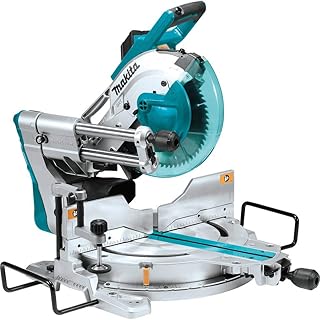
Makita LS1019L 10″ Dual-Bevel Slider
My pick for furniture work: the twin-rail forward slide keeps it close to the wall, the bevel scales are legible and hold their setting, and the cut quality out of the box is the cleanest in this group. If you want joints that close without filler, this is the machine.
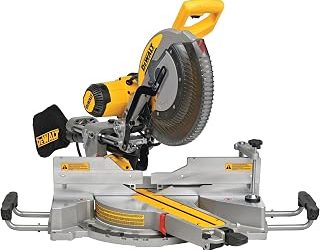
DEWALT DWS780 12-Inch Double Bevel Slider
The XPS shadow light alone justifies the price for anyone doing precise layout work, and the 12-inch blade gives you real headroom on thick stock. Heavy, loud, and worth it if your projects are bigger than nightstands.
DEWALT DWS779 12-Inch Double Bevel Slider
Mechanically very close to the DWS780 but without the shadow light, which makes it the value play for anyone comfortable working off the blade edge. Strong crosscut capacity and a motor that doesn’t bog in hardwood.
DOVAMAN Updated 10-Inch Sliding Miter Saw
A well-thought-out budget entry: three included TCT blades, dual speeds for wood and softer metals, ambidextrous controls, and nine detents. Fit and finish trail the name brands, but for occasional furniture builds it punches above its price.
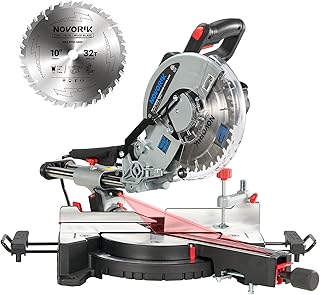
NOVORIK Single Bevel Compound Sliding Miter Saw
A straightforward 15-amp single-bevel 10-inch saw with a laser guide and decent factory blade. Expect to check the fence for square on arrival; once dialed in, it handles slats, rails, and trim capably.
Frequently Asked Questions
Is 10 inches enough for building a bed frame?
For almost every standard bed frame, yes. A 10-inch slider crosscuts wide side rails and slat stock comfortably. You’d only want 12 inches for chunky four-poster components or thick reclaimed timber.
Do I actually need the sliding function?
If you cut anything wider than about 6 inches — and furniture work constantly does — then yes. A fixed compound saw will leave you flipping boards and chasing mismatched cuts.
Are the factory blades usable?
They’re usable for rough work. For visible furniture joints, fit an 60–80 tooth fine-crosscut blade; it’s the single cheapest upgrade to your results.
Can I use one of these indoors?
Only with serious dust extraction and hearing protection. Fine wood dust lingers in soft furnishings and bedding, so I’d keep the saw in a garage or outdoors and bring components inside for assembly.
Final Thoughts
For most people building furniture destined for a bedroom, the Makita LS1019L is the saw I’d buy — compact, accurate, and pleasant to live with. If your projects run heavier, the DEWALT DWS780 and its shadow-line system is the more capable machine, with the DWS779 offering nearly the same performance for less if you can do without the light.