Key takeaways
- Noise floor over headline decibels: A “28dB” or “20dB” rating describes the quietest setting, not your working setting. What matters is how loud the fan is at the speed that actually keeps you comfortable — which is why DC models with nine to seventeen increments outperform four-speed AC fans for sleep. You can dial in “just enough” airflow instead of overshooting into audible territory.
- Airflow velocity vs. usable reach: Figures between 26 and 29 ft/s are all more than adequate for a bedroom; the difference shows up in large or open-plan rooms where you need throw distance. If your fan sits within six feet of the bed, prioritize fine speed control over raw velocity.
- Oscillation width and placement: Ninety degrees is right for a fan positioned at the foot of the bed or in a corner. A 120° sweep is worth paying for when the unit has to serve two sleepers, a bed plus a seating area, or a room where you can’t put it directly in front of the target.
- Sleep mode and timer logic: Look for a fan that steps speed down progressively rather than simply switching off, and that dims or kills its display without a workaround. Twelve-hour timers give you more granularity than eight-hour ones, which is useful if you want airflow to taper before your alarm.
- Height, footprint, and controls: Adjustable-height towers direct air above mattress level, which reduces the dry-eye and stiff-neck complaints that come from a jet aimed at your face all night. Remote control is a baseline expectation; app and voice control matter mainly if you want scheduling or hands-free adjustment in the dark.
What's inside
Most people shop for a bedroom fan in the middle of a heat wave, when the only criterion that feels urgent is “move air, fast.” That’s how you end up with a machine that cools the room beautifully and then keeps you in light, fragmented sleep all night — because airflow is only half the equation. The other half is what the fan does to your acoustic environment, and specifically whether its sound stays steady and broadband or fluctuates in a way your brain keeps flagging as new information. A fan that surges, ticks, or whines at 3 a.m. will pull you out of slow-wave sleep even when you don’t fully wake up and remember it.
Dreo has become a default recommendation in sleep circles for one unglamorous reason: the brand leaned hard into DC motors and low-speed tuning, which is exactly what a bedroom needs. This guide looks at six Dreo tower fans through a sleep-quality lens — measured noise floor at usable speeds, how convincingly their “sleep” and “natural” modes vary airflow, oscillation coverage for beds pushed against a wall, timer behavior, and whether smart control actually earns its place in a bedroom. Below you’ll find the shortlist, a buying framework, individual assessments, and answers to the questions that come up most often.
As an Amazon Associate we earn from qualifying purchases.


How to Choose a Dreo Tower Fan (2026)
- Noise floor over headline decibels: A “28dB” or “20dB” rating describes the quietest setting, not your working setting. What matters is how loud the fan is at the speed that actually keeps you comfortable — which is why DC models with nine to seventeen increments outperform four-speed AC fans for sleep. You can dial in “just enough” airflow instead of overshooting into audible territory.
- Airflow velocity vs. usable reach: Figures between 26 and 29 ft/s are all more than adequate for a bedroom; the difference shows up in large or open-plan rooms where you need throw distance. If your fan sits within six feet of the bed, prioritize fine speed control over raw velocity.
- Oscillation width and placement: Ninety degrees is right for a fan positioned at the foot of the bed or in a corner. A 120° sweep is worth paying for when the unit has to serve two sleepers, a bed plus a seating area, or a room where you can’t put it directly in front of the target.
- Sleep mode and timer logic: Look for a fan that steps speed down progressively rather than simply switching off, and that dims or kills its display without a workaround. Twelve-hour timers give you more granularity than eight-hour ones, which is useful if you want airflow to taper before your alarm.
- Height, footprint, and controls: Adjustable-height towers direct air above mattress level, which reduces the dry-eye and stiff-neck complaints that come from a jet aimed at your face all night. Remote control is a baseline expectation; app and voice control matter mainly if you want scheduling or hands-free adjustment in the dark.
The Best Dreo Tower Fans (2026) Reviewed
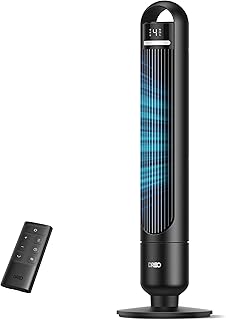
Dreo Smart Tower Fan, 40″–45″ Adjustable Height
The strongest all-round bedroom choice here: a 20dB floor, nine DC speeds, and a height range that lets you aim airflow over the mattress rather than across it. Alexa and Google support make it easy to adjust without turning on a lamp — a genuinely underrated feature for anyone who wakes at night.
Dreo Smart Tower Fan, 120° Oscillating, 12 Speeds
Best suited to shared bedrooms and larger spaces, where the wider sweep and twelve-step DC motor let you cover two sleepers without blasting either one. App scheduling is the practical draw: set it to ramp down an hour after lights-out and forget about it.
Dreo Tower Fan, Upgraded DC 28ft/s, 9 Speeds
A bladeless DC tower that delivers strong airflow while keeping its low speeds genuinely unobtrusive, with a 12-hour timer and four modes. If you want the sleep-friendly motor without paying for smart features you won’t use, this is the value pick.
Dreo Tower Fan, 40″ Standing, 5 Speeds, 4 Modes
The taller 40-inch body raises the airstream to a more comfortable level, and five speeds plus four modes give you reasonable control for the price. A sensible middle ground for a guest room or home office.
Dreo Tower Fan, 26ft/s, 4 Speeds, 8H Timer
The entry model, and still a competent quiet fan for a small bedroom — though four speeds and an 8-hour timer limit how finely you can tune it. Consider it if budget is the deciding factor and the room is compact.
Frequently Asked Questions
Is sleeping with a fan on all night actually bad for you?
For most people, no. The common complaints — dry eyes, nasal congestion, morning stiffness — come from direct airflow on the face and body, not from the fan itself. Angle the unit past the bed, raise its height, or use a taper-down mode and those issues largely disappear.
Does a fan help you sleep, or just cool the room?
Both, and the cooling matters more than people expect. Core temperature has to drop to initiate and maintain sleep, and gentle air movement accelerates that. The steady broadband sound is a secondary benefit, useful mainly for masking intermittent noise from outside.
Are DC motor fans worth the extra cost?
For a bedroom, yes. They draw less power, run cooler, and — critically — offer far more speed increments, so you can find a setting that’s comfortable without being audible. AC fans tend to jump from “too little” to “too loud.”
Should I get the fan and heater combo instead?
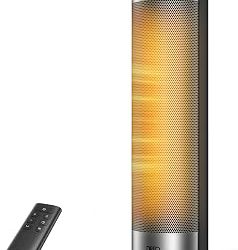
The Dreo Tower Fan and Heater Combo makes sense if storage is tight or you want one unit for a home office year-round. For pure sleep performance, a dedicated fan with a lower noise floor is the better call.
Final Thoughts
If you want the best sleep outcome, start with the Dreo Smart Tower Fan with adjustable 40″–45″ height — the combination of a 20dB floor, nine DC speeds, and airflow you can raise above the mattress addresses the real reasons fans disrupt rest. Shared or larger bedrooms are better served by the 120° Oscillating Smart Tower Fan, while the Upgraded DC 28ft/s model delivers most of the same sleep-friendly motor behavior at a lower price.