Key takeaways
- Match capacity to cubic feet, not marketing claims: A “1000 sq ft” rating assumes an open, moderately humid space. A sealed 40–60 sq ft bathroom generates far more moisture per square foot, so a 95 oz unit gives you headroom between empties rather than overkill.
- Prioritize sub-40 dB operation: Peltier units have no compressor, which is why they whisper. If the bathroom shares a wall with a bedroom, look for a documented sleep or night mode that also dims the display — light leakage under a door suppresses melatonin as effectively as noise disrupts sleep.
- Insist on auto shut-off: A full tank in an unattended bathroom is an overflow risk. Every model worth buying stops the fan and signals when the reservoir hits capacity; verify it’s automatic, not just an indicator light.
- Check the footprint against your actual surface: Vent-free bathrooms are usually small bathrooms. Measure the vanity corner or floor space you can genuinely spare, and favor a narrow vertical body over a wide one.
- Treat ambient lighting as a feature, not a gimmick: A warm amber setting doubles as a low-glare night light for 2 a.m. trips, which helps you avoid switching on a bright overhead fixture and resetting your circadian signal.
What's inside
A bathroom with no exhaust fan is a closed feedback loop: every hot shower releases a liter or more of water vapor into the air, and with nowhere to go, that moisture settles into grout, drywall, towels, and the underside of vanity cabinets. Within weeks you get the telltale signs — a mirror that never fully clears, a musty edge to the laundry, dark speckling along the silicone seams. From a sleep-wellness standpoint this matters more than most people realize, because an unvented bathroom sits adjacent to the room where you spend a third of your life. Airborne mold spores and dust mite populations both thrive above roughly 60% relative humidity, and both are well-documented triggers for the nighttime congestion and micro-arousals that fragment deep sleep.
The fix is not a full renovation. A compact thermo-electric (Peltier) dehumidifier draws moisture out of the air continuously and silently, with no ductwork and no plumbing — you simply empty a tank. This guide covers the units that actually suit a small, enclosed, vent-free bathroom: what tank capacity and coverage figures really mean, why noise output deserves as much attention as extraction rate when the unit runs near a bedroom, and which specific models earn their place. Below are our current picks, followed by a buying framework and individual reviews.
As an Amazon Associate we earn from qualifying purchases.



How to Choose a/an Dehumidifier For Bathroom Without Vent (2026)
- Match capacity to cubic feet, not marketing claims: A “1000 sq ft” rating assumes an open, moderately humid space. A sealed 40–60 sq ft bathroom generates far more moisture per square foot, so a 95 oz unit gives you headroom between empties rather than overkill.
- Prioritize sub-40 dB operation: Peltier units have no compressor, which is why they whisper. If the bathroom shares a wall with a bedroom, look for a documented sleep or night mode that also dims the display — light leakage under a door suppresses melatonin as effectively as noise disrupts sleep.
- Insist on auto shut-off: A full tank in an unattended bathroom is an overflow risk. Every model worth buying stops the fan and signals when the reservoir hits capacity; verify it’s automatic, not just an indicator light.
- Check the footprint against your actual surface: Vent-free bathrooms are usually small bathrooms. Measure the vanity corner or floor space you can genuinely spare, and favor a narrow vertical body over a wide one.
- Treat ambient lighting as a feature, not a gimmick: A warm amber setting doubles as a low-glare night light for 2 a.m. trips, which helps you avoid switching on a bright overhead fixture and resetting your circadian signal.
The Best Dehumidifier For Bathroom Without Vent (2026)s Reviewed
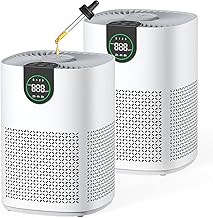
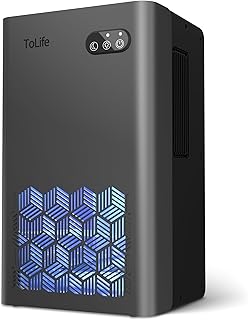
ToLife 95 oz Dehumidifier with Sleep Mode
Our overall pick, largely because the sleep mode is genuinely engineered rather than badged on — fan speed and display brightness both drop, so it can run through the night without intruding. The 95 oz tank means a household of two can shower daily and empty it roughly twice a week.
95 oz Dehumidifier with 7-Color Ambient Light (Black)
Functionally close to the ToLife but with a matte black shell that hides splash marks better in a bathroom setting. Quiet, reliable auto shut-off, and the warm end of the color range makes a serviceable nightlight.
1000 Sq Ft Dehumidifier with 95 oz Tank (Grey)
A sensible pick if your unvented bathroom opens onto a hallway or bedroom, since the generous coverage rating lets it manage both spaces with the door ajar. Build quality is straightforward and the tank seats cleanly, which is more than can be said for many units in this class.
60 oz Dual-Semiconductor Dehumidifier with Timer
The dual-semiconductor design extracts noticeably faster than single-element rivals, and the timer is the standout: set it for two hours post-shower and it handles the peak moisture load without running all day. Also the best choice for an RV bathroom.
Deyagoo 50 oz Small Dehumidifier
The right answer for a genuinely tiny powder room or en-suite under about 300 sq ft, where a larger tank is just wasted floor space. Energy-efficient, near-silent, and light enough to relocate to a closet between uses.
Frequently Asked Questions
Will a small dehumidifier really work in a bathroom with no fan?
Yes, provided you size it sensibly and run it consistently. These units won’t clear a fogged mirror in ninety seconds the way an exhaust fan does, but they steadily hold relative humidity in the 45–55% range, which is the band where mold and dust mites can’t establish.
Where should I position it?
On the floor, a few inches clear of walls, away from the direct shower spray zone. Moist air is denser and pools low, and Peltier units need unobstructed intake and exhaust airflow to work efficiently.
Can I leave it running overnight?
That’s arguably the ideal schedule. Overnight operation targets the residual moisture left by evening showers, and with auto shut-off engaged there’s no overflow risk. Use sleep mode so neither noise nor light reaches the bedroom.
How often will I be emptying the tank?
In a typical unvented bathroom, expect every two to four days for a 95 oz reservoir and every one to two days for a 35–60 oz model. Rinse the tank weekly to prevent biofilm forming in standing water.
Final Thoughts
For most unvented bathrooms, the ToLife 95 oz with sleep mode is the one to buy — it balances tank size, genuine quietness, and thoughtful night-time behavior better than anything else in the category. If your bathroom is small enough that floor space is the binding constraint, the Deyagoo 50 oz is the smarter fit, while the 60 oz dual-semiconductor model with its programmable timer is the pick for anyone who wants targeted post-shower cycles rather than continuous running.