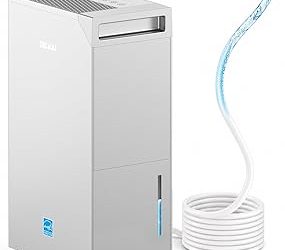
Key takeaways
- Confirm the thread standard: Nearly all residential dehumidifiers use a 3/4-inch FHT (female hose thread) port — the same standard as a garden spigot. Check your manual before ordering; a handful of compact units use a push-fit barb instead and need an adapter.
- Choose brass over plastic fittings: Plastic connectors are the single most common failure point. Brass threads seat evenly against the port gasket, tolerate repeated removal for cleaning, and won’t crack under the torque of a hand-tightened seal.
- Buy for kink resistance, not length: A thin-walled hose folds shut wherever it turns a corner, and a blocked line backs water into the reservoir. Look for thickened or reinforced walls that hold a curve behind a dresser or nightstand.
- Measure your true run, then add a little: Gravity drainage needs continuous downhill slope, so measure the actual path around furniture rather than the straight-line distance. Excess coil is fine; a hose stretched taut and dipping upward is not.
- Prioritize a leak-proof seal in sleeping spaces: A slow drip in a bedroom is worse than an empty bucket — it means dampness, odor, and eventually mold in the exact room you’re trying to keep dry. Choose a hose with a gasketed connector and check it a week after installation.
What's inside
Most people trace bad sleep back to caffeine, screens, or stress — rarely to the bedroom’s relative humidity. Yet a room sitting above 60% RH interferes with the body’s ability to shed heat overnight, which is exactly what your core temperature needs to do for deep sleep to consolidate. Damp air also feeds dust mites and mold spores, the two most common triggers of the 3 a.m. congestion that fragments sleep without ever fully waking you. A dehumidifier fixes the air. What it doesn’t fix is the bucket you have to remember to empty, or the drone of the compressor cycling harder because that bucket filled up and shut the unit down at 1 a.m.
A gravity drain hose solves that problem for roughly the cost of a takeout lunch. Screw it onto the unit’s drain port, run it to a floor drain, sump, or condensate pump, and the machine simply runs — silently, continuously, unattended. The catch is that a cheap hose kinks behind furniture, and a cheap fitting corrodes into a slow drip you don’t notice until the baseboard swells. Below I’ve assessed the hoses currently worth buying in 2026, judged on fitting metallurgy, kink resistance, and how quietly and reliably they disappear into the background of a bedroom.
As an Amazon Associate we earn from qualifying purchases.




🛒 Best Price Today on Amazon
Prime members get fast, free shipping on everything above, plus member-only deals. New members get a 30-day free trial — cancel anytime.
How to Choose a Dehumidifier Drain Hose (2026)
- Confirm the thread standard: Nearly all residential dehumidifiers use a 3/4-inch FHT (female hose thread) port — the same standard as a garden spigot. Check your manual before ordering; a handful of compact units use a push-fit barb instead and need an adapter.
- Choose brass over plastic fittings: Plastic connectors are the single most common failure point. Brass threads seat evenly against the port gasket, tolerate repeated removal for cleaning, and won’t crack under the torque of a hand-tightened seal.
- Buy for kink resistance, not length: A thin-walled hose folds shut wherever it turns a corner, and a blocked line backs water into the reservoir. Look for thickened or reinforced walls that hold a curve behind a dresser or nightstand.
- Measure your true run, then add a little: Gravity drainage needs continuous downhill slope, so measure the actual path around furniture rather than the straight-line distance. Excess coil is fine; a hose stretched taut and dipping upward is not.
- Prioritize a leak-proof seal in sleeping spaces: A slow drip in a bedroom is worse than an empty bucket — it means dampness, odor, and eventually mold in the exact room you’re trying to keep dry. Choose a hose with a gasketed connector and check it a week after installation.
The Best Dehumidifier Drain Hoses (2026) Reviewed
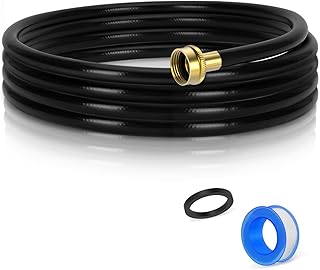
12FT Dehumidifier Drain Hose with 3/4″ FHT Brass Connector
The most versatile pick here, and my default recommendation for bedrooms where the nearest drain is down a hall or in an adjoining laundry room. Twelve feet gives you room to route the line along a baseboard instead of across a walkway, and the rust-resistant brass fittings hold a dry seal through repeated seasonal disconnection.
No-Kink Dehumidifier Hose, 3/4″ FHT, 5 Feet
Built specifically to resist collapsing at tight bends, which matters when the unit sits in a closet or a corner with a hard turn to the drain. The matte black jacket is also the least visually intrusive option if the hose has to cross open floor.
Dehumidifier Drain Hose, 7 Length Options, Brass Fittings
Same well-made brass hardware as the 12-foot model but sold across seven lengths, so you can buy close to your measured run rather than managing a pile of surplus coil. Ideal for basement bedrooms and finished lower levels with a floor drain nearby.
5FT Thickened Leakproof Dehumidifier Drain Hose, 3/4″ FHT
The heavy wall thickness is the differentiator: it stays round under its own weight and shrugs off being nudged by a vacuum or a chair leg. A strong short-run choice for a unit parked beside a sump pit or utility sink.
Premium Brass Connector Dehumidifier Hose, 3/4″ FHT, 5FT
Fitting quality is the standout, with cleanly machined brass that threads on without cross-binding — worth the small premium if you’re draining over finished flooring. Best suited to short, simple routes where you want maximum confidence in the joint.
Frequently Asked Questions
Will a drain hose make my dehumidifier quieter?
Indirectly, yes. Continuous drainage keeps the unit from filling, shutting down, and later restarting — and it’s those start-up surges and full-tank alarm chimes that most often intrude on light sleep.
What humidity should I target for sleep?
Aim for 40–50% RH. That range suppresses dust mite reproduction and mold growth while staying high enough to avoid the dry throat and nasal irritation that come with over-drying a bedroom.
Do I need a pump, or is gravity enough?
Gravity works only if the drain sits lower than the unit’s outlet along the entire run. If the hose must rise at any point, add a small condensate pump; a hose alone will back up.
How often should the hose be cleaned?
Flush it with warm water and a little white vinegar every two to three months during heavy use. Condensate is clean water, but biofilm still develops inside the line and can slow flow or create odor.
Final Thoughts
For most bedrooms, the 12FT brass-fitted hose is the safest buy — the extra length lets you route it discreetly and out of foot traffic. If your drain is close by, the No-Kink 5-Foot hose is the tidiest short-run option, while the Premium Brass Connector 5FT model is worth the upgrade when the line passes over flooring you can’t afford to have wet.