Key takeaways
- Seat-to-counter clearance: Measure your counter’s underside and subtract 10–12 inches to find your seat height. Too little clearance forces shoulder elevation; too much drops the arms and rounds the upper back — both are postures that keep muscles switched on when they should be releasing.
- Real lumbar contact: A backrest that touches only the shoulder blades encourages slumping. Look for contoured or barrel-shaped backs that meet the lower spine, which lets the pelvis stay neutral and the diaphragm move freely.
- Seat depth and edge softness: A firm front edge presses into the back of the thighs and restricts circulation during longer sits. Padded, slightly rolled edges are worth prioritizing if evening conversations at your island run past twenty minutes.
- Weight capacity as a stability signal: Ratings of 400 lbs and above usually indicate thicker gauge metal and better joinery. Wobble is a subtle stressor — the body braces against it constantly, and bracing is the opposite of winding down.
- Surface material and temperature: Bonded leather and PU wipe clean and suit busy kitchens; linen and woven fabrics breathe better and feel warmer against skin, which matters if your evening routine involves relaxing rather than refueling.
What's inside
Most people never connect their kitchen stools to how they sleep, but I’ve spent years helping clients audit the hours between dinner and bedtime — and a surprising amount of that window happens at a counter. It’s where the last coffee gets poured, where homework gets finished, where the phone comes out “for a second” at 10:40 p.m. If the seat is hard, backless, or the wrong height, the body compensates by hunching forward, tightening the hip flexors and shallowing the breath. That low-grade physical tension follows you upstairs and makes it harder for your nervous system to downshift into sleep.
This guide looks at counter height stools through that lens: postural support, materials that stay comfortable during a slow evening, and stability you don’t have to think about. I’ve focused on 24–27 inch models suited to standard 36 inch counters and kitchen islands, and I’ve flagged where backrests, swivels, and seat depth actually matter for people who linger rather than perch. Below you’ll find current picks, followed by the buying criteria I use myself.
As an Amazon Associate we earn from qualifying purchases.


🛒 Best Price Today on Amazon
Prime members get fast, free shipping on everything above, plus member-only deals. New members get a 30-day free trial — cancel anytime.
How to Choose Counter Height Stools (2026)
- Seat-to-counter clearance: Measure your counter’s underside and subtract 10–12 inches to find your seat height. Too little clearance forces shoulder elevation; too much drops the arms and rounds the upper back — both are postures that keep muscles switched on when they should be releasing.
- Real lumbar contact: A backrest that touches only the shoulder blades encourages slumping. Look for contoured or barrel-shaped backs that meet the lower spine, which lets the pelvis stay neutral and the diaphragm move freely.
- Seat depth and edge softness: A firm front edge presses into the back of the thighs and restricts circulation during longer sits. Padded, slightly rolled edges are worth prioritizing if evening conversations at your island run past twenty minutes.
- Weight capacity as a stability signal: Ratings of 400 lbs and above usually indicate thicker gauge metal and better joinery. Wobble is a subtle stressor — the body braces against it constantly, and bracing is the opposite of winding down.
- Surface material and temperature: Bonded leather and PU wipe clean and suit busy kitchens; linen and woven fabrics breathe better and feel warmer against skin, which matters if your evening routine involves relaxing rather than refueling.
The Best Counter Height Stools (2026) Reviewed
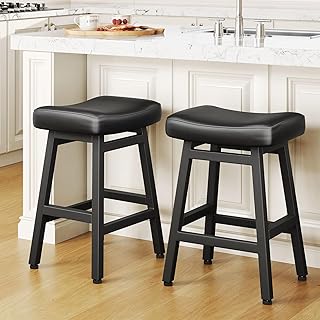
Raynesys 24″ Bonded Leather Curved Stools (Set of 2)
The curved seat is the standout here — it cradles the sit bones instead of letting you slide forward, which quietly discourages the forward-lean posture that stiffens the neck. Heavy duty metal legs keep things planted, and the all-black bonded leather is the most forgiving surface on this list for households with kids and late snacks.
26″ Modern Barrel Counter Stools with Arms (Set of 2)
Barrel backs wrap around the ribcage and give the lower spine somewhere to rest, and the arms let the shoulders drop rather than hover — a small change that makes a real difference to upper-body tension by the end of the day. With a 450 lb rating and linen upholstery, this is the pick I’d suggest for anyone who genuinely sits and unwinds at the counter.
TAVR 24″ Faux Leather Barstools (Set of 2)
An armless profile with a soft, low backrest, so you get spinal support without the bulk — useful in narrow galley kitchens where wide stools crowd the walkway. The 500 lb capacity is the highest here, and it shows in how little these move under shifting weight.
FIRAVOE 26″ Upholstered Barstools (Set of 4)
The most sensible option if you’re seating a full family or hosting regularly, with thickened metal legs that hold up better than the price suggests. PU leather in coffee brown hides evening spills, though I’d add a thin cushion if anyone in the household sits for hours.
27″ Sand Linen Swivel Stools with Contoured Backrest (Set of 2)
The 360° swivel is the underrated feature: it lets you turn to face someone without twisting through the lumbar spine, which is where a lot of end-of-day back complaints actually originate. Solid wood legs and breathable sand-colored linen make these the most calming choice aesthetically — pale, warm neutrals suit dimmed evening lighting far better than glossy black.
Frequently Asked Questions
What stool height fits a 36 inch counter?
A 24–26 inch seat height is correct for standard 36 inch counters. Taller 27 inch models suit counters closer to 38 inches or anyone with a longer inseam who finds standard stools cramp the knees.
Are swivel stools worth the extra cost?
If your counter doubles as a social or work surface, yes. Swivels reduce repetitive spinal rotation, and adjustable versions like the Nalupatio set let multiple household members find a neutral posture on the same seat.
Should I choose backless stools to save space?
Only for short, transitional sitting. Without a backrest the postural muscles work continuously, which is fine for ten minutes and counterproductive for an hour of evening screen time.
Does kitchen seating really affect sleep?
Indirectly, but meaningfully. Uncomfortable seating shortens the relaxed, low-stimulation portion of your evening and leaves residual muscular tension — both of which make falling asleep slower and lighter.
Final Thoughts
For most kitchens I’d start with the 26″ Modern Barrel Counter Stools, which offer the best postural support of the group, or the TAVR 24″ set if space is tight and stability is the priority. If your island is where the household genuinely decompresses at night, the 27″ sand linen swivel stools are the most restful choice — breathable, contoured, and easy on the spine when the evening runs long.