Key takeaways
- Airflow at your sleeping height: CFM is the number to watch, but ceiling height changes everything. Under a standard 8-foot ceiling, roughly 3,500–4,500 CFM covers a typical bedroom comfortably; vaulted or open-plan spaces benefit from 5,500 CFM and up, since the air column has farther to travel before it reaches you.
- Motor type and acoustic character: DC motors draw less power and, more importantly, hum at a lower and steadier frequency than most AC units. What disturbs sleep is not volume so much as fluctuation — a fan that changes pitch as it loads up will wake you long before a slightly louder but perfectly constant one does.
- Speed range at the bottom end: Six speeds sounds like marketing until you need one. The lowest setting is the one you’ll live with overnight, so prioritize fans whose speed one is a genuine whisper rather than a slightly restrained version of speed three.
- Mounting and blade clearance: Flush-mount and low-profile designs are the right call for ceilings under about 8.5 feet, keeping blades safely overhead while still moving air. Sloped ceilings need a fan explicitly rated for the angle, and downrods should place blades roughly 8–9 inches below the ceiling for efficient circulation.
- Timers and remote control: A 1/4/8-hour timer lets the fan carry you through sleep onset and then shut off before the early-morning temperature dip, which is when most people wake up cold. A remote or app control means you never have to stand up and reset anything.
What's inside
Most people shop for a ceiling fan the way they shop for a lamp — they look up. But if you have ever laid awake at 1 a.m. while a glass light kit rattled faintly against its housing, or squinted as a motion-triggered bulb flared on above your bed, you already understand the appeal of a fan that does one job well. Sleep quality is built from small physical details: a stable air temperature in the low-to-mid 60s Fahrenheit, gentle and continuous airflow, and no visual noise overhead. A light-free fan removes a heat source, a glare source, and one of the most common mechanical rattles in the whole fixture.
This guide looks at ceiling fans with no light through that lens — airflow you can actually feel at mattress height, motors quiet enough to disappear into the background, and controls that don’t require you to leave a dark room. Below you’ll find our current picks for 2026, followed by the specifications that genuinely matter, honest notes on each model, and answers to the questions readers send us most.
As an Amazon Associate we earn from qualifying purchases.


How to Choose a Ceiling Fan With No Light (2026)
- Airflow at your sleeping height: CFM is the number to watch, but ceiling height changes everything. Under a standard 8-foot ceiling, roughly 3,500–4,500 CFM covers a typical bedroom comfortably; vaulted or open-plan spaces benefit from 5,500 CFM and up, since the air column has farther to travel before it reaches you.
- Motor type and acoustic character: DC motors draw less power and, more importantly, hum at a lower and steadier frequency than most AC units. What disturbs sleep is not volume so much as fluctuation — a fan that changes pitch as it loads up will wake you long before a slightly louder but perfectly constant one does.
- Speed range at the bottom end: Six speeds sounds like marketing until you need one. The lowest setting is the one you’ll live with overnight, so prioritize fans whose speed one is a genuine whisper rather than a slightly restrained version of speed three.
- Mounting and blade clearance: Flush-mount and low-profile designs are the right call for ceilings under about 8.5 feet, keeping blades safely overhead while still moving air. Sloped ceilings need a fan explicitly rated for the angle, and downrods should place blades roughly 8–9 inches below the ceiling for efficient circulation.
- Timers and remote control: A 1/4/8-hour timer lets the fan carry you through sleep onset and then shut off before the early-morning temperature dip, which is when most people wake up cold. A remote or app control means you never have to stand up and reset anything.
The Best Ceiling Fans With No Light (2026), Reviewed
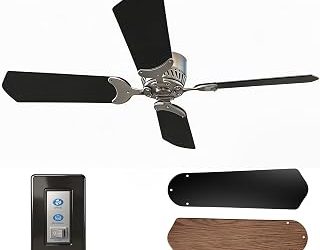
ZMISHIBO 52″ Ceiling Fan, Black (3713 CFM)
This is the most broadly useful fan on the list: 3,713 CFM is more than enough for a standard bedroom or a mid-sized living room, and the reversible DC motor gives you winter circulation without a draft. The six-speed range and 1/4/8-hour timer make it easy to dial in a low overnight setting and let it switch itself off before dawn.
60″ Wood Indoor/Outdoor Fan, Walnut
A 60-inch span is the sweet spot for open bedrooms, sunrooms, and covered porches where you want coverage without cranking the speed — larger blades move the same air more slowly, which almost always means more quietly. The walnut finish and flat-or-sloped-ceiling compatibility make it the most flexible pick here for awkward rooms.
Sofucor 52″ Wood Fan, Flush Mount
Genuinely low-profile fans that still move real air are rare, and this one earns its place in rooms with 7.5-to-8-foot ceilings where a downrod simply isn’t an option. The DC motor, six speeds, timer, and remote give it the same overnight control as taller-mounted models, with a warm wood-grain look that reads as furniture rather than hardware.
Hunter Builder Elite 52″, New Bronze
The pull-chain, no-remote simplicity here is a feature, not a compromise — there’s no receiver to fail, no batteries to replace, and Hunter’s mechanical reliability is well established across decades of these fixtures. Choose it for a guest room, kitchen, or any space where you’d rather set a speed once and forget the fan exists.
ZMISHIBO 65″ Ceiling Fan, Black (6116 CFM)
At 6,116 CFM, this is the pick for high ceilings, large primary bedrooms, garages, and covered patios where smaller fans stir the air near the ceiling and never reach you. The reversible DC motor and six-speed remote let it run gently overnight and then handle serious summer heat when you need it.
Frequently Asked Questions
Does sleeping with a ceiling fan on affect sleep quality?
For most people it helps. Gentle air movement supports the natural drop in core body temperature that initiates sleep, and the consistent low-frequency sound masks intermittent noise from traffic, plumbing, or housemates. If you wake with a dry throat or stiff neck, aim the airflow away from your head or drop to the lowest speed rather than turning the fan off entirely.
Are DC motor fans really quieter than AC models?
Generally yes, and the difference is most noticeable at low speeds, which is exactly where it matters overnight. DC motors also use substantially less electricity — often 60–70% less than a comparable AC fan — so running one all night costs very little.
Can I install a fan with no light in a box that has light wiring?
Yes. An unused light wire is simply capped off inside the canopy, and any fan-rated electrical box will accept a light-free fixture. Confirm the box is rated for fan support, not just lighting weight, since fans impose ongoing rotational stress that standard boxes aren’t built for.
Which direction should the blades turn?
Counterclockwise in summer pushes air downward for a cooling breeze. Clockwise on low in winter pulls air up and pushes warm ceiling air down the walls, which evens out room temperature without creating a chill — useful in bedrooms with high ceilings where heat stratifies overnight.
Final Thoughts
For most bedrooms, the ZMISHIBO 52″ in black is the easiest recommendation — strong airflow, a quiet DC motor, and the timer that makes overnight use genuinely practical. If your ceiling is low, the Sofucor 52″ flush-mount delivers nearly the same experience without the headroom penalty, and for large or vaulted rooms the ZMISHIBO 65″ is the one that will actually reach you where you sleep.