Key takeaways
- Measured noise, not marketing noise: Look for a stated decibel figure — 35 dB or lower is the range where a fan disappears into the background instead of becoming the thing you’re listening to. DC motors are consistently quieter than the older AC designs, and they hum less as they age.
- Airflow you’ll actually use: Headline CFM numbers are measured at maximum speed, which most people never run overnight. What matters more is having six or more speeds so the lowest setting delivers gentle circulation rather than a wind tunnel across your face.
- Blade span versus room size: A 52-inch fan suits most bedrooms (roughly 225–400 sq ft). Go to 60–65 inches for great rooms, open-plan living areas, or covered patios where air has room to spread before it reaches you.
- Mounting reality and ceiling height: Confirm sloped-ceiling compatibility before you buy, and keep blades at least seven feet off the floor. Flush or standard-mount options matter enormously in rooms under nine feet.
- Moisture rating for anything semi-outdoors: Damp-rated fans handle covered porches and sunrooms; wet-rated units handle direct exposure. Indoor-only fans on a porch will corrode, wobble, and eventually fail.
What's inside
Ask anyone who has spent a summer night staring at a glowing fan housing above their bed, and they’ll tell you the same thing: light where you don’t want it is a sleep problem, not a decorating problem. Even small amounts of stray illumination — a bright LED module, a nightlight nub, a switch-plate glow — register on the retina and nudge the circadian system toward “still daytime.” Meanwhile, the reason you wanted a fan in the first place is thermoregulation: the human body needs to shed roughly a degree of core temperature to fall asleep and stay there, and moving air does that job better than almost anything else in the room.
That’s the case for the light-free ceiling fan. Fewer parts, fewer failure points, no cold-blue accent light you’ll never use, and a cleaner ceiling line in bedrooms with low headroom. Below I’ve assessed six current models the way I’d assess any sleep-environment upgrade — airflow at usable speeds, motor noise at head height, dimmer-free operation, and whether the controls let you fine-tune conditions without getting out of bed. Wood-bladed indoor fans, damp-rated outdoor units, and one no-frills pull-chain workhorse are all represented.
As an Amazon Associate we earn from qualifying purchases.


🛒 Best Price Today on Amazon
Prime members get fast, free shipping on everything above, plus member-only deals. New members get a 30-day free trial — cancel anytime.
How to Choose a Ceiling Fan Without Light (2026)
- Measured noise, not marketing noise: Look for a stated decibel figure — 35 dB or lower is the range where a fan disappears into the background instead of becoming the thing you’re listening to. DC motors are consistently quieter than the older AC designs, and they hum less as they age.
- Airflow you’ll actually use: Headline CFM numbers are measured at maximum speed, which most people never run overnight. What matters more is having six or more speeds so the lowest setting delivers gentle circulation rather than a wind tunnel across your face.
- Blade span versus room size: A 52-inch fan suits most bedrooms (roughly 225–400 sq ft). Go to 60–65 inches for great rooms, open-plan living areas, or covered patios where air has room to spread before it reaches you.
- Mounting reality and ceiling height: Confirm sloped-ceiling compatibility before you buy, and keep blades at least seven feet off the floor. Flush or standard-mount options matter enormously in rooms under nine feet.
- Moisture rating for anything semi-outdoors: Damp-rated fans handle covered porches and sunrooms; wet-rated units handle direct exposure. Indoor-only fans on a porch will corrode, wobble, and eventually fail.
The Best Ceiling Fans Without Light (2026), Reviewed
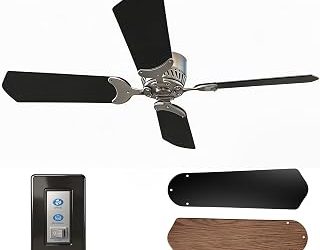
52-Inch Solid Wood 3-Blade with Remote
This is my default bedroom recommendation: natural wood blades, six speeds, and a genuinely quiet motor that stays civil at the low settings you’ll sleep under. The flat-or-sloped mounting flexibility solves the problem that eliminates a lot of otherwise good fans from older homes.
Ohniyou 60″ Industrial No-Light Fan
A 6,800 CFM output with a claimed 35 dB DC motor is an unusual pairing — most fans moving that much air announce it. Built for covered patios and porches, though the app control makes it a reasonable choice for a large open living space too.
52-Inch Outdoor Solid Wood BLDC, Dark Walnut
Damp-rated but handsome enough to live indoors, this three-blade propeller design pairs a high-efficiency BLDC motor with a rustic walnut finish. A smart pick if you want one fan aesthetic running continuously from the living room out to the screened porch.
ZMISHIBO 65-Inch Reversible DC
At 65 inches and 6,116 CFM, this is the one to specify for vaulted great rooms, garages, and workshops where smaller fans just stir the air near the ceiling. Reversibility earns its keep in winter, pushing warm air back down instead of stratifying it overhead.
Obabala 52-Inch Outdoor with Remote
A clean white six-speed with a reversible DC motor, well suited to bright coastal or minimalist rooms where a dark fan would visually crowd the ceiling. Straightforward installation and a remote that covers everything you need.
Frequently Asked Questions
Does a ceiling fan actually help you sleep better?
Yes, primarily through temperature. Air movement accelerates evaporative and convective heat loss, which supports the core-temperature drop that initiates sleep. The steady low-frequency sound also masks intermittent noise like traffic or a partner shifting position.
Is sleeping under a fan bad for you?
For most people, no. Some wake with dry sinuses, a scratchy throat, or stiff neck muscles from direct airflow — aim the fan to circulate the room rather than blow straight down on your pillow, and drop to a lower speed.
Can I install a light-free fan where a light fixture used to be?
Usually, provided the box is fan-rated. Standard light-fixture boxes aren’t built for rotational load and must be replaced with a braced fan box. Cap the unused switch leg or wire it to control the fan instead.
Which direction should the blades turn?
Counterclockwise in warm months for a downward cooling breeze; clockwise on low in cold months to gently redistribute warm ceiling air without a draft.
Final Thoughts
For bedrooms, the 52-inch solid wood three-blade is the one I’d install first — quiet, mounting-flexible, and free of any glow to interfere with melatonin. Large rooms and vaulted ceilings are better served by the ZMISHIBO 65-inch, while the Ohniyou 60-inch is the strongest covered-porch option, delivering serious airflow at a noise level that won’t intrude on the room below.