Key takeaways
- Motor type and noise floor: DC motors run cooler, draw less power, and — critically — produce a smoother, lower-frequency hum than older AC units. Aim for a fan whose lowest speed is audible only as soft air movement, since inconsistent noise is far more disruptive than constant noise.
- Adjustable color temperature: Look for at least three CCT presets, ideally reaching 3000K or warmer. Evening exposure to short-wavelength light suppresses melatonin onset; a warm setting after sunset lets the same fixture serve both a morning routine and a wind-down.
- Dimming resolution: Stepless or near-stepless dimming matters more than maximum brightness. The ability to sit at 5–10% output gives you a functional nightlight for a 3 a.m. trip without fully waking the visual system.
- Blade span versus room size: A 52-inch span suits bedrooms over about 225 square feet; 20-inch fandeliers are engineered for compact rooms where a large fan would create a draft directly over the pillow. Cold air blowing on exposed skin all night can actually worsen sleep continuity.
- Mounting height and reversibility: Flush-mount designs preserve headroom in 8-foot rooms, and a reversible motor lets you push warm ceiling air downward in winter without the summer breeze effect. Confirm the downrod option matches your ceiling before ordering.
Sleep architecture is fragile, and the ceiling above your bed influences it more than most people realize. Thermal comfort and acoustic consistency are two of the strongest environmental levers on sleep quality — core body temperature needs to drop roughly a degree to initiate deep sleep, and a steady low-level airflow sound masks the sudden noises that fragment it. Yet most shoppers choose a bedroom fan on looks alone, then discover a rattling motor at speed three, a light that glares blue-white at 10 p.m., or a fixture that hangs low enough to clip a doorway in an eight-foot room.
This guide approaches the category from a sleep-environment perspective rather than a purely decorative one. I’ve weighted low-noise DC motors, tunable color temperature that can drop into warm amber territory before bed, genuine dimming range (not three coarse steps), and flush-mount profiles that suit standard-height bedrooms. Below are the models worth shortlisting in 2026, plus the specifications that actually correlate with better nights.
Our top picks



As an Amazon Associate we earn from qualifying purchases at no extra cost to you. Ratings are shown as listed on Amazon.
🛒 Best Price Today on Amazon
Prime members get fast, free shipping on everything above, plus member-only deals. New members get a 30-day free trial — cancel anytime.
How to Choose a Ceiling Fan Light For Bedroom (2026)
- Motor type and noise floor: DC motors run cooler, draw less power, and — critically — produce a smoother, lower-frequency hum than older AC units. Aim for a fan whose lowest speed is audible only as soft air movement, since inconsistent noise is far more disruptive than constant noise.
- Adjustable color temperature: Look for at least three CCT presets, ideally reaching 3000K or warmer. Evening exposure to short-wavelength light suppresses melatonin onset; a warm setting after sunset lets the same fixture serve both a morning routine and a wind-down.
- Dimming resolution: Stepless or near-stepless dimming matters more than maximum brightness. The ability to sit at 5–10% output gives you a functional nightlight for a 3 a.m. trip without fully waking the visual system.
- Blade span versus room size: A 52-inch span suits bedrooms over about 225 square feet; 20-inch fandeliers are engineered for compact rooms where a large fan would create a draft directly over the pillow. Cold air blowing on exposed skin all night can actually worsen sleep continuity.
- Mounting height and reversibility: Flush-mount designs preserve headroom in 8-foot rooms, and a reversible motor lets you push warm ceiling air downward in winter without the summer breeze effect. Confirm the downrod option matches your ceiling before ordering.
The Best Ceiling Fan Light For Bedroom (2026)s Reviewed
POCHFAN 52″ Flush Mount Ceiling Fan with Light
This is the pick for larger master bedrooms, where a 52-inch span moves enough air at low speed that you never need to run it hard — the quietest way to cool a room is a big fan turning slowly. Six speeds, dimmable output, ETL listing, and a brushed nickel low-profile body make it a sensible default for standard ceilings.
LEDIARY Caged Fandelier, White Gold
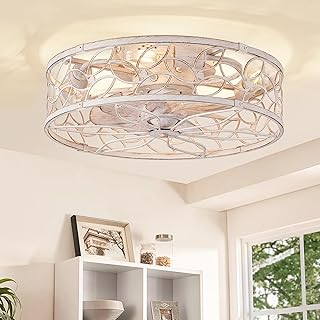
A bladeless caged design eliminates the flicker-and-shadow effect that some sleepers find visually agitating when a fan runs with the light on. App control is the real differentiator here: adjusting brightness from your phone means not standing up and hunting for a wall switch once you’re already settled.
LEDIARY 20″ Caged Fan, Black Gold
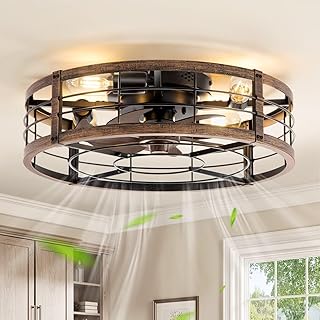
Mechanically the same well-executed DC platform in a darker, more architectural finish that reads well against deep wall colors. The enclosed cage is also the practical choice for rooms with lofted beds or anywhere hands and headboards come close to the fixture.
LEDIARY 20″ Fandelier, Stepless Dimmable White
My favorite of the compact LEDIARY family on sleep-hygiene grounds alone: stepless dimming plus three CCT settings gives you genuinely granular control over evening light exposure rather than a jump from bright to off. Quiet reversible DC operation makes it a year-round fixture, not just a summer one.
LEDIARY 20″ Modern White Fandelier
A cleaner, more minimal take with stepless color temperature transition — useful if you prefer sliding gradually from neutral to warm rather than toggling presets. Best suited to bedrooms under about 150 square feet where its six speeds have room to be genuinely subtle.
Frequently Asked Questions
Does sleeping with a ceiling fan on actually help?
For most people, yes — gentle air movement supports the evening drop in core body temperature and provides consistent broadband sound that masks intermittent noise. The main caveats are dry eyes, sinus irritation, and circulating dust, all of which are usually solved by lowering the speed rather than turning it off.
What speed should I run overnight?
Start at the lowest setting that you can feel at pillow height and no higher. Many six-speed DC fans are effectively designed so that speeds one and two are the sleep range; anything above that is for cooling a room down before bed, ideally with a timer.
Is a 20-inch fandelier powerful enough for a bedroom?
In rooms up to roughly 150–180 square feet, yes. Compact fandeliers with DC motors move a surprising volume of air, and in a small bedroom the goal is circulation rather than a strong directional breeze.
Which color temperature is best before bed?
Choose the warmest available setting — typically 3000K — for the last hour or two before sleep, and keep the brightness low. Reserve 5000–6000K for morning or task use, where cooler light genuinely helps alertness.
Final Thoughts
For larger bedrooms, the POCHFAN 52-inch remains the most sensible airflow-per-decibel proposition on this list. In compact rooms, the LEDIARY 20″ stepless-dimmable fandelier is my top overall recommendation on sleep-quality grounds, with the ZMISHIBO 19.7″ a strong alternative if you want a timer and a 3000–6000K range in a darker finish.