Key takeaways
- Wet vs. damp rating: Anything exposed to blowing rain, mist, or pool splash needs a wet-rated or IP65/IP66 housing. A damp-rated fan under a deep, dry soffit is fine; one over an open pergola is a corrosion problem waiting to happen.
- Size to the footprint, not the ceiling: Roughly, a 20″–24″ caged fan covers a seating nook or a 10′ x 12′ area, a 52″ fan handles a standard covered patio, and 56″ suits long or wide spans. Oversizing beats undersizing — you can always run a big fan on speed one.
- DC motor and speed range: Reversible DC motors draw less power and, more importantly for rest, give you a genuinely low bottom speed. Six speeds means you can find the setting that moves air without turning your patio into a wind tunnel.
- Light quality over light quantity: Look for dimmable LEDs with 3CCT switching. Use ~5000K for daytime tasks and drop to the warmest setting (2700–3000K) after sunset so the fixture isn’t fighting your melatonin.
- Mounting and control reality check: No junction box overhead? A plug-in model with a hanging hook installs in minutes. If you’ll be adjusting it from a lounger, confirm remote range — and app control if you want scheduling or timers.
What's inside
Outdoor lounging has become an extension of the bedroom for a lot of us — the porch swing where you fade out after dinner, the screened patio where the toddler naps, the pergola where you read until your eyelids give up. As someone who spends my working life on sleep environments, I can tell you the thing that ruins those moments is almost never the temperature alone. It’s stagnant, heavy air, the whine of a cheap motor, and a light that’s the wrong color for winding down. Most patio fans on the market solve the first problem and create the other two.
This guide takes a rest-first view of outdoor ceiling fans: how much airflow you actually need for a given patio footprint, why DC motors matter for quiet operation, what IP65 and IP66 wet ratings really promise, and how tunable color temperature (3CCT) keeps evening light from working against your circadian rhythm. Below you’ll find a mix of compact plug-in caged models for pergolas and balconies alongside full-size 52″ and 56″ fans for covered patios — plus a short buying framework so you can match one to your space in a couple of minutes.
As an Amazon Associate we earn from qualifying purchases.



🛒 Best Price Today on Amazon
Prime members get fast, free shipping on everything above, plus member-only deals. New members get a 30-day free trial — cancel anytime.
How to Choose a Ceiling Fan For Patio (2026)
- Wet vs. damp rating: Anything exposed to blowing rain, mist, or pool splash needs a wet-rated or IP65/IP66 housing. A damp-rated fan under a deep, dry soffit is fine; one over an open pergola is a corrosion problem waiting to happen.
- Size to the footprint, not the ceiling: Roughly, a 20″–24″ caged fan covers a seating nook or a 10′ x 12′ area, a 52″ fan handles a standard covered patio, and 56″ suits long or wide spans. Oversizing beats undersizing — you can always run a big fan on speed one.
- DC motor and speed range: Reversible DC motors draw less power and, more importantly for rest, give you a genuinely low bottom speed. Six speeds means you can find the setting that moves air without turning your patio into a wind tunnel.
- Light quality over light quantity: Look for dimmable LEDs with 3CCT switching. Use ~5000K for daytime tasks and drop to the warmest setting (2700–3000K) after sunset so the fixture isn’t fighting your melatonin.
- Mounting and control reality check: No junction box overhead? A plug-in model with a hanging hook installs in minutes. If you’ll be adjusting it from a lounger, confirm remote range — and app control if you want scheduling or timers.
The Best Ceiling Fan For Patio (2026)s Reviewed
addlon 20″ Caged Outdoor Fan
This is the fan I recommend most often for balconies, gazebos, and porch nooks where drilling into the ceiling isn’t an option — the hanging hook and plug-in cord make it a same-afternoon install. The reversible DC motor is genuinely quiet at low speeds, and the built-in timer is a small feature that matters a lot if you tend to doze off outside.
LEDIARY 20″ Waterproof Black Fan
Rated for roughly a 10′ x 12′ area, the LEDIARY pairs an IP65 wet-rated body with app control and 3CCT dimming, so you can schedule a warm, low-output evening setting instead of remembering to adjust it. The matte black cage disappears against a dark pergola better than most competitors’ finishes.
56″ Wet-Rated High-CFM Fan
If your patio traps heat, this is the airflow workhorse of the group: seven UV-coated blades on an energy-efficient DC motor push serious CFM without the motor drone you’d expect at that size. The UV coating is the underrated part — it’s what keeps blades from chalking and warping after two summers of direct sun.
56″ IP66 Fan with App Control
The IP66 housing is a step above most of the field, making this the safer choice for genuinely exposed installs or coastal humidity. Auto memory means it returns to your last speed and color temperature after a power blip, which is a nicer quality-of-life feature than it sounds.
52″ Farmhouse Patio Fan
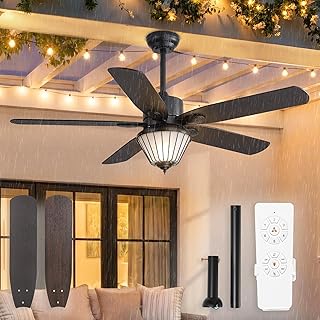
A good middle-ground pick for standard covered patios, with five dual-finish blades that read as intentional design rather than utilitarian hardware. Six speeds on a reversible DC motor give you real control, including a downdraft-free low setting for cooler evenings.
Frequently Asked Questions
Can I use a regular indoor ceiling fan outside?
No. Indoor-rated fans use motors and electrical components that aren’t sealed against moisture, and outdoor humidity alone can cause rust, wobble, and eventually a short. Choose damp-rated for fully protected ceilings and wet-rated or IP65/IP66 for anywhere exposed to rain or mist.
How quiet is quiet enough for sleeping or napping outdoors?
A well-balanced DC motor produces mostly broadband air noise rather than mechanical hum, which many people find easier to rest through than silence. If a fan clicks, ticks, or hums tonally, that’s usually a mounting or balance issue rather than a motor defect — check the downrod connection and blade screws first.
Does a patio fan actually cool the air?
It doesn’t lower the temperature, but moving air accelerates evaporation from your skin, which can feel several degrees cooler. Air movement also helps discourage mosquitoes from settling, which is a quiet bonus for evening comfort.
Should I run the fan in reverse outdoors?
Occasionally, yes. In cooler months, reverse mode gently circulates warmer air trapped near a covered ceiling instead of blowing directly down on you — useful if you use a patio heater or have a three-season porch.
Final Thoughts
For most covered patios, the 56″ wet-rated high-CFM fan delivers the best balance of airflow, durability, and quiet operation, while the 52″ farmhouse model is the more design-conscious pick for standard-size spaces. And if you’re working with a pergola, balcony, or no ceiling wiring at all, the addlon 20″ caged plug-in fan gets you comfortable air movement and warm, dimmable evening light with almost no installation friction.