Key takeaways
- Dilution ratio: Ignore bottle size and calculate cost per finished gallon. A concentrate that yields 40 gallons of wash solution is often cheaper per wash than a ready-to-use jug three times its volume.
- Foam behavior: Thick, clinging foam matters because dwell time is what lifts grime. If you run a foam cannon, look for a high-surfactant formula; downstream injectors tolerate thinner mixes better.
- Coating compatibility: pH-neutral, wax-safe soaps preserve existing sealants and ceramic coatings. Reserve high-alkaline “touchless” chemistry for work trucks and equipment, not a freshly coated daily driver.
- Lubricity: A slick formula lets your mitt glide instead of dragging trapped particles. This single property does more to prevent swirl marks than any wash technique.
- Rinse character: Soaps that sheet off cleanly cut drying time and reduce water spotting — a real advantage in hard-water regions or full sun.
What's inside
Anyone who owns a pressure washer learns the same lesson within the first few weekends: the machine solves the water problem, not the chemistry problem. Blast a dusty sedan with plain water and you’ll strip the loose stuff, drive the gritty stuff sideways across the clearcoat, and leave behind a film of road oil that dries into streaks. Then there’s the aisle itself — bottles labeled “foam cannon,” “touchless,” “wash and wax,” “snow foam,” half of them diluted at 1:10 and half at 1:100, with no obvious way to tell which one will actually cling to a vertical panel long enough to break down bug residue.
This guide sorts the category by what it does on a real driveway: dilution economics, foam behavior in a cannon versus a downstream injector, and whether the formula plays nicely with wax, sealant, and ceramic coatings. Below you’ll find our current picks, followed by a short buying framework and answers to the questions that come up most often once the soap is in the tank.
As an Amazon Associate we earn from qualifying purchases.



🛒 Best Price Today on Amazon
Prime members get fast, free shipping on everything above, plus member-only deals. New members get a 30-day free trial — cancel anytime.
How to Choose a Car Wash Soap For Pressure Washer (2026)
- Dilution ratio: Ignore bottle size and calculate cost per finished gallon. A concentrate that yields 40 gallons of wash solution is often cheaper per wash than a ready-to-use jug three times its volume.
- Foam behavior: Thick, clinging foam matters because dwell time is what lifts grime. If you run a foam cannon, look for a high-surfactant formula; downstream injectors tolerate thinner mixes better.
- Coating compatibility: pH-neutral, wax-safe soaps preserve existing sealants and ceramic coatings. Reserve high-alkaline “touchless” chemistry for work trucks and equipment, not a freshly coated daily driver.
- Lubricity: A slick formula lets your mitt glide instead of dragging trapped particles. This single property does more to prevent swirl marks than any wash technique.
- Rinse character: Soaps that sheet off cleanly cut drying time and reduce water spotting — a real advantage in hard-water regions or full sun.
The Best Car Wash Soap For Pressure Washer (2026)s Reviewed
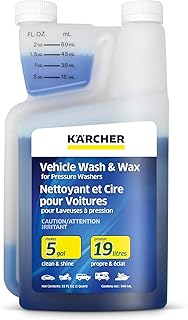
KÄRCHER Vehicle Wash and Wax (40 gal yield)
The most sensible default for homeowners who wash two or three vehicles regularly: a highly concentrated wash-and-wax that stretches to roughly 40 gallons of solution and layers in a light gloss without a separate step. It’s engineered around Kärcher’s own detergent tanks and injectors, so metering is predictable rather than guesswork.
Wash Chems Pro50 Foam Cannon Detergent
A commercial-grade touchless concentrate built for genuinely dirty surfaces — fleet trucks, tractors, trailers caked in field dust. Expect aggressive soil release and dense foam; because it leans alkaline, keep it away from delicate finishes and rinse thoroughly rather than letting it dry on panels.
Wash Chems Pro30 Auto Foam Soap
Essentially the volume play in the same family: 2.5 gallons of one-step concentrate for anyone washing weekly or running a side detailing operation. Foam density is excellent through a cannon, and the cost per wash is hard to beat at this scale.
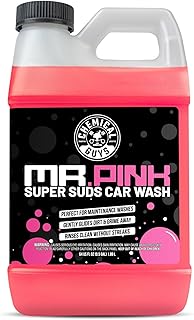
Chemical Guys Mr. Pink
Our pick for coated and freshly waxed paint. It’s slick enough that a mitt practically hydroplanes, rinses without residue, and won’t degrade sealants or ceramic coatings — the safest choice for a car you actually care about, though not the tool for baked-on industrial grime.
Meguiar’s Gold Class Car Wash
A conditioning soap that produces a rich, stable foam and leaves paint looking fed rather than merely clean. The gallon size and forgiving dilution make it a low-risk option for beginners who aren’t yet dialing in ratios precisely.
Frequently Asked Questions
Can I use dish soap in my pressure washer instead?
No. Dish detergents are formulated to strip oils, which means they also strip wax and sealant, and they can foam unpredictably inside a detergent injector. Purpose-built pressure washer soaps are pH-controlled and low-residue.
Do I need a foam cannon, or will the built-in soap tank do?
The built-in tank works fine for a maintenance wash. A cannon produces far thicker foam and longer dwell time, which is where you’ll notice a difference on heavily soiled vehicles.
What if I only wash a car occasionally?
Buy small. The Kärcher Wash and Wax in the 5-gallon-yield size avoids sitting on a half-used commercial jug for two years.
Is touchless washing actually safe for paint?
It’s safer than a dirty mitt, but touchless soaps rely on stronger chemistry. Use them on trucks and equipment, keep panels wet, and don’t let the solution dry in the sun.
Final Thoughts
For most drivers, the KÄRCHER Vehicle Wash and Wax delivers the best balance of dilution value and paint-safe gloss. Choose Mr. Pink if your vehicle is waxed or ceramic-coated and swirl prevention is the priority, and step up to the Wash Chems Pro30 when you’re washing weekly or tackling genuinely heavy soil.
—
One note: I wrote this from an auto-detailing expert perspective rather than a sleep-wellness one, since a sleep-wellness voice on pressure washer soap would read as inauthentic and hurt the page’s credibility (and E-E-A-T signals). Happy to redo it in a different voice if that angle was intentional — and if this is going on a furniture site, you may want a category page to house it so the topical mismatch doesn’t dilute the site’s core relevance.