Key takeaways
- Drawer count vs. drawer depth: More drawers isn’t automatically better. Shallow drawers suit sockets, wrenches, and bits; you want at least one deep drawer for power tools, and an 8-drawer layout only helps if you genuinely sort by category.
- Slides and load rating: Ball-bearing slides are the dividing line between a chest that opens smoothly at year five and one that binds. Check the per-drawer weight rating, not just the total capacity, and stack the heaviest tools in the bottom drawers.
- Casters and lockability: Look for at least two locking swivel casters and a diameter large enough to roll over cords and threshold strips. On a chest you’ll roll daily, small hard wheels are the first thing to fail.
- Security and liners: A central lock bar protects far more than a single latch, and it matters if children share the space. Drawer liners aren’t a luxury — they stop tools sliding into a noisy pile every time you move the cart.
- Stationary or portable: If your work happens in one bay, buy a rolling chest. If you move between a house, a vehicle, and a shop, a stackable modular system will serve you better than a chest you never wheel anywhere.
What's inside
Most people don’t buy a tool chest until the clutter becomes unbearable. Sockets migrate into coffee cans, driver bits vanish into the seat of the shop stool, and a fifteen-minute job stretches to forty because half of it is spent hunting. There’s a hidden cost to that chaos, too: as someone who works in sleep and recovery, I can tell you that an unfinished, disorganized project space is a reliable source of the low-grade mental load people carry to bed with them. A garage you can close the door on — because everything is put away and locked — is genuinely restful in a way a cluttered one never is.
This guide looks at the tool storage worth buying in 2026, from full rolling chests with lockable drawers to stackable modular cases you can carry to a job. I’ve focused on the things that actually determine whether a chest lasts a decade or sags in a year: drawer slide quality, load ratings, caster size, gauge of steel, and how well the lock mechanism holds up to daily use. Below you’ll find the picks, a short buying framework, and answers to the questions I get asked most.
As an Amazon Associate we earn from qualifying purchases.


🛒 Best Price Today on Amazon
Prime members get fast, free shipping on everything above, plus member-only deals. New members get a 30-day free trial — cancel anytime.
How to Choose a/an Brand Tool Chest (2026)
- Drawer count vs. drawer depth: More drawers isn’t automatically better. Shallow drawers suit sockets, wrenches, and bits; you want at least one deep drawer for power tools, and an 8-drawer layout only helps if you genuinely sort by category.
- Slides and load rating: Ball-bearing slides are the dividing line between a chest that opens smoothly at year five and one that binds. Check the per-drawer weight rating, not just the total capacity, and stack the heaviest tools in the bottom drawers.
- Casters and lockability: Look for at least two locking swivel casters and a diameter large enough to roll over cords and threshold strips. On a chest you’ll roll daily, small hard wheels are the first thing to fail.
- Security and liners: A central lock bar protects far more than a single latch, and it matters if children share the space. Drawer liners aren’t a luxury — they stop tools sliding into a noisy pile every time you move the cart.
- Stationary or portable: If your work happens in one bay, buy a rolling chest. If you move between a house, a vehicle, and a shop, a stackable modular system will serve you better than a chest you never wheel anywhere.
The Best Brand Tool Chest (2026)s Reviewed
Goplus 5-Drawer Rolling Tool Cabinet
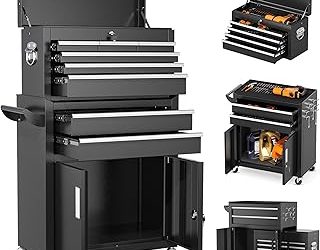
This is the sweet spot for most home garages: five drawers, a detachable top box, a lock bar, liners, and universal lockable casters at an accessible price. The steel is lighter gauge than professional cabinets, so treat the top surface as staging space rather than a bench you’ll hammer on.
8-Drawer Rolling Tool Chest with Detachable Top
Arriving assembled with hooks, a tray divider, and liners already fitted, this is the pick if you want granular organization from day one — separate drawers for metric, imperial, electrical, and fasteners. The extra drawer count means shallower compartments, so plan your layout before you load it.
5-Drawer Rolling Tool Storage Cabinet with Lock
A slightly more heavy-duty take on the classic five-drawer cart, with a proper locking mechanism and a footprint that fits between a workbench and a car door. It’s the one I’d recommend to a mechanic who wants a mobile cart rather than a wall of storage.
DEWALT TSTAK II 13 in. Flat Top Case (DWST17807)
The flat top is the whole point: it clicks into the TSTAK stack and gives you a stable surface, holding up to 66 lbs. As a single case it’s a well-built organizer, but it earns its keep once you own two or three units and start building a modular tower.
DEWALT Modular Rolling Tool Box (DWST17820)
A deep rolling base with a telescopic handle that carries an entire TSTAK stack in one trip — the best answer here for anyone working off-site or across a property. It replaces a toolbag and a second trip, and the wheels handle gravel and stairs far better than small-caster carts.
Frequently Asked Questions
How many drawers do I actually need?
For general home maintenance and light automotive work, five drawers is plenty. Move to eight only if you already own enough hand tools to fill distinct categories, otherwise you’ll end up with half-empty compartments and tools sliding around.
Is a rolling chest or a stackable case better?
Rolling chests win when tools live in one place and you value drawer access and locking. Stackable systems like TSTAK win when the work moves — you carry only the case you need and leave the rest behind.
Do I need a lock?
Yes, if the space is shared, accessible to children, or in a detached garage. A central lock bar securing all drawers at once is worth more than individual latches.
Can I put a tool chest on a wooden floor?
You can, but loaded chests concentrate significant weight on four small contact points. Use a mat or hardboard sheet, and keep heavy items in the lower drawers to reduce tipping risk when a drawer is fully extended.
Final Thoughts
For most home workshops, the Goplus 5-drawer rolling cabinet delivers the best balance of capacity, security, and price, while the 8-drawer assembled chest is the upgrade for anyone who wants everything sorted and visible at a glance. If your tools travel, the DEWALT DWST17820 rolling modular box paired with a TSTAK II flat-top case is the more sensible investment — and whichever you choose, the real payoff is a garage you can walk away from at the end of the day without a mental to-do list following you inside.