Key takeaways
- Measure before you buy: Run a tape measure from the seam at the base of your mattress to the top of the foam, then add any topper. Choose a pocket depth that exceeds that number by two to three inches — a sheet that barely reaches will migrate every night.
- Prioritize weave over thread count: Percale (a crisp one-over-one weave) breathes noticeably better than sateen and suits hot sleepers on foam. Sateen feels smoother and drapes closer, which some sleepers prefer in cooler months. Anything above roughly 600 threads in a tight weave starts trading airflow for softness.
- Look for full-perimeter elastic: Corner-only elastic cannot hold tension across a surface that flexes. All-around elastic, and ideally side straps or anchor pockets, is what keeps a fitted sheet flat on a conforming bed.
- Check for a safety certification: OEKO-TEX Standard 100 confirms the finished fabric was tested for harmful substances. On a foam mattress, where the bed itself may still be off-gassing slightly, a certified sheet is a sensible baseline.
- Match fiber to your sweat pattern: Long-staple cotton wicks and releases moisture well, making it the stronger choice for anyone who wakes damp. Brushed microfiber runs warmer but resists wrinkles and holds color longer, which suits guest rooms and cooler bedrooms.
Memory foam behaves unlike any innerspring mattress when it comes to bedding, and most shoppers discover this the hard way. Viscoelastic foam stores body heat rather than venting it, and because the surface contours instead of compressing evenly, a fitted sheet has to stretch across a shape that shifts every time you roll over. Add the fact that modern foam beds routinely measure 12 to 16 inches deep — more with a topper — and you get the two complaints I hear constantly in sleep consultations: sheets that pop off the corners by 3 a.m., and a bed that feels several degrees warmer than it should.
The fix is less about thread count than most marketing suggests. What matters is pocket depth relative to your actual mattress height, a weave that moves air rather than trapping it, and elastic that wraps the full perimeter instead of just the corners. Below I’ve assessed six popular queen sets against those criteria, then laid out the buying framework I use with clients so you can match a set to your specific bed rather than guessing.
Our top picks



As an Amazon Associate we earn from qualifying purchases at no extra cost to you. Ratings are shown as listed on Amazon.
🛒 Best Price Today on Amazon
Prime members get fast, free shipping on everything above, plus member-only deals. New members get a 30-day free trial — cancel anytime.
How to Choose a Bed Sheets For Memory Foam Mattress (2026)
- Measure before you buy: Run a tape measure from the seam at the base of your mattress to the top of the foam, then add any topper. Choose a pocket depth that exceeds that number by two to three inches — a sheet that barely reaches will migrate every night.
- Prioritize weave over thread count: Percale (a crisp one-over-one weave) breathes noticeably better than sateen and suits hot sleepers on foam. Sateen feels smoother and drapes closer, which some sleepers prefer in cooler months. Anything above roughly 600 threads in a tight weave starts trading airflow for softness.
- Look for full-perimeter elastic: Corner-only elastic cannot hold tension across a surface that flexes. All-around elastic, and ideally side straps or anchor pockets, is what keeps a fitted sheet flat on a conforming bed.
- Check for a safety certification: OEKO-TEX Standard 100 confirms the finished fabric was tested for harmful substances. On a foam mattress, where the bed itself may still be off-gassing slightly, a certified sheet is a sensible baseline.
- Match fiber to your sweat pattern: Long-staple cotton wicks and releases moisture well, making it the stronger choice for anyone who wakes damp. Brushed microfiber runs warmer but resists wrinkles and holds color longer, which suits guest rooms and cooler bedrooms.
The Best Bed Sheets For Memory Foam Mattress (2026)s Reviewed
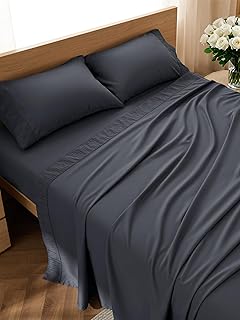
Queen 4-Piece Cooling Sheet Set, Dark Grey
A sensible default for a standard 12-to-14-inch foam bed: the deep pockets and easy-fit construction seat cleanly on a conforming surface, and the fabric stays smooth without ironing. The OEKO-TEX certification and genuinely breathable hand make this the set I’d suggest to someone buying their first foam-specific sheets.
Bedsure Queen Sheet Set, 4-Piece Embossed
Bedsure’s embossed finish does real work here — the textured surface creates micro-gaps that keep the fabric from sealing against your skin, which matters on heat-retaining foam. Fade and shrink resistance are the standouts over repeated washing, so the fitted sheet holds its dimensions rather than tightening away from the corners.
Bedlifes 1000TC Egyptian Cotton Queen Sheets
The most luxurious option of the group, with a sateen weave over long-staple Egyptian cotton that delivers a fluid, cool-to-the-touch drape. The 18-to-24-inch pockets are the deepest here, making this the clear pick if you’ve stacked a topper on an already-tall foam mattress.
DREAMCARE Queen Sheet Set, Extra Deep Gray
The side pockets are the differentiator — they act as anchors that resist the lateral pull foam generates as it contours, so the sheet stays taut through the night. With up to 21 inches of depth and a soft, cooling finish, it’s a strong choice for restless sleepers who constantly re-tuck corners.
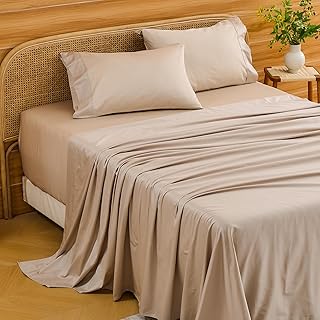
Extra Deep Queen 6-Piece Sheet Set, Wheat
Two extra pillowcases make this the best value for couples or anyone who rotates linens weekly. The secure-fit fitted sheet handles tall foam beds well, and the wheat colorway resists the dinginess that shows on white sets after a season of washing.
Frequently Asked Questions
Do memory foam mattresses really need special sheets?
Not special, but specific. Foam beds are typically taller and more contouring than innersprings, so you need deeper pockets and stronger elastic. Breathability also matters more, since the mattress itself won’t help dissipate heat.
What pocket depth should I choose for a 12-inch foam mattress?
Aim for 14 to 16 inches. That gives the sheet enough fabric to tuck fully under the mattress, which is what creates holding tension. If you use a two-to-three-inch topper, step up to an 18-inch-plus set.
Will cooling sheets fix a mattress that sleeps hot?
They help meaningfully but won’t transform the bed. Breathable sheets reduce trapped surface heat; if you’re still overheating, the more effective interventions are a ventilated mattress protector, a lighter duvet fill, and lowering the room to the 65–68°F range.
How often should these sheets be washed?
Every seven to ten days, in warm water with a mild detergent, then dried on low. Skip fabric softener — it coats fibers and reduces the wicking performance you paid for.
Final Thoughts
For most foam mattresses, the Queen 4-Piece Cooling Set in dark grey is the balanced choice: certified, breathable, and deep enough for a typical build. If you sleep hot and want a genuine upgrade in feel, the Bedlifes 1000TC Egyptian Cotton set offers the deepest pockets and the best fiber quality here, while the DREAMCARE Extra Deep set is the one to buy if keeping corners anchored has been your persistent frustration.