Key takeaways
- Length before power: Reach determines where the compressor can sit. A 50 ft or 100 ft hose lets you place the tank behind a closed door or in a far bay, which does more for a quiet house than any tool upgrade.
- Inner diameter: Choose 1/4″ for brad nailers, staplers, blowguns, and tire inflation. Step up to 3/8″ for impact wrenches, sanders, spray guns, and any run longer than 50 ft, where a narrow bore starves the tool and makes the compressor cycle more often.
- Material behavior: Polyurethane is light and abrasion-tough. Hybrid polymer blends stay limp in cold garages and lie flat instead of curling. Recoil hoses self-retract and store themselves but resist being pulled to full length.
- Fittings and bend restrictors: Solid brass ends thread more reliably and corrode less than plated steel. Bend restrictors at both couplers prevent the failure point that kills most hoses — the sharp kink right where it meets the fitting.
- Pressure rating and coupler type: 300 PSI working pressure covers every home compressor with margin. Confirm your couplers match the existing standard in your shop, usually 1/4″ industrial, so you aren’t juggling adapters mid-project.
What's inside
Anyone who has run an air compressor inside an attached garage knows the problem isn’t really the tool — it’s the hose. A stiff, coiled length of rubber drags across concrete, snags on a table leg, and forces you to reposition the compressor three times for a job that should have taken ten minutes. Every extra trip back to the tank means another start-stop cycle of that motor, and if you’re finishing a nightstand at 9pm while someone upstairs is trying to wind down, those cycles are the difference between a productive evening and a household-wide sleep disruption. A hose with real reach and real flexibility lets you park the compressor once, in the far corner, insulated behind a door, and simply work.
That’s the lens we’ve used for this guide. Below you’ll find our current picks for air compressor hoses, evaluated on the things that actually matter for home workshops built next to bedrooms: usable length, cold-weather flexibility, kink resistance, fitting quality, and how little the hose fights you. We cover diameter and length selection, the differences between polyurethane, hybrid polymer, and recoil designs, and the fitting standards that determine whether your new hose will connect to the tools you already own.
As an Amazon Associate we earn from qualifying purchases.



🛒 Best Price Today on Amazon
Prime members get fast, free shipping on everything above, plus member-only deals. New members get a 30-day free trial — cancel anytime.
How to Choose a/an Air Hose For Air Compressor (2026)
- Length before power: Reach determines where the compressor can sit. A 50 ft or 100 ft hose lets you place the tank behind a closed door or in a far bay, which does more for a quiet house than any tool upgrade.
- Inner diameter: Choose 1/4″ for brad nailers, staplers, blowguns, and tire inflation. Step up to 3/8″ for impact wrenches, sanders, spray guns, and any run longer than 50 ft, where a narrow bore starves the tool and makes the compressor cycle more often.
- Material behavior: Polyurethane is light and abrasion-tough. Hybrid polymer blends stay limp in cold garages and lie flat instead of curling. Recoil hoses self-retract and store themselves but resist being pulled to full length.
- Fittings and bend restrictors: Solid brass ends thread more reliably and corrode less than plated steel. Bend restrictors at both couplers prevent the failure point that kills most hoses — the sharp kink right where it meets the fitting.
- Pressure rating and coupler type: 300 PSI working pressure covers every home compressor with margin. Confirm your couplers match the existing standard in your shop, usually 1/4″ industrial, so you aren’t juggling adapters mid-project.
The Best Air Hose For Air Compressor (2026)s Reviewed
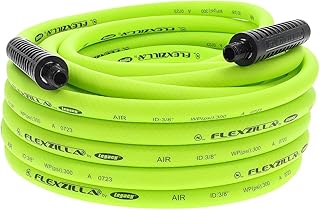
Flexzilla 3/8 in. x 50 ft. Air Compressor Hose
The hybrid polymer construction is the closest thing to a hose that simply does what you ask — it stays flexible near freezing, refuses to hold coils, and drags quietly across a finished floor. At 3/8″ and 50 ft it feeds hungry tools like sanders and spray guns without pressure drop, which means fewer compressor restarts and a noticeably calmer house.
Hybrid Air Hose 3/8-Inch by 50 Feet
A strong value alternative in the same category, pairing all-weather hybrid flex with brass coupler and plug included. Kink resistance is genuinely good, and the lightweight build makes overhead work with an impact wrench far less tiring.
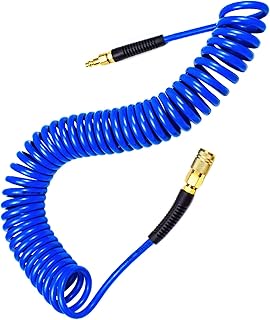
YOTOO Polyurethane Recoil Air Hose, 1/4″ x 25′
The ideal hose for tidy, small-footprint shops: it springs back into a compact coil and never needs winding. Best paired with a stationary bench station and light-duty tools, since the recoil tension makes long pulls across a room feel like work.
Hybrid Air Hose 1/4 in x 25 ft, Solid Brass Fittings
A well-built short hose for brad nailers and finish work — exactly the tools you use assembling furniture. Solid brass male fittings and dual bend restrictors give it a lifespan well beyond typical budget 25-footers.
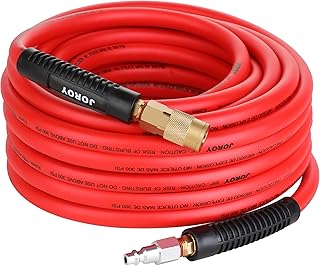
25FT 1/4 Inch Reinforced Polyurethane Air Hose
Braided reinforcement over polyurethane makes this the pick for garages with rough concrete and sharp corners. Quick-connect fittings ship installed, so it’s ready to run out of the box at a genuinely low price.
Frequently Asked Questions
Does a longer hose reduce air pressure?
Yes, gradually. Friction loss is minor at 25 to 50 ft, but on a 100 ft run you’ll notice it with air-hungry tools. Move up to 3/8″ inner diameter and the drop becomes negligible for most home use.
Can a hose actually make my compressor quieter?
Indirectly, and significantly. Distance is the cheapest sound insulation there is — every doubling of distance meaningfully cuts perceived loudness, and a 100 ft option like the 1/4″ reinforced polyurethane kit lets you exile the tank to a shed or basement corner entirely.
Polyurethane or hybrid polymer?
Polyurethane wins on abrasion resistance and lightness. Hybrid polymer wins on cold-weather limpness and lying flat. For unheated garages, hybrid is the more pleasant daily companion.
Do I need bend restrictors?
They’re not optional in practice. The coupler junction takes the most stress of any point on the hose, and restrictors are what stop it from cracking there after a season of use.
Final Thoughts
For most home workshops, the Flexzilla 3/8 in. x 50 ft. is the hose worth paying for — flexible, quiet-handling, and correctly sized for real tools. Choose the 3/8-inch by 50 Feet Hybrid Air Hose if you want the same behavior for less, and add the Hybrid 1/4 in x 25 ft for bench-side finish nailing when a long hose is just clutter.