Key takeaways
- Read the decibel rating as a scale, not a number: Loudness is logarithmic. A 68 dB unit is perceived as roughly twice as loud as a 58 dB unit, not fifteen percent louder. If sleep protection is your goal, treat anything under 62 dB as genuinely household-friendly and 68 dB as tolerable behind a closed door.
- Size the tank to your duty cycle: Larger tanks (5 to 6.4 gallons) run the motor less often, which means fewer noise events even if each one lasts longer. Intermittent quiet is easier on a sleeping household than a small tank cycling every ninety seconds.
- Check CFM at 90 PSI, not peak pressure: Sustained airflow determines whether you can run a framing nailer or spray gun. Brad nailing and tire inflation need little; HVLP spraying and impact wrenches need real volume.
- Favor oil-free pumps for low-maintenance placement: Oil-free units can live in a closet, basement corner, or utility room without drip trays or seasonal oil changes — useful when the quietest spot in the house is also the least accessible.
- Plan for structural isolation: Rubber isolation feet, a dense mat, or a length of hose that lets the compressor sit on concrete rather than a wooden floor will cut transmitted vibration more than most buyers expect. Airborne noise is only half the problem.
What's inside
Anyone who has run a compressor in an attached garage on a Saturday morning knows the sound: a sudden mechanical bark that travels through studs, drywall, and closed doors, and lands squarely in the bedroom of whoever is still asleep. In my work on household sound environments, air compressors come up more often than you might expect — not because people are worried about their hearing, but because the machine keeps waking the baby, ending the nap, or making a home workshop unusable before 9 a.m. A conventional oil-lubricated pancake unit can spike past 90 decibels. That is roughly the intensity of a passing motorcycle, and it is more than enough to fragment sleep two rooms away.
The good news is that low-noise compressor design has matured considerably. Brushless induction motors turning at reduced RPM, insulated shrouds, and oil-free pump assemblies now deliver usable air pressure in the 59 to 68 dB range — closer to conversation than construction. This guide looks at what those numbers actually mean for a shared living space, how to match tank size and airflow to real projects, and which of the current quiet models earn a spot in a garage that shares a wall with a bedroom. Every pick below is chosen with acoustic comfort weighted as heavily as performance.
As an Amazon Associate we earn from qualifying purchases.


🛒 Best Price Today on Amazon
Prime members get fast, free shipping on everything above, plus member-only deals. New members get a 30-day free trial — cancel anytime.
How to Choose a Quiet Air Compressor (2026)
- Read the decibel rating as a scale, not a number: Loudness is logarithmic. A 68 dB unit is perceived as roughly twice as loud as a 58 dB unit, not fifteen percent louder. If sleep protection is your goal, treat anything under 62 dB as genuinely household-friendly and 68 dB as tolerable behind a closed door.
- Size the tank to your duty cycle: Larger tanks (5 to 6.4 gallons) run the motor less often, which means fewer noise events even if each one lasts longer. Intermittent quiet is easier on a sleeping household than a small tank cycling every ninety seconds.
- Check CFM at 90 PSI, not peak pressure: Sustained airflow determines whether you can run a framing nailer or spray gun. Brad nailing and tire inflation need little; HVLP spraying and impact wrenches need real volume.
- Favor oil-free pumps for low-maintenance placement: Oil-free units can live in a closet, basement corner, or utility room without drip trays or seasonal oil changes — useful when the quietest spot in the house is also the least accessible.
- Plan for structural isolation: Rubber isolation feet, a dense mat, or a length of hose that lets the compressor sit on concrete rather than a wooden floor will cut transmitted vibration more than most buyers expect. Airborne noise is only half the problem.
The Best Quiet Air Compressors (2026) Reviewed
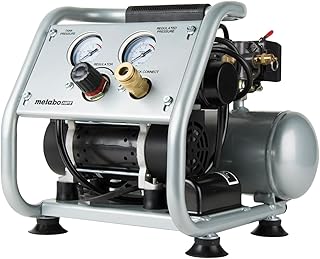
Metabo HPT EC28M Portable 1-Gallon
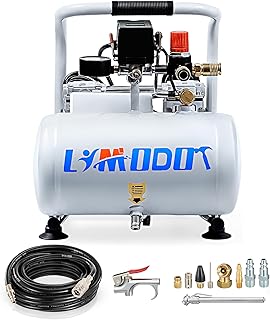
At a claimed 59 dB, this is the quietest unit in the group and the one I recommend most often for apartments, workshops beneath bedrooms, and finish carpentry indoors. The single-gallon tank limits it to trim nailing and inflation, but its universal quick coupler and light weight make it genuinely portable.
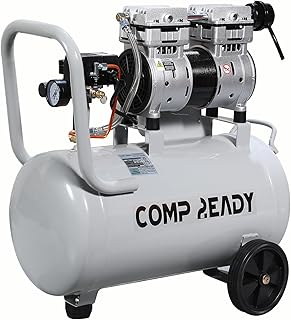
Ultra Quiet 6.4-Gallon, 60 dB, 2HP
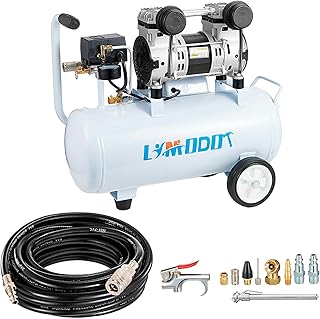
The strongest all-rounder here: 6.71 CFM at 115 PSI and a 6.4-gallon reservoir mean it recovers slowly enough to handle spray painting and auto work, while the 60 dB rating keeps each cycle from carrying through the house. This is the pick if you want one compressor to cover everything.
Ultra Quiet 2.4-Gallon, 60 dB, 1.5HP
Essentially the same acoustic engineering in a smaller footprint, which matters when the compressor has to share a mudroom or garage bay with cars and cabinetry. Expect more frequent motor cycling on sustained tasks, but the same low noise floor.
Quiet Oil-Free 5-Gallon, 68 dB
A sensible value option with a steel tank, 2.8 CFM at 90 PSI, and an included hose kit. At 68 dB it is not library-quiet, but it is dramatically calmer than a legacy pancake unit and fine for daytime garage use behind a closed door.
2-Gallon Portable, 0.75HP, 60 dB
The lightweight choice for tire inflation, bike maintenance, and occasional pneumatic tool work. Its 1.7 CFM output rules out spraying, but 60 dB in a compressor you can carry one-handed is a rare combination.
Frequently Asked Questions
How quiet is quiet enough to run near a sleeping person?
Sleep research generally points to keeping intrusive indoor noise below about 40 dB at the ear. A 59 to 60 dB compressor two rooms away, behind a closed door, typically lands near that threshold — but sudden onset matters as much as level, so avoid overnight or early-morning use regardless.
Do oil-free compressors sacrifice durability?
Modern oil-free pumps have shorter service lives than industrial oil-lubricated units under heavy continuous use, but for homeowner duty cycles the difference is largely academic. The maintenance savings and placement flexibility usually outweigh it.
Can I put the compressor in a cabinet to muffle it?
Only with real ventilation. These motors need airflow to shed heat, and an enclosed cabinet risks thermal shutdown or premature failure. A vented enclosure with acoustic lining and a routed hose is the safer approach.
What tank size do I need for a brad nailer?
One gallon is sufficient. Brad and finish nailers consume very little air per shot, which is why the smallest units on this list are perfectly matched to trim and cabinet work.
Final Thoughts
If protecting a quiet home is your priority, the Metabo HPT EC28M sets the acoustic benchmark at 59 dB and is the right answer for indoor finish work and shared walls. For a single machine that handles spraying, auto repair, and nailing without dominating the house, the Ultra Quiet 6.4-Gallon 2HP offers the best balance of airflow and restraint, with the 2.4-Gallon version covering the same ground in a tighter space.