Key takeaways
- Match the tool to your compressor, not your ambition: Most 1/2-inch impacts want 4–6 CFM at 90 PSI. A pancake compressor with a 6-gallon tank will run one in short bursts and then leave you waiting; a 20-gallon or larger tank with adequate CFM keeps you working continuously.
- Read loosening torque, not maximum torque: Headline figures are often measured in reverse under ideal conditions with a sustained pull. Nut-busting or loosening torque is the honest number, and a genuine 500–700 ft-lbs handles almost every fastener on a passenger vehicle.
- Weigh it against your working position: A tool that feels manageable at the bench feels very different held overhead under a car for ten minutes. Composite housings in the 4–5 pound range dramatically reduce forearm fatigue without giving up meaningful power.
- Take noise seriously: Impact wrenches routinely exceed 100 dBA, well past the threshold where hearing damage accumulates. Models rated near 89 dBA are a genuine health feature, not marketing, and hearing protection is non-negotiable regardless.
- Look for serviceability and torque control: Multi-position power regulators let you snug fasteners without shearing studs, and brands with available rebuild kits and published parts diagrams are worth paying for if the tool will see regular use.
What's inside
Most people don’t buy an impact wrench until a lug nut wins. You’re on the garage floor, breaker bar flexing, penetrating oil doing nothing, and the realization lands: muscle isn’t the answer here, air is. Pneumatic impact wrenches solve the problem differently than your body does — they deliver thousands of short, hammering blows per minute instead of one long strain, which is why a four-pound tool can break loose a fastener that has defeated you for twenty minutes. The catch is that spec sheets have become an arms race. Torque figures climb past 1,500 ft-lbs on tools that cost less than a decent socket set, and the numbers stop meaning much.
This guide cuts through that. We’ve focused on 1/2-inch drive air impact wrenches — the size that handles wheels, suspension, exhaust bolts, and most of what a home garage or small shop throws at it — and evaluated them on the things that actually matter after week one: real-world loosening torque, air consumption relative to a typical compressor, noise output, weight over a long session, and whether the tool will still feel tight after a few hundred hours. Below you’ll find our picks, followed by a practical buying framework and answers to the questions we hear most.
As an Amazon Associate we earn from qualifying purchases.



🛒 Best Price Today on Amazon
Prime members get fast, free shipping on everything above, plus member-only deals. New members get a 30-day free trial — cancel anytime.
How to Choose an Air Compressor Impact Wrench (2026)
- Match the tool to your compressor, not your ambition: Most 1/2-inch impacts want 4–6 CFM at 90 PSI. A pancake compressor with a 6-gallon tank will run one in short bursts and then leave you waiting; a 20-gallon or larger tank with adequate CFM keeps you working continuously.
- Read loosening torque, not maximum torque: Headline figures are often measured in reverse under ideal conditions with a sustained pull. Nut-busting or loosening torque is the honest number, and a genuine 500–700 ft-lbs handles almost every fastener on a passenger vehicle.
- Weigh it against your working position: A tool that feels manageable at the bench feels very different held overhead under a car for ten minutes. Composite housings in the 4–5 pound range dramatically reduce forearm fatigue without giving up meaningful power.
- Take noise seriously: Impact wrenches routinely exceed 100 dBA, well past the threshold where hearing damage accumulates. Models rated near 89 dBA are a genuine health feature, not marketing, and hearing protection is non-negotiable regardless.
- Look for serviceability and torque control: Multi-position power regulators let you snug fasteners without shearing studs, and brands with available rebuild kits and published parts diagrams are worth paying for if the tool will see regular use.
The Best Air Compressor Impact Wrenches (2026) Reviewed
Ingersoll Rand 2135QXPA 1/2″ Drive
This is the tool professionals reach for when a job can’t stall, pairing roughly 1,100 ft-lbs of maximum torque with a quiet-technology housing that keeps operating noise noticeably below comparable guns in its class. The balance is exceptional for a metal-bodied wrench, and the twin-hammer mechanism has a reputation for outlasting the compressors that feed it.
AIRCAT 1150 1/2″ Composite Impact Wrench
At 89 dBA and 900 ft-lbs of max torque, the 1150 is the strongest argument that power and quiet operation aren’t mutually exclusive — a real consideration in an attached garage or shared workspace. The composite shell and contoured grip make it the most comfortable pick here for extended overhead work.
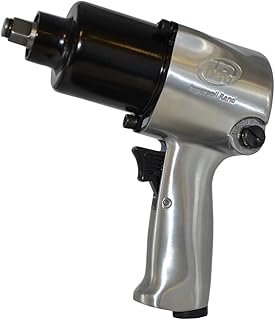
Ingersoll Rand 231C 1/2″ Drive
A deservedly legendary workhorse: 600 ft-lbs is more than enough for wheels, brakes, and suspension, and the 231C’s simple, rebuildable design means it tends to be handed down rather than replaced. If you want one air impact for the next fifteen years, this is the safe answer.
ACDelco ANI405A Heavy Duty Twin Hammer Kit
The five-speed regulator is the standout feature, giving you genuine control for assembly work rather than a blunt on/off choice at 500 ft-lbs. Arriving as a kit with sockets and accessories makes it a sensible first air impact for someone building out a home garage.
AEROPRO TOOLS 1/2-Inch Twin Hammer Impact Gun
Treat the 1200 ft-lb rating as optimistic and this becomes a strong value proposition — a lightweight twin-hammer gun that removes seized lug nuts confidently for a fraction of professional-tier pricing. Best suited to occasional weekend use rather than daily shop duty.
Frequently Asked Questions
What size air compressor do I need?
Aim for a compressor delivering at least 5 CFM at 90 PSI with a 20-gallon or larger tank. Smaller units will operate an impact wrench, but only in short bursts between long recovery cycles.
How much torque is actually enough?
For passenger cars and light trucks, 400–600 ft-lbs of loosening torque covers virtually everything, including rusted lug nuts. Higher figures matter mainly for heavy truck work, farm equipment, and badly corroded suspension hardware.
Do I need impact-rated sockets?
Yes, without exception. Chrome hand sockets can crack or shatter under impact loads; the black, thicker-walled impact sockets are designed to absorb repeated hammering safely.
How do I maintain a pneumatic impact wrench?
Add a few drops of air tool oil into the inlet before each use, drain your compressor tank regularly to keep moisture out of the lines, and run an inline filter. That routine alone prevents most premature failures.
Final Thoughts
For most buyers, the Ingersoll Rand 231C remains the smartest all-around purchase — proven, rebuildable, and powerful enough for every job a home garage generates. If you want more headroom and quieter operation, the Ingersoll Rand 2135QXPA is the professional’s choice, while the AIRCAT 1150 wins on comfort and noise for anyone spending long stretches under a vehicle.